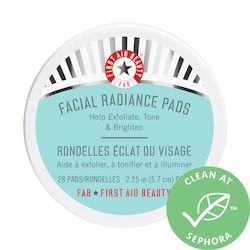
First Aid Beauty Mini Facial Radiance Pads
Works for
2 of 2 advertised claims delivered
Evens skin toneLactic acid, Glycolic acid + 3 moreStrong evidence
“Skin Type Normal, Dry, and Combination Skincare Concerns Dullness and Uneven Texture, Dark Spots, and Pores Formulation Wipes Highlighted Ingredients , Glycolic and Lactic Acids Alpha hydroxy acids that exfoliate skin, helping it appear brighter and with improved texture.”
This product can help reduce hypepigmentation and even out the skin tone because it contains the following effective ingredients: glycolic acid, lactic acid
The following ingredient (ingredients) in this product might be helpful, but there is no evidence to confirm that it actually can help even out the skin tone: glycyrrhiza glabra root extract.
Keep in mind that you would need to apply any topical skincare targetted at hypigmentation consistently for a couple of months to get a result. No topical skincare product can help get rid of hyperpigmentation (including post-acne marks and age spots) instantly.
ExfoliationLactic acid, Glycolic acidStrong evidence
“Skin Type Normal, Dry, and Combination Skincare Concerns Dullness and Uneven Texture, Dark Spots, and Pores Formulation Wipes Highlighted Ingredients , Glycolic and Lactic Acids Alpha hydroxy acids that exfoliate skin, helping it appear brighter and with improved texture.”
This product can help exfoliate the skin. In other words, it helps break down the bonds between dead cells on the surface of the skin and speed up the skin turnover. Skin often appears softer and brighter after exfoliation, but overdoing it can result in disrupted skin barrier. The following ingredient is doing the exfoliating job in this product: glycolic acid, lactic acid.
Anti-agingNot advertised by the brand · Glycolic acid, Lactic acid + 4 moreStrong evidence
This product can help reduce and prevent fine lines and wrinkles, improve skin elasticity and firmness because it contains glycolic acid.
These ingredients in the product can also be helpful, even though there is less evidence for their effectiveness: lactic acid.
Keep in mind that it typically takes at least 6 weeks to notice any results because the changes that are needed to improve fine lines and elasticity happen in the deeper layers of the skin. No topical anti-aging product can “erase” wrinkles or fully reverse signs of aging.
Anti-oxidationNot advertised by the brand · Camellia sinensis leaf extract, Glycyrrhiza glabra root extract + 1 moreModerate evidence
This product contains antioxidants (camellia sinensis leaf extract) that might be able to help neutralize free radicals in skin to lessen the damage it gets from the UV light (sun). There is not enough evidence to confirm their effectiveness in skin though.
MoisturizingNot advertised by the brand · Lactic acid, Glycerin + 4 moreGood evidence
This product contains good ingredients to attract water to the upper layer of the skin. These ingredients are called "humectants": glycerin, hyaluronic acid.
When humectants are on the surface of the skin, they “pull in” the moisture from the outside environment, or from within deeper layers of the skin. If the air is dry, humectants can speed up the moisture loss from the skin. This is why it is a good idea to use another product on top of this one to help "seal in" the moisture (look for ingredients like dimethicone, squalane, oils and butters).
Can it cause trouble?
Irritancy3 strong irritants: Chrysanthemum parthenium extract, Citrus limon peel extract + 1 more — patch-test recommendedHigh risk
ComedogenicClean of flagged comedogenic ingredientsNone flagged

User reviews
Be the first — your take helps the next person decide.
Ingredients
Filter by role to see what each ingredient is doing.
Water~40–60%
Aloe barbadensis leaf juice~6.3–9.4%
- Irritation risk
- Medium
Traditionally used to treat sunburns, dermatitis and inflammation, but evidence for its effectiveness is lacking. The extract can contain humectants that help attract water into the skin
More about Aloe barbadensis leaf juiceGlycerin~3.8–5.6%
- Irritation risk
- Low
One of the best moisturizing ingredients. Naturally present in skin. It attracts water to the upper layer of the skin working as a humectant
More about GlycerinCucumis sativus fruit water~2.8–4.2%
Lactic acid~2.1–3.1%
- Irritation risk
- Medium
An exfoliating and moisturizing alpha-hydroxy acid (AHA). Typically causes less irritation than other AHAs, for example, glycolic acid. At high concentrations (about 15%), lactic acid can help reduce lines and wrinkles. Recent studies show that lactic acid can support the "good" bacteria living on skin's surface (healthy skin microbiome)
More about Lactic acidGlycolic acid~1.7–2.6%
- Irritation risk
- High
An alpha-hydroxy acid (AHA) that helps to remove the dead skin cells on the surface of the skin reveling a more even, smoother complexation. It is also able to stimulate collagen production with long-term use. Could help to reduce pore congestion. It can be irritating to the skin. Apply sunscreen daily if using products with glycolic acid
More about Glycolic acidSodium hydroxide~1.4–2.1%
Phenoxyethanol~0.5–1%
- Irritation risk
- Low
A preservative. It helps prevent bacterial growth in cosmetic products
More about PhenoxyethanolChrysanthemum parthenium extract~0.95–1.4%
- Irritation risk
- High
Could have anti-inflammatory effect on skin, but can be irritating as well. Can be added to products for its smell
More about Chrysanthemum parthenium extractPolysorbate 20~0.85–1.25%
Camellia sinensis leaf extract~0.5–1.2%
- Irritation risk
- Low
Can contain potent anti-oxidant compounds (abbreviated ECG, GCG, EGC, and EGCG) that might help protect the skin from free radicals. Can help calm down inflammation and has some anti-bacterial properties. Unfortunately, these antioxidants are unstable and lose their effectiveness very quickly in products. The concentration of the antioxidant compounds in the extract also tends to be low to be effective in topical formulation
More about Camellia sinensis leaf extractCitrus limon peel extract~0.4–1%
Citrus nobilis fruit extract~0.35–0.85%
- Irritation risk
- High
Glycyrrhiza glabra root extract~0.3–0.75%
- Irritation risk
- Medium
A plant extract that can help lighten the skin and calm down inflammation. Might be helpful in neutralizing free radicals
More about Glycyrrhiza glabra root extractPotassium sorbate~0.15–0.6%
Phyllanthus emblica fruit extract~0.15–0.65%
- Irritation risk
- Medium
A plant extract that might be helpful in neutralizing free radicals and have a skin lightening effect if used in high enough concentrations
More about Phyllanthus emblica fruit extractSodium benzoate~0.1–0.45%
Citric acid~0.1–0.4%
- Irritation risk
- Medium
Can work as an exfoliant but is typically used to adjust the product pH
More about Citric acidHyaluronic acid~0.1–0.35%
- Irritation risk
- Low
One of the best moisturizing ingredients. Attracts water into the upper layer of the skin. Naturally present in skin. Typically has large molecule size unless advertised otherwise on the product label. Helps support skin's barrier function and may help to reduce inflammation
More about Hyaluronic acidChlorphenesin~0.05–0.25%
Edta~0.05–0.15%
Tetrasodium edta~0.05–0.15%
Ingredient list view
Water, Aloe barbadensis leaf juice, Glycerin, Cucumis sativus fruit water, Lactic acid, Glycolic acid, Sodium hydroxide, Phenoxyethanol, Chrysanthemum parthenium extract, Polysorbate 20, Camellia sinensis leaf extract, Citrus limon peel extract, Citrus nobilis fruit extract, Glycyrrhiza glabra root extract, Potassium sorbate, Phyllanthus emblica fruit extract, Sodium benzoate, Citric acid, Hyaluronic acid, Chlorphenesin, Edta, Tetrasodium edta
Compare prices
Retailers ranked by price — lowest first.
Affiliate links · prices updated regularly · As an Amazon Associate, WIMJ earns from qualifying purchases.
Worth comparing, line by line.
Match % combines shared ingredients, the first five ingredients, shared actives and hero ingredients, irritancy (lower counts in the alternative's favour), texture and body area. Only products in the same routine step are compared.
| First Aid BeautyMini Facial Radiance PadsYOUR PRODUCT | ZO Skin HealthExfoliation Accelerator | Deviant SkincareGentle Resurfacing Liquid | QMS MedicosmeticsActive Exfoliant 11 % Resurfacing Fluid | |
|---|---|---|---|---|
| Match | — | 61% | 61% | 61% |
| Price | $30.00 | $89.26+$59.26 | $52.00+$22.00 | $120.31+$90.31 |
| Shared key ingredients | — | 4 of 6 | 4 of 6 | 4 of 6 |
| Key difference | — | Retinyl Palmitate | Salicylic Acid | Panthenol |
| Irritancy | High | Medium | Low | Medium |
| Drying alcohol | — | — | — | Contains drying alcohol |
| View product | Shop | Shop | Shop |


Sources cited in this review
Every concentration estimate and effectiveness label is anchored to one of these 11 studies and safety reviews.
- 1
- 2Epidermal and dermal effects of topical lactic acidncbi.nlm.nih.gov
- 3Dual Effects of Alpha-Hydroxy Acids on the Skinpdfs.semanticscholar.org
- 4
- 5Glycolic acid peel therapy – a current reviewncbi.nlm.nih.gov
- 6

Affiliate links · As an Amazon Associate, WIMJ earns from qualifying purchases.