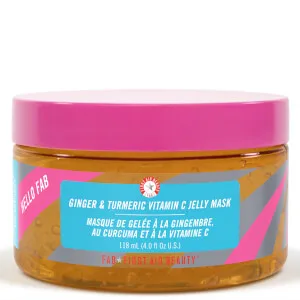
First Aid Beauty Hello FAB Ginger and Turmeric Vitamin C Jelly Mask

First Aid Beauty Hello FAB Ginger and Turmeric Vitamin C Jelly Mask

Efficacy75/100IrritancyHigh

Works for

Anti-aging
Ascorbyl glucoside, Camellia sinensis leaf extract + 1 more
May help
What the product description says
“Delivering long-lasting moisture and hydration, the luxurious treatment utilises skin-brightening Vitamin C to combat dullness and minimise the look of fine lines and wrinkles for a smoother, more refined visage.”
Source: Lookfantastic

This product contains ascorbyl glucoside. There is some human evidence that this ingredient helps reduce and prevent fine lines and wrinkles and improve skin elasticity and firmness, though it is smaller or less consistent than the evidence for the best anti-aging ingredients.

Ascorbyl glucosideKey activeEffect: MediumA vitamin C derivative that is more stable but less potent than pure form of vitamin C. Has a potential to boost collagen production, nutralise free radicals and reduce hyperpigmentation, but the required concentration is likely to be much higher than for the pure form of vitamin C, limiting the ingredient's effectiveness in products~1.6–2%
Camellia sinensis leaf extractEffect: LowCan contain potent anti-oxidant compounds (abbreviated ECG, GCG, EGC, and EGCG) that might help protect the skin from free radicals. Can help calm down inflammation and has some anti-bacterial properties. Unfortunately, these antioxidants are unstable and lose their effectiveness very quickly in products. The concentration of the antioxidant compounds in the extract also tends to be low to be effective in topical formulation~0.6–0.95%
Lactic acidUnder-dosedAn exfoliating and moisturizing alpha-hydroxy acid (AHA). Typically causes less irritation than other AHAs, for example, glycolic acid. At high concentrations (about 15%), lactic acid can help reduce lines and wrinkles. Recent studies show that lactic acid can support the "good" bacteria living on skin's surface (healthy skin microbiome)~0.2–0.4%
Moisturizing
Glycerin, Sodium pca + 8 more
Works
What the product description says
“Delivering long-lasting moisture and hydration, the luxurious treatment utilises skin-brightening Vitamin C to combat dullness and minimise the look of fine lines and wrinkles for a smoother, more refined visage.”
Source: Lookfantastic

This product contains good ingredients to attract water to the upper layer of the skin. These ingredients are called "humectants": biosaccharide gum-1, glycerin.

When humectants are on the surface of the skin, they “pull in” the moisture from the outside environment, or from within deeper layers of the skin. If the air is dry, humectants can speed up the moisture loss from the skin. This is why it is a good idea to use another product on top of this one to help "seal in" the moisture (look for ingredients like dimethicone, squalane, oils and butters).

GlycerinKey active· HumectantEffect: HighOne of the best moisturizing ingredients. Naturally present in skin. It attracts water to the upper layer of the skin working as a humectant~0.55–0.8%
Sodium pcaKey active· HumectantEffect: HighNaturally present in skin and helps to attract water to its upper layer~0.4–0.6%
Biosaccharide gum-1Key active· HumectantEffect: HighHelps attract water to the upper layer of the skin and is claimed to provide a longer-lasting hydration because of its ability to create a water-binding film on the surface of the skin~0.25–0.45%
Lactobacillus fermentKey active· HumectantEffect: HighA fermentation product created by bacteria Lactobacillus. The fermented product has anti-bacterial properties and might be helpful in calming down inflammation, but studies are lacking. Helps attract water to the upper layer of the skin. Can be used as a preservative~0.2–0.4%
Butylene glycol· HumectantEffect: LowUsed to create a nice product texture and help delivery of other ingredients. Might be somewhat helpful in attracting water to the upper layer of the skin~6–7.3%
Selaginella lepidophylla extract· Humectant, EmollientEffect: LowA plant extract that might be able to attract water to the upper layer of the skin, soften it and have some antioxidant effect, but evidence of effectiveness in skin is lacking~2.3–2.8%
Camellia sinensis leaf extractEffect: LowCan contain potent anti-oxidant compounds (abbreviated ECG, GCG, EGC, and EGCG) that might help protect the skin from free radicals. Can help calm down inflammation and has some anti-bacterial properties. Unfortunately, these antioxidants are unstable and lose their effectiveness very quickly in products. The concentration of the antioxidant compounds in the extract also tends to be low to be effective in topical formulation~0.6–0.95%
Hydrolyzed corn starch· HumectantEffect: LowHelps improve the product texture~0.45–0.65%
AllantoinUnder-dosedHelps calm down inflammation in skin and can help reduce itching. Helps to repair the skin barrier and keep skin hydrated~0.35–0.65%
Lactic acidUnder-dosedAn exfoliating and moisturizing alpha-hydroxy acid (AHA). Typically causes less irritation than other AHAs, for example, glycolic acid. At high concentrations (about 15%), lactic acid can help reduce lines and wrinkles. Recent studies show that lactic acid can support the "good" bacteria living on skin's surface (healthy skin microbiome)~0.2–0.4%
Evens skin tone
Ascorbyl glucoside, Glycyrrhiza glabra root extract + 2 more
May help
What the product description says
“Delivering long-lasting moisture and hydration, the luxurious treatment utilises skin-brightening Vitamin C to combat dullness and minimise the look of fine lines and wrinkles for a smoother, more refined visage.”
Source: Lookfantastic

The following ingredient (ingredients) in this product might be helpful, but there is no evidence to confirm that it actually works: ascorbyl glucoside, glycyrrhiza glabra root extract.

Ascorbyl glucosideKey activeEffect: MediumA vitamin C derivative that is more stable but less potent than pure form of vitamin C. Has a potential to boost collagen production, nutralise free radicals and reduce hyperpigmentation, but the required concentration is likely to be much higher than for the pure form of vitamin C, limiting the ingredient's effectiveness in products~1.6–2%
Glycyrrhiza glabra root extractEffect: LowA plant extract that can help lighten the skin and calm down inflammation. Might be helpful in neutralizing free radicals~0.9–1.1%
Camellia sinensis leaf extractEffect: LowCan contain potent anti-oxidant compounds (abbreviated ECG, GCG, EGC, and EGCG) that might help protect the skin from free radicals. Can help calm down inflammation and has some anti-bacterial properties. Unfortunately, these antioxidants are unstable and lose their effectiveness very quickly in products. The concentration of the antioxidant compounds in the extract also tends to be low to be effective in topical formulation~0.6–0.95%
Lactic acidUnder-dosedAn exfoliating and moisturizing alpha-hydroxy acid (AHA). Typically causes less irritation than other AHAs, for example, glycolic acid. At high concentrations (about 15%), lactic acid can help reduce lines and wrinkles. Recent studies show that lactic acid can support the "good" bacteria living on skin's surface (healthy skin microbiome)~0.2–0.4%
Anti-oxidation
Side benefit · Ascorbyl glucoside, Camellia sinensis leaf extract + 5 more
May help

This product contains antioxidants (ascorbyl glucoside, camellia sinensis leaf extract) that can help neutralize free radicals in skin to lessen the damage it gets from the UV light (sun). There is some human evidence for this effect in skin, though it is smaller or less consistent than the evidence for the best antioxidants.

Ascorbyl glucosideKey activeEffect: MediumA vitamin C derivative that is more stable but less potent than pure form of vitamin C. Has a potential to boost collagen production, nutralise free radicals and reduce hyperpigmentation, but the required concentration is likely to be much higher than for the pure form of vitamin C, limiting the ingredient's effectiveness in products~1.6–2%
Camellia sinensis leaf extractKey activeEffect: MediumCan contain potent anti-oxidant compounds (abbreviated ECG, GCG, EGC, and EGCG) that might help protect the skin from free radicals. Can help calm down inflammation and has some anti-bacterial properties. Unfortunately, these antioxidants are unstable and lose their effectiveness very quickly in products. The concentration of the antioxidant compounds in the extract also tends to be low to be effective in topical formulation~0.6–0.95%
Selaginella lepidophylla extractEffect: LowA plant extract that might be able to attract water to the upper layer of the skin, soften it and have some antioxidant effect, but evidence of effectiveness in skin is lacking~2.3–2.8%
Zingiber officinale root extractEffect: LowA plant extract that can contain an irritating essential oil. Might have some anti-oxidant effect, but evidence is lacking~1.7–2.1%
Glycyrrhiza glabra root extractEffect: LowA plant extract that can help lighten the skin and calm down inflammation. Might be helpful in neutralizing free radicals~0.9–1.1%
Lactobacillus fermentEffect: LowA fermentation product created by bacteria Lactobacillus. The fermented product has anti-bacterial properties and might be helpful in calming down inflammation, but studies are lacking. Helps attract water to the upper layer of the skin. Can be used as a preservative~0.2–0.4%
Beta vulgaris root extractEffect: Low, below effective doseA plant extract that might have some antioxidant properties, but mostly used in cosmetics for its color~1.3–1.6%

Can it cause trouble?

Irritancy
9 strong irritants: Zingiber officinale root extract, Chrysanthemum parthenium extract + 7 more — patch-test recommended
High risk
We flagged 21 ingredients with irritancy potential. Severity depends on your sensitivity threshold; the table lists the worst offenders first.
IngredientFunctionIrritationEst. amount
Curcuma longa root extractA plant extract that can contain an active compound curcumin, that may have some anti-inflammatory properties when applied to the skin, but solid research is lacking and the typical concentration used in skincare products is too low. Can be an irritantHigh~2.9–3.5%est.
Zingiber officinale root extractA plant extract that can contain an irritating essential oil. Might have some anti-oxidant effect, but evidence is lackingHigh~1.7–2.1%est.
Chrysanthemum parthenium extractCould have anti-inflammatory effect on skin, but can be irritating as well. Can be added to products for its smellHigh~0.75–1.15%est.
Zingiber officinale root oilAn essential oil that is likely to be irritating and can cause photosensitivityHigh~0.35–0.65%est.
Thymus vulgaris flower/leaf oil—High~0.3–0.55%est.
Eugenia caryophyllus bud oilUsed as a fragrance. Can be irritatingHigh~0.25–0.5%est.
Eucalyptus globulus leaf oilAn essential oil that can be very irritating. Has some anti-bacterial propertiesHigh~0.25–0.45%est.
Eugenia caryophyllus leaf oilAn essential oil. Used as a fragrance. Can be irritating and sensitizingHigh~0.2–0.35%est.
Citrus limon peel oilA highly irritating fragranceHigh~0.2–0.4%est.
Citrus aurantifolia oil—High~0.25–0.45%est.
P-anisic acidHelps preserve products. Can mask unpleasant smell. Could be irritatingHigh~0.25–0.45%est.
Ci 75120An orange dyeHigh~0.05–0.1%est.
Selaginella lepidophylla extractA plant extract that might be able to attract water to the upper layer of the skin, soften it and have some antioxidant effect, but evidence of effectiveness in skin is lackingMedium~2.3–2.8%est.
Ascorbyl glucosideA vitamin C derivative that is more stable but less potent than pure form of vitamin C. Has a potential to boost collagen production, nutralise free radicals and reduce hyperpigmentation, but the required concentration is likely to be much higher than for the pure form of vitamin C, limiting the ingredient's effectiveness in productsMedium~1.6–2%est.
Beta vulgaris root extractA plant extract that might have some antioxidant properties, but mostly used in cosmetics for its colorMedium~1.3–1.6%est.
Glycyrrhiza glabra root extractA plant extract that can help lighten the skin and calm down inflammation. Might be helpful in neutralizing free radicalsMedium~0.9–1.1%est.
Lactic acidAn exfoliating and moisturizing alpha-hydroxy acid (AHA). Typically causes less irritation than other AHAs, for example, glycolic acid. At high concentrations (about 15%), lactic acid can help reduce lines and wrinkles. Recent studies show that lactic acid can support the "good" bacteria living on skin's surface (healthy skin microbiome)Medium~0.2–0.4%est.
Disodium edtaStabilizes the product formulationMedium~0.2–0.4%est.
Sorbitan oleate decylglucoside crosspolymerHelps oil and water mix together. Used as a cleansing agentMedium~0.3–0.5%est.
Citric acidCan work as an exfoliant but is typically used to adjust the product pHMedium~0.2–0.35%est.
Potassium hydroxideUsed to adjust the pH level of productsMedium~0.15–0.3%est.
Comedogenic
Clean of flagged comedogenic ingredients
None flagged

User reviews

Would you recommend?
No community reviews yet.

Be the first — your take helps the next person decide.

Ingredients

Filter by role to see what each ingredient is doing.

Water~45–55%
Formula
Irritation risk
Low

Plain old water

More about Water
Butylene glycol~6–7.3%
Formula
Irritation risk
Low
Works for
Moisturizing

Used to create a nice product texture and help delivery of other ingredients. Might be somewhat helpful in attracting water to the upper layer of the skin

More about Butylene glycol
Carbomer~4.4–5.3%
Formula
Irritation risk
Low
Works for
Cleansing

Helps create a thicker or gel-like product texture. It is not a surfactant but can be used in gentle cleansing formulations

More about Carbomer
Curcuma longa root extract~2.9–3.5%
Irritant · high
Irritation risk
High
Works for
Anti-inflammatory

A plant extract that can contain an active compound curcumin, that may have some anti-inflammatory properties when applied to the skin, but solid research is lacking and the typical concentration used in skincare products is too low. Can be an irritant

More about Curcuma longa root extract
Selaginella lepidophylla extract~2.3–2.8%
Irritant · medium
Irritation risk
Medium
Works for
MoisturizingAnti-oxidation

A plant extract that might be able to attract water to the upper layer of the skin, soften it and have some antioxidant effect, but evidence of effectiveness in skin is lacking

More about Selaginella lepidophylla extract
Zingiber officinale root extract~1.7–2.1%
Irritant · high
Irritation risk
High
Works for
Anti-oxidation

A plant extract that can contain an irritating essential oil. Might have some anti-oxidant effect, but evidence is lacking

More about Zingiber officinale root extract
Ascorbyl glucoside~1.6–2%
Key activeIrritant · medium
Irritation risk
Medium
Works for
Evens skin toneAnti-agingAnti-oxidation

A vitamin C derivative that is more stable but less potent than pure form of vitamin C. Has a potential to boost collagen production, nutralise free radicals and reduce hyperpigmentation, but the required concentration is likely to be much higher than for the pure form of vitamin C, limiting the ingredient's effectiveness in products

More about Ascorbyl glucoside
Beta vulgaris root extract~1.3–1.6%
Irritant · medium
Irritation risk
Medium
Works for
Anti-oxidation

A plant extract that might have some antioxidant properties, but mostly used in cosmetics for its color

More about Beta vulgaris root extract
Glycyrrhiza glabra root extract~0.9–1.1%
Irritant · medium
Irritation risk
Medium
Works for
Anti-inflammatoryReduces rednessEvens skin toneAnti-oxidationAntibacterial

A plant extract that can help lighten the skin and calm down inflammation. Might be helpful in neutralizing free radicals

More about Glycyrrhiza glabra root extract
Chrysanthemum parthenium extract~0.75–1.15%
Irritant · high
Irritation risk
High

Could have anti-inflammatory effect on skin, but can be irritating as well. Can be added to products for its smell

More about Chrysanthemum parthenium extract
Camellia sinensis leaf extract~0.6–0.95%
Key active
Irritation risk
Low
Works for
Anti-oxidationAntibacterialAnti-agingAnti-blemishEvens skin toneMoisturizing

Can contain potent anti-oxidant compounds (abbreviated ECG, GCG, EGC, and EGCG) that might help protect the skin from free radicals. Can help calm down inflammation and has some anti-bacterial properties. Unfortunately, these antioxidants are unstable and lose their effectiveness very quickly in products. The concentration of the antioxidant compounds in the extract also tends to be low to be effective in topical formulation

More about Camellia sinensis leaf extract
Alteromonas ferment filtrate~0.55–0.8%
Formula
Glycerin~0.55–0.8%
Key active
Irritation risk
Low
Works for
Moisturizing

One of the best moisturizing ingredients. Naturally present in skin. It attracts water to the upper layer of the skin working as a humectant

More about Glycerin
Hydrolyzed corn starch~0.45–0.65%
Formula
Irritation risk
Low
Works for
Moisturizing

Helps improve the product texture

More about Hydrolyzed corn starch
Allantoin~0.35–0.65%
Under-dosed
Irritation risk
Low
Works for
Anti-inflammatoryMoisturizingAnti-blemishReduces rednessReduces irritationExfoliation

Helps calm down inflammation in skin and can help reduce itching. Helps to repair the skin barrier and keep skin hydrated

More about Allantoin
Sodium pca~0.4–0.6%
Key active
Irritation risk
Low
Works for
Moisturizing

Naturally present in skin and helps to attract water to its upper layer

More about Sodium pca
Zingiber officinale root oil~0.35–0.65%
Irritant · high
Irritation risk
High

An essential oil that is likely to be irritating and can cause photosensitivity

More about Zingiber officinale root oil
Thymus vulgaris flower/leaf oil~0.3–0.55%
Irritant · high
Myrtus communis oil~0.3–0.55%
Formula
Eugenia caryophyllus bud oil~0.25–0.5%
Irritant · high
Irritation risk
High

Used as a fragrance. Can be irritating

More about Eugenia caryophyllus bud oil
Eucalyptus globulus leaf oil~0.25–0.45%
Irritant · high
Irritation risk
High
Works for
Antibacterial

An essential oil that can be very irritating. Has some anti-bacterial properties

More about Eucalyptus globulus leaf oil
Elettaria cardamomum seed oil~0.2–0.4%
Formula
Eugenia caryophyllus leaf oil~0.2–0.35%
Irritant · high
Irritation risk
High

An essential oil. Used as a fragrance. Can be irritating and sensitizing

More about Eugenia caryophyllus leaf oil
Citrus limon peel oil~0.2–0.4%
Irritant · high
Irritation risk
High

A highly irritating fragrance

More about Citrus limon peel oil
Citrus aurantifolia oil~0.25–0.45%
Irritant · high
Biosaccharide gum-1~0.25–0.45%
Key active
Irritation risk
Low
Works for
Moisturizing

Helps attract water to the upper layer of the skin and is claimed to provide a longer-lasting hydration because of its ability to create a water-binding film on the surface of the skin

More about Biosaccharide gum-1
Lactic acid~0.2–0.4%
Under-dosedIrritant · medium
Irritation risk
Medium
Works for
Evens skin toneMoisturizingExfoliationAnti-aging

An exfoliating and moisturizing alpha-hydroxy acid (AHA). Typically causes less irritation than other AHAs, for example, glycolic acid. At high concentrations (about 15%), lactic acid can help reduce lines and wrinkles. Recent studies show that lactic acid can support the "good" bacteria living on skin's surface (healthy skin microbiome)

More about Lactic acid
P-anisic acid~0.25–0.45%
Irritant · high
Irritation risk
High

Helps preserve products. Can mask unpleasant smell. Could be irritating

More about P-anisic acid
Phenoxyethanol~0.25–0.45%
Formula
Irritation risk
Low

A preservative. It helps prevent bacterial growth in cosmetic products

More about Phenoxyethanol
Disodium edta~0.2–0.4%
Irritant · medium
Irritation risk
Medium

Stabilizes the product formulation

More about Disodium edta
Lactobacillus ferment~0.2–0.4%
Key active
Irritation risk
Low
Works for
MoisturizingAnti-oxidationAnti-inflammatoryReduces irritation

A fermentation product created by bacteria Lactobacillus. The fermented product has anti-bacterial properties and might be helpful in calming down inflammation, but studies are lacking. Helps attract water to the upper layer of the skin. Can be used as a preservative

More about Lactobacillus ferment
Sorbitan oleate decylglucoside crosspolymer~0.3–0.5%
Irritant · medium
Irritation risk
Medium
Works for
Cleansing

Helps oil and water mix together. Used as a cleansing agent

More about Sorbitan oleate decylglucoside crosspolymer
Citric acid~0.2–0.35%
Irritant · medium
Irritation risk
Medium

Can work as an exfoliant but is typically used to adjust the product pH

More about Citric acid
Sodium hydroxide~0.15–0.3%
Formula
Irritation risk
Low

Used to adjust the product's pH

More about Sodium hydroxide
Potassium hydroxide~0.15–0.3%
Irritant · medium
Irritation risk
Medium

Used to adjust the pH level of products

More about Potassium hydroxide
Terpineol acetate~0.1–0.2%
Formula
Linalyl acetate~0.1–0.15%
Formula
Geranyl acetate~0.05–0.1%
Formula
Ci 75120~0.05–0.1%
Irritant · high
Irritation risk
High

An orange dye

More about Ci 75120
Ingredient list view

Water, Butylene glycol, Carbomer, Curcuma longa root extract, Selaginella lepidophylla extract, Zingiber officinale root extract, Ascorbyl glucoside, Beta vulgaris root extract, Glycyrrhiza glabra root extract, Chrysanthemum parthenium extract, Camellia sinensis leaf extract, Alteromonas ferment filtrate, Glycerin, Hydrolyzed corn starch, Allantoin, Sodium pca, Zingiber officinale root oil, Thymus vulgaris flower/leaf oil, Myrtus communis oil, Eugenia caryophyllus bud oil, Eucalyptus globulus leaf oil, Elettaria cardamomum seed oil, Eugenia caryophyllus leaf oil, Citrus limon peel oil, Citrus aurantifolia oil, Biosaccharide gum-1, Lactic acid, P-anisic acid, Phenoxyethanol, Disodium edta, Lactobacillus ferment, Sorbitan oleate decylglucoside crosspolymer, Citric acid, Sodium hydroxide, Potassium hydroxide, Terpineol acetate, Linalyl acetate, Geranyl acetate, Ci 75120

Compare prices

Retailers ranked by price — lowest first.

🇬🇧 Lookfantastic (UK)
≈ $39.59 Out of stock
Check
🇬🇧 Mankind (UK)
≈ $39.59 Out of stock
Check
🇦🇺 Amazon Australia (AU)
Price unavailable Out of stock
Check

Affiliate links · As an Amazon Associate, WIMJ earns from qualifying purchases.

Worth comparing, line by line.

Match % combines shared ingredients, the first five ingredients, shared actives and hero ingredients, irritancy (lower counts in the alternative's favour), texture and body area. Only products in the same routine step are compared.

Side-by-side comparison of this product against its closest alternatives
First Aid BeautyHello FAB Ginger and Turmeric Vitamin C Jelly MaskYOUR PRODUCTMALIN + GOETZDetox Face MaskLANEIGEWater Bank Soothing Gel MaskSkin Inc Supplement BarCustom Recovery Sleep Mask - Hydro Gel
Match—37%37%36%
Price—$55.46—$123.67
Shared key ingredients—4 of 74 of 72 of 7
Key difference—PanthenolDipotassium GlycyrrhizateCaffeine
Irritancy High Medium Medium Medium
Drying alcohol————
View product Shop Shop Shop

More alternatives: M-61 Hydraboost HA Gel MaskThe Crème Shop x BT21 CHIMMY’S CHARMING Printed Essence Sheet Mask - Infused with Vitamin C, Turmeric, Niacinamide

Cheaper alternatives? See how this stacks up against similar formulas.
We compare ingredient profiles across our catalog — pick the closest match for your budget.
Open dupe finder

Sources cited in this review

Every concentration estimate and effectiveness label is anchored to one of these 14 studies and safety reviews.

  1. 1
  2. 2
  3. 3
  4. 4
  5. 5
  6. 6
First Aid Beauty Hello FAB Ginger and Turmeric Vitamin C Jelly Mask
First Aid BeautyHello FAB Ginger and Turmeric Vitamin C Jelly Mask

Affiliate links · As an Amazon Associate, WIMJ earns from qualifying purchases.

As an Amazon Associate, WIMJ earns from qualifying purchases.