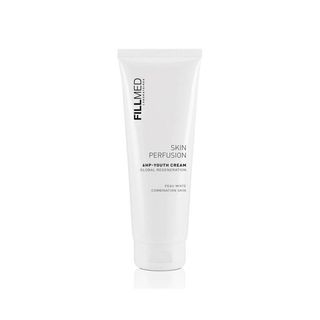
Fillmed Skin Perfusion 6 HP-Youth Cream
Works for
1 of 1 advertised claim delivered
Anti-aging11 ingredients credited for this claimModerate support
“This ultra light cream has been designed specifically for combination to oily skin, to boost radiance and target firmness and wrinkles.”
This product contains aspartic acid, folic acid, retinyl acetate, serine, threonine. These ingredients might be able to help reduce and prevent fine lines and wrinkles, improve skin elasticity and firmness, but there is not enough evidence that it actually works.
Anti-oxidationNot advertised by the brand · 6 ingredients credited for this claimStrong support
This product contains antioxidants (glutathione) that can help neutralize free radicals in skin. By doing so, they can lessen the damage the skin gets from the UV light (sun).
Evens skin toneNot advertised by the brand · 5 ingredients credited for this claimStrong support
This product can help reduce hypepigmentation and even out the skin tone because it contains the following effective ingredients: glutathione
The following ingredient (ingredients) in this product might be helpful, but there is no evidence to confirm that it actually can help even out the skin tone: alanine.
Keep in mind that you would need to apply any topical skincare targetted at hypigmentation consistently for a couple of months to get a result. No topical skincare product can help get rid of hyperpigmentation (including post-acne marks and age spots) instantly.
MoisturizingNot advertised by the brand · 37 ingredients credited for this claimGood support
This product can help improve hydration of the skin with the two types of ingredients.
The first type is called “humectants”:
these ingredients help attract water.
When humectants are on the surface of the skin, they “pull in” the moisture from the outside environment, or from
within deeper layers of the skin. The following ingredients in this product do the job:
alanine, aminobutyric acid.
This product also contains ingredients called “occlusives”. They help reduce the speed with which our skin loses moisture to the outside environment. These ingredients also help soften the upper layer of the skin, so it feels less tight and nicer to the touch. The following ingredients in this product do the job: arginine, caprylic/capric triglyceride.
Can it cause trouble?
Irritancy7 strong irritants: Alcohol, Retinyl acetate + 5 more — patch-test recommendedHigh risk
Comedogenic1 ingredient rated 2 or more on the 0–5 pore-clogging scale1 flagged


User reviews
Be the first — your take helps the next person decide.
Ingredients
Filter by role to see what each ingredient is doing.
Water~45–55%
Glycerin~4.4–5.4%
- Irritation risk
- Low
One of the best moisturizing ingredients. Naturally present in skin. It attracts water to the upper layer of the skin working as a humectant
More about GlycerinSilica~4.1–5%
Methylsilanol hydroxyproline~3–3.7%
- Irritation risk
- Low
Propanediol~2.3–2.8%
- Irritation risk
- Low
Acts as a solvent for other ingredients. Speeds up the absorption of other ingredients into the skin
More about PropanediolCaprylic/capric triglyceride~1.9–2.3%
- Irritation risk
- Medium
A good mix of fatty acids that forms a protective layer on the skin. Improves the shelf life of products. Derived from coconut and glycerin
More about Caprylic/capric triglycerideElaeis guineensis extract~1.5–1.9%
- Irritation risk
- Low
Pentylene glycol~1.4–1.7%
- Irritation risk
- Medium
Used to preserve products, dissolve other ingredients and create a nice product texture
More about Pentylene glycolPolymethyl methacrylate~1.2–1.4%
- Irritation risk
- Low
Is used to enhance product texture and can help to optically mask skin imperfections
More about Polymethyl methacrylatePropylheptyl caprylate~0.95–1.15%
- Irritation risk
- Low
Helps soften the upper layer of the skin
More about Propylheptyl caprylatePolyacrylate crosspolymer-6~0.65–1%
- Irritation risk
- Low
Squalane~0.6–0.9%
- Irritation risk
- Low
An oil naturally present in skin. Works as an emollient to soften the skin and form a protective layer on its surface without a greasy feeling.
More about Squalane2-hexanol~0.45–0.7%
- Irritation risk
- Low
Caprylyl glycol~0.45–0.7%
- Irritation risk
- Medium
Helps preserve products and creates a nice product texture
More about Caprylyl glycolSteareth-2~0.4–0.65%
Steareth-21~0.5–0.75%
Zinc pca~0.45–0.65%
- Irritation risk
- Low
A compound that combines zinc with a hydrating ingredient PCA. Might to be helpful against acne and clogged pores. Can help calm down inflammation in skin. Could be helpful in reducing the formation of free radicals in skin. Might help to reduce fine lines in wrinkles, but solid evidence is missing
More about Zinc pcaSucrose palmitate~0.4–0.6%
Sodium acrylate/sodium acryloyldimethyl taurate copolymer~0.3–0.55%
- Irritation risk
- Low
Used to create a thicker product consistency
More about Sodium acrylate/sodium acryloyldimethyl taurate copolymerAlcohol~0.3–0.5%
- Irritation risk
- High
Can be drying and contribute to skin irritation. Used in formulars to dissolve other ingredients, create a thinner product consistency or for its antibacterial properties
More about AlcoholAcacia senegal gum~0.3–0.5%
- Irritation risk
- Medium
Helps mask the small of other ingredients and improve the product texture
More about Acacia senegal gumIsohexadecane~0.35–0.65%
- Irritation risk
- Low
Improves the texture of the product and helps soften the skin. Helps oil and water mix together and can be used as a cleansing agent
More about IsohexadecaneXanthan gum~0.25–0.45%
- Irritation risk
- Low
Used to create a thicker product consistency
More about Xanthan gumSodium benzoate~0.25–0.45%
Phenoxyethanol~0.25–0.45%
- Irritation risk
- Low
A preservative. It helps prevent bacterial growth in cosmetic products
More about PhenoxyethanolPyridoxine hcl~0.25–0.4%
- Irritation risk
- Medium
Might help neutralize free radicals in skin
More about Pyridoxine hclPrunus amygdalus dulcis oil~0.25–0.5%
- Irritation risk
- Low
An emollient that softens the skin
More about Prunus amygdalus dulcis oilPolysorbate 80~0.25–0.5%
Sodium hyaluronate~0.25–0.45%
- Irritation risk
- Low
One of the best moisturizing ingredients. Attracts water into the upper layer of the skin
More about Sodium hyaluronatePotassium hydroxide~0.25–0.45%
Lecithin~0.25–0.5%
- Irritation risk
- Low
Used mostly for creating emulsions - helping oil and water mix together. Helps soften the upper layer of the skin
More about LecithinPistacia lentiscus gum~0.25–0.5%
- Irritation risk
- High
A tree rasin that could temporarily tighten the skin and might help regulate sebum production, but the research on its effectiveness in skin is lacking
More about Pistacia lentiscus gumHydroxypropyl cyclodextrin~0.25–0.5%
- Irritation risk
- Medium
Used to stabilize product formulations and help soften the upper layer of the skin
More about Hydroxypropyl cyclodextrinT-butyl alcohol~0.2–0.4%
- Irritation risk
- Medium
Used to dissolve other ingredients and to improve smell of products. It could be irritating
More about T-butyl alcoholSorbitan oleate~0.25–0.45%
- Irritation risk
- Medium
- Comedogenicity
- 2/5
Helps oil and water mix together
More about Sorbitan oleatePotassium sorbate~0.25–0.45%
Biosaccharide gum-1~0.25–0.45%
- Irritation risk
- Low
Helps attract water to the upper layer of the skin and is claimed to provide a longer-lasting hydration because of its ability to create a water-binding film on the surface of the skin
More about Biosaccharide gum-1Citric acid~0.25–0.45%
- Irritation risk
- Medium
Can work as an exfoliant but is typically used to adjust the product pH
More about Citric acidSalicylic acid~0.2–0.4%
- Irritation risk
- High
Used for skin exfoliation. It has an anti-inflammatory and anti-bacterial effect, helps to unclog pores, prevent blemishes and speed up healing of the existing ones. Sometimes referred to as a BHA (beta-hydroxy acid)
More about Salicylic acidTocopherol~0.25–0.45%
- Irritation risk
- Low
Pure form of vitamin E. Can help moisturise and protect the skin from free radicals. Often used to help stabilise other ingredients or the formula itself
More about TocopherolSodium chloride~0.25–0.5%
- Irritation risk
- Low
Used to stabilize mixtures of oil and water, and create thicker, gel-like product textures
More about Sodium chlorideGlucose~0.25–0.45%
- Irritation risk
- Low
Helps attract water to the upper layer of the skin. Could be helpful in restoring the skin barrier function
More about GlucosePotassium chloride~0.25–0.45%
- Irritation risk
- Low
Calcium chloride~0.25–0.45%
- Irritation risk
- Medium
Helps create a thicker product consistency. Might be irritating
More about Calcium chlorideMagnesium sulfate~0.25–0.5%
Glutamine~0.25–0.4%
- Irritation risk
- Low
Sodium phosphate~0.25–0.45%
Sodium acetate~0.25–0.45%
- Irritation risk
- Low
Sorbic acid~0.25–0.45%
Lysine hcl~0.25–0.4%
Arginine~0.2–0.4%
- Irritation risk
- Low
An amino acid that is naturally present in skin and helps keep it hydrated. When used together with AHAs, it can reduce their irritating effect on the skin
More about ArginineAlanine~0.2–0.4%
- Irritation risk
- Low
An amino-acid that helps to attract water to the upper layer of the skin and might help to lighten the skin, but solid evidence is lacking
More about AlanineHistidine~0.2–0.4%
Valine~0.2–0.4%
- Irritation risk
- Low
Leucine~0.25–0.4%
- Irritation risk
- Low
Threonine~0.25–0.45%
- Irritation risk
- Low
An amino-acid that helps to attract water to the upper layer of the skin. In combination with other amino-acids, might help to reduce fine lines and wrinkles
More about ThreonineIsoleucine~0.25–0.4%
- Irritation risk
- Low
An amino acid that can help attract water to the upper layer of the skin and support skin's barrier function
More about IsoleucineTryptophan~0.25–0.45%
- Irritation risk
- Low
Tyrosine~0.2–0.4%
Glycine~0.2–0.4%
- Irritation risk
- Low
Helps to attract water to the upper layer of the skin and can help restore the skin barrier function
More about GlycineSerine~0.2–0.4%
- Irritation risk
- Low
An amino-acid that helps to attract water to the upper layer of the skin. In combination with other amino-acids, might help to reduce fine lines and wrinkles
More about SerineCystine~0.25–0.45%
- Irritation risk
- Low
Glutathione~0.25–0.45%
- Irritation risk
- Medium
A peptide that can help neutralize free radicals in skin and reduce melanin production resulting in skin lightening effect and reduction in hyperpigmentation. It can also help attract moisture to the upper layer of the skin
More about GlutathioneCyanocobalamin~0.25–0.4%
- Irritation risk
- Low
Can support skin barrier function and reduce inflammation in skin
More about CyanocobalaminAsparagine~0.25–0.4%
- Irritation risk
- Low
Aspartic acid~0.2–0.4%
- Irritation risk
- Low
An amino-acid that helps increase skin hydration and might help to slightly improve skin firmness, potentially reducing lines and wrinkles
More about Aspartic acidOrnithine~0.25–0.4%
- Irritation risk
- Low
An amino-acid. Helps attract water to the upper layer of the skin
More about OrnithineGlutamic acid~0.25–0.45%
- Irritation risk
- Low
An amino-acid that helps attract water to the upper layer of the skin
More about Glutamic acidNicotinamide adenine dinucleotide~0.25–0.4%
- Irritation risk
- Low
Proline~0.25–0.45%
Aminobutyric acid~0.25–0.45%
- Irritation risk
- Low
Has been shown to support wound healing and skin barrier function when used topically in rats. Is likely to be effective in supporting skin's hydration and barrier function, but research for human skin is missing. Might have some anti-aging properties but the research is missing
More about Aminobutyric acidMethionine~0.25–0.4%
- Irritation risk
- Low
Taurine~0.25–0.45%
- Irritation risk
- Medium
Could be helpful in reducing inflammation in skin, evening out the skin tone and neutralizing free radicals, but more research is needed to confirm its effectiveness
More about TaurineHydroxyproline~0.25–0.4%
- Irritation risk
- Low
Is helpful in restoring skin barrier function supporting its moisture levels. Is claimed to stimulte collagen production in skin but evidence is lacking
More about HydroxyprolineGlucosamine~0.25–0.45%
- Irritation risk
- Low
Coenzyme a~0.2–0.4%
- Irritation risk
- Low
Helps soften the upper layer of the skin and dissolve other ingredients in a product
More about Coenzyme aThiamine diphosphate~0.25–0.45%
- Irritation risk
- Low
Retinyl acetate~0.2–0.4%
Inositol~0.2–0.4%
Niacin~0.2–0.4%
- Irritation risk
- High
A form of vitamin B3. It is similar in action to niacinamide, but is more likely to cause red flashes in skin as the side effect
More about NiacinBiotin~0.2–0.35%
- Irritation risk
- Low
Might have some moisturising properties. Is not effective when applied topically beyond some moisturizing effect
More about BiotinCalcium pantothenate~0.2–0.35%
- Irritation risk
- Low
Helps support skin barrier function improving skin hydration and reducing sensitivity
More about Calcium pantothenateFolic acid~0.2–0.35%
- Irritation risk
- Low
Can help stimulate collagen production in skin. While available studies are promising, more research is needed to confirm the efficacy in skin
More about Folic acidRiboflavin~0.15–0.3%
- Irritation risk
- Low
Tocopheryl phosphate~0.25–0.45%
Parfum~0.1–0.2%
- Irritation risk
- High
An aromatic blend of unspecified and possibly irritating ingredients
More about ParfumLimonene~0.1–0.25%
- Irritation risk
- High
A common frangrance that can easily irritate skin, especially if exposed to air, light or heat
More about LimoneneLinalool~0.1–0.2%
Geraniol~0.05–0.1%
Citral~0.05–0.1%
Ingredient list view
Water, Glycerin, Silica, Methylsilanol hydroxyproline, Propanediol, Caprylic/capric triglyceride, Unknown, Elaeis guineensis extract, Pentylene glycol, Polymethyl methacrylate, Propylheptyl caprylate, Polyacrylate crosspolymer-6, Unknown, Squalane, 2-hexanol, Caprylyl glycol, Steareth-2, Steareth-21, Zinc pca, Sucrose palmitate, Sodium acrylate/sodium acryloyldimethyl taurate copolymer, Alcohol, Acacia senegal gum, Isohexadecane, Xanthan gum, Sodium benzoate, Phenoxyethanol, Pyridoxine hcl, Prunus amygdalus dulcis oil, Polysorbate 80, Sodium hyaluronate, Potassium hydroxide, Lecithin, Pistacia lentiscus gum, Hydroxypropyl cyclodextrin, T-butyl alcohol, Sorbitan oleate, Potassium sorbate, Biosaccharide gum-1, Citric acid, Salicylic acid, Tocopherol, Sodium chloride, Glucose, Potassium chloride, Calcium chloride, Magnesium sulfate, Glutamine, Sodium phosphate, Sodium acetate, Sorbic acid, Lysine hcl, Arginine, Alanine, Histidine, Valine, Leucine, Threonine, Isoleucine, Tryptophan, Tyrosine, Glycine, Serine, Cystine, Glutathione, Cyanocobalamin, Asparagine, Aspartic acid, Ornithine, Glutamic acid, Nicotinamide adenine dinucleotide, Proline, Aminobutyric acid, Methionine, Taurine, Hydroxyproline, Glucosamine, Coenzyme a, Thiamine diphosphate, Retinyl acetate, Inositol, Niacin, Biotin, Calcium pantothenate, Folic acid, Riboflavin, Tocopheryl phosphate, Parfum, Limonene, Linalool, Geraniol, Citral
Compare prices
Retailers ranked by price — lowest first.
Worth comparing, line by line.
Match % combines shared ingredients, the first five ingredients, shared actives and hero ingredients, irritancy (lower counts in the alternative's favour), texture and body area. Only products in the same routine step are compared.
| Fillmed Skin Perfusion6 HP-Youth CreamYOUR PRODUCT | e.l.f. CosmeticsBlemish Breakthrough Blemish Calming Water Cream | NuhanciamAnti-Imperfection Face Cream | VichyLiftActiv Supreme Anti-Wrinkle and Hydrating Face Cream for Dry Skin | |
|---|---|---|---|---|
| Match | — | 85% | 84% | 82% |
| Price | $158.63 | — | $20.00−$138.63 | $42.00−$116.63 |
| Shared key ingredients | — | 3 of 28 | 4 of 28 | 4 of 28 |
| Key difference | — | Niacinamide | Glycine Soja Oil | Meadowfoam Seed Oil |
| Irritancy | High | Low | Medium | Medium |
| Drying alcohol | Contains drying alcohol | — | — | Contains drying alcohol |
| View product | Shop | Shop | Shop |


Sources cited in this review
Every concentration estimate and effectiveness label is anchored to one of these 43 studies and safety reviews.
- 1
- 2
- 3
- 4Zinc Therapy in Dermatology: A Review hindawi.com
- 5
- 6Hyaluronic acid: A key molecule in skin agingncbi.nlm.nih.gov

Affiliate links · As an Amazon Associate, WIMJ earns from qualifying purchases.