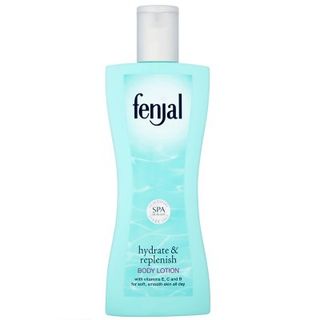
Works for
1 of 1 advertised claim delivered
Moisturizing6 ingredients credited for this claimGood support
“Classic Hydrating Body Lotion”
This product contains good ingredients to attract water to the upper layer of the skin. These ingredients are called "humectants": glycerin.
When humectants are on the surface of the skin, they “pull in” the moisture from the outside environment, or from within deeper layers of the skin. If the air is dry, humectants can speed up the moisture loss from the skin. This is why it is a good idea to use another product on top of this one to help "seal in" the moisture (look for ingredients like dimethicone, squalane, oils and butters).
Can it cause trouble?
Irritancy8 strong irritants: Parfum, Cinnamyl alcohol + 6 more — patch-test recommendedHigh risk
ComedogenicClean of flagged comedogenic ingredientsNone flagged

User reviews
Be the first — your take helps the next person decide.
Ingredients
Filter by role to see what each ingredient is doing.
Water~40–60%
Cyclopentasiloxane~6.3–9.5%
- Irritation risk
- Low
A silicone that helps improve the product texture and spreadability. Can absorb oil creating a short-term mattifying effect on the skin
More about CyclopentasiloxaneEthylhexyl stearate~4–5.9%
- Irritation risk
- Low
Helps soften the upper layer of the skin
More about Ethylhexyl stearatePrunus amygdalus dulcis oil~2.9–4.3%
- Irritation risk
- Low
An emollient that softens the skin
More about Prunus amygdalus dulcis oilGlycerin~2.2–3.3%
- Irritation risk
- Low
One of the best moisturizing ingredients. Naturally present in skin. It attracts water to the upper layer of the skin working as a humectant
More about GlycerinAmmonium acryloyldimethyltaurate/vp copolymer~1.7–2.6%
- Irritation risk
- Low
Increases thickness of a product. Texture enhancer for oil-in-water emulsions
More about Ammonium acryloyldimethyltaurate/vp copolymerTocopheryl acetate~1.4–2.2%
- Irritation risk
- Medium
A more stable but less bio-available form of vitamin E compared to Tocopherol. Might help moisturize and protect the skin from free radicals, but mostly used in low concentrations to stabilize other ingredients.
More about Tocopheryl acetateAllantoin panthenol~1.3–1.9%
- Irritation risk
- Low
Sodium ascorbyl phosphate~1–1.5%
- Irritation risk
- Medium
A stable derivative of vitamin C. It is oil-soluble which means it is more likely to penetrate the skin compared to the pure form of vitamin C (which is water-soluble), but it is less bio-available and is way less effective in stimulating collagen and reducing wrinkles compared to the pure form of vitamin C (L-ascorbic acid) and its other derivatives (for example, magnesium ascorbyl phosphate). At the same time, this vitamin C derivative has been shown in studies to be effective in reducing acne, blemishes and clogged pores. It is less irritating then the pure form of vitamin C
More about Sodium ascorbyl phosphatePhenoxyethanol~0.5–1%
- Irritation risk
- Low
A preservative. It helps prevent bacterial growth in cosmetic products
More about PhenoxyethanolEthylhexylglycerin~0.5–1.2%
Glyceryl stearate~0.45–1.1%
- Irritation risk
- Low
An emollient that softens the skin and forms a protective layer on its surface. Helps water and oil mix together
More about Glyceryl stearateParfum~0.35–0.85%
- Irritation risk
- High
An aromatic blend of unspecified and possibly irritating ingredients
More about ParfumPolyglyceryl-3 methylglucose distearate~0.35–0.85%
- Irritation risk
- Medium
Helps water and oil mix together
More about Polyglyceryl-3 methylglucose distearateAloe barbadensis leaf juice~0.3–0.75%
- Irritation risk
- Medium
Traditionally used to treat sunburns, dermatitis and inflammation, but evidence for its effectiveness is lacking. The extract can contain humectants that help attract water into the skin
More about Aloe barbadensis leaf juiceBisabolol~0.15–0.65%
- Irritation risk
- Low
An active component of chamomile plant that historically has been used to calm down irritated skin. A recent study shows that bisabolol indeed can have some anti-inflammatory effect on skin, even though conclusive data is lacking. Bisabolol has a sweet floral scent and can be added to products for its aromatic properties
More about BisabololCitric acid~0.15–0.6%
- Irritation risk
- Medium
Can work as an exfoliant but is typically used to adjust the product pH
More about Citric acidDisodium edta~0.15–0.55%
Cinnamyl alcohol~0.1–0.45%
- Irritation risk
- High
Hydroxycitronellal~0.1–0.35%
- Irritation risk
- High
A fragrance. A likely allergen and can be irritating
More about HydroxycitronellalCoumarin~0.1–0.3%
Butylphenyl methylpropional~0.05–0.3%
- Irritation risk
- High
A fragrance. Can trigger allergic reactions and be irritating
More about Butylphenyl methylpropionalLinalool~0.05–0.25%
Citronellol~0.05–0.15%
Limonene~0.05–0.15%
- Irritation risk
- High
A common frangrance that can easily irritate skin, especially if exposed to air, light or heat
More about LimoneneIngredient list view
Water, Cyclopentasiloxane, Ethylhexyl stearate, Prunus amygdalus dulcis oil, Glycerin, Ammonium acryloyldimethyltaurate/vp copolymer, Tocopheryl acetate, Allantoin panthenol, Sodium ascorbyl phosphate, Phenoxyethanol, Ethylhexylglycerin, Glyceryl stearate, Parfum, Polyglyceryl-3 methylglucose distearate, Aloe barbadensis leaf juice, Bisabolol, Citric acid, Disodium edta, Cinnamyl alcohol, Hydroxycitronellal, Coumarin, Butylphenyl methylpropional, Linalool, Citronellol, Limonene
Compare prices
Retailers ranked by price — lowest first.
Affiliate links · prices updated regularly · As an Amazon Associate, WIMJ earns from qualifying purchases.
Worth comparing, line by line.
Match % combines shared ingredients, the first five ingredients, shared actives and hero ingredients, irritancy (lower counts in the alternative's favour), texture and body area. Only products in the same routine step are compared.
| FenjalClassic Hydrating Body LotionYOUR PRODUCT | Beekman 1802Pure Goat Milk Lotion | NiveaNourishing Skin Firming Body Lotion w/ Q10 and Vitamin C | EmerginCVitamin C, Hemp, Avocado and Argan Body Lotion | |
|---|---|---|---|---|
| Match | — | 66% | 66% | 64% |
| Price | $7.93 | $20.00+$12.07 | $9.79+$1.86 | $67.69+$59.76 |
| Shared key ingredients | — | 1 of 4 | 1 of 4 | 2 of 4 |
| Key difference | — | Panthenol | Mineral Oil | Glycolic Acid |
| Irritancy | High | Low | Medium | Low |
| Drying alcohol | — | — | — | — |
| View product | Shop | Shop | Shop |


Sources cited in this review
Every concentration estimate and effectiveness label is anchored to one of these 10 studies and safety reviews.
- 1
- 2
- 3
- 4Sodium ascorbyl phosphate in topical microemulsionssciencedirect.com
- 5
- 6

Affiliate links · As an Amazon Associate, WIMJ earns from qualifying purchases.