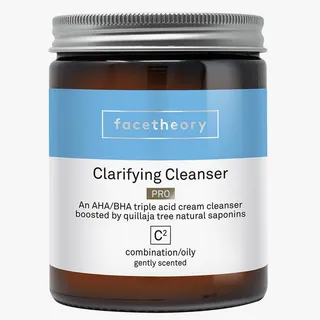
Works for
Anti-blemishSalicylic acid, Glycolic acidWorks well
“Salicylic acid is a beta hydroxy acid and exfoliates by penetrating deep into the pore.”
This product can help reduce breakouts and clogged pores because it contains the following ingredient: salicylic acid. This ingredient is used for treating acne and can have a noticeable effect.
The following ingredient (ingredients) in this product might be helpful, but there is no evidence to confirm that it actually works: glycolic acid
CleansingCetyl alcohol, Glyceryl stearate + 3 moreCleanses gently
“Clarifying Cleanser C2 Pro”
This product works by removing dirt and oil from the surface of the skin. It uses a combination of mild cleansing agents (cetyl alcohol, glyceryl caprylate, glyceryl stearate, quillaja saponaria bark extract, xanthan gum) and should be able to cleanse the skin gently. Still keep in mind that any cleansing can disrupt the skin barrier, and most people do not need to cleanse their skin more than once per day.
ExfoliationGlycolic acid, Salicylic acid + 1 moreWorks well
“Salicylic acid is a beta hydroxy acid and exfoliates by penetrating deep into the pore.”
This product can help exfoliate the skin. In other words, it helps break down the bonds between dead cells on the surface of the skin and speed up the skin turnover. Skin often appears softer and brighter after exfoliation, but overdoing it can result in disrupted skin barrier. The following ingredient is doing the exfoliating job in this product: glycolic acid, salicylic acid.
Can it cause trouble?
Irritancy3 strong irritants: Citrus nobilis peel oil, Limonene + 1 more — patch-test recommendedHigh risk
Comedogenic1 ingredient rated 2 or more on the 0–5 pore-clogging scale1 flagged


User reviews
Be the first — your take helps the next person decide.
Ingredients
Filter by role to see what each ingredient is doing.
Water~40–60%
Dimethyl isosorbide~6.1–9.2%
- Irritation risk
- Low
Used to dissolve other ingredients in a product and can enhance their ability to penetrate the skin
More about Dimethyl isosorbideSucrose~3.6–5.4%
- Irritation risk
- Low
Can help attract water to the upper layer of the skin. In crystal form, it can work as a gentle exfoliant, gentler than the salt scrub. Helps stabilize the emulsion
More about SucroseCetyl alcohol~2.3–3.5%
- Irritation risk
- Low
A non-drying alcohol that works to soften the skin and stabilize product formulations helping oil and water mix together
More about Cetyl alcoholCocos nucifera oil~2.2–3.2%
- Irritation risk
- Low
- Comedogenicity
- 3/5
An emollient. Found to be as effective as a moisturizer for dry skin as mineral oil. Could be comedogenic
More about Cocos nucifera oilGlyceryl stearate~1.8–2.7%
- Irritation risk
- Low
An emollient that softens the skin and forms a protective layer on its surface. Helps water and oil mix together
More about Glyceryl stearatePolyglyceryl-6 stearate~1.5–2.3%
- Irritation risk
- Low
Helps soften the upper layer of the skin
More about Polyglyceryl-6 stearateSodium glycolate~1.3–1.9%
- Irritation risk
- Low
Glycolic acid4%
- Irritation risk
- High
An alpha-hydroxy acid (AHA) that helps to remove the dead skin cells on the surface of the skin reveling a more even, smoother complexation. It is also able to stimulate collagen production with long-term use. Could help to reduce pore congestion. It can be irritating to the skin. Apply sunscreen daily if using products with glycolic acid
More about Glycolic acidBha~1–1.5%
Quillaja saponaria bark extract~0.9–1.35%
- Irritation risk
- Medium
Helps water and oil mix together
More about Quillaja saponaria bark extractLactic acid1%
- Irritation risk
- Medium
An exfoliating and moisturizing alpha-hydroxy acid (AHA). Typically causes less irritation than other AHAs, for example, glycolic acid. At high concentrations (about 15%), lactic acid can help reduce lines and wrinkles. Recent studies show that lactic acid can support the "good" bacteria living on skin's surface (healthy skin microbiome)
More about Lactic acidSodium salicylate~0.25–0.5%
- Irritation risk
- Medium
The salt of salicylic acid. Helps exfoliate the upper layer of the skin. Can also work to preserve cosmetic products
More about Sodium salicylateSalicylic acid2%
- Irritation risk
- High
Used for skin exfoliation. It has an anti-inflammatory and anti-bacterial effect, helps to unclog pores, prevent blemishes and speed up healing of the existing ones. Sometimes referred to as a BHA (beta-hydroxy acid)
More about Salicylic acidGlyceryl caprylate~0.5–1.1%
- Irritation risk
- Low
An emollient that can also help water and oil mix together, as well as prevent bacteria growth in products
More about Glyceryl caprylateCetyl hydroxyethylcellulose~0.4–0.95%
- Irritation risk
- Low
Used to create a thicker product consistency and stabilize formulations
More about Cetyl hydroxyethylcellulosePolyglyceryl-6 behenate~0.35–0.85%
Xanthan gum~0.3–0.7%
- Irritation risk
- Low
Used to create a thicker product consistency
More about Xanthan gumCitric acid~0.15–0.6%
- Irritation risk
- Medium
Can work as an exfoliant but is typically used to adjust the product pH
More about Citric acidPotassium sorbate~0.15–0.55%
Sorbic acid~0.1–0.35%
Citrus nobilis peel oil~0.05–0.25%
- Irritation risk
- High
A plant oil with high content of volatile compounds that, especially when exposed to air, can cause allergic reactions and irritate the skin
More about Citrus nobilis peel oilLimonene0.97%
- Irritation risk
- High
A common frangrance that can easily irritate skin, especially if exposed to air, light or heat
More about LimoneneLinalool0.01%
Ingredient list view
Water, Dimethyl isosorbide, Sucrose, Cetyl alcohol, Cocos nucifera oil, Unknown, Glyceryl stearate, Polyglyceryl-6 stearate, Sodium glycolate, Unknown, Glycolic acid, Bha, Quillaja saponaria bark extract, Lactic acid, Sodium salicylate, Unknown, Salicylic acid, Glyceryl caprylate, Cetyl hydroxyethylcellulose, Polyglyceryl-6 behenate, Xanthan gum, Citric acid, Potassium sorbate, Unknown, Sorbic acid, Citrus nobilis peel oil, Limonene, Linalool
Compare prices
Retailers ranked by price — lowest first.

Worth comparing, line by line.
Match % combines shared ingredients, the first five ingredients, shared actives and hero ingredients, irritancy (lower counts in the alternative's favour), texture and body area. Only products in the same routine step are compared.
| FacetheoryClarifying Cleanser C2 ProYOUR PRODUCT | CeraVeGel Moussant Anti-Imperfections | COSRXThe AHA BHA PHA LHA 35 Peel | PurifideBlackhead Control 2% SA Deep Exfoliating Cleanser | |
|---|---|---|---|---|
| Match | — | 80% | 78% | 75% |
| Price | $24.00 | — | $10.46−$13.54 | — |
| Shared key ingredients | — | 4 of 10 | 3 of 10 | 5 of 10 |
| Key difference | — | Niacinamide | Gluconolactone | Linoleic Acid |
| Irritancy | High | Low | Medium | Medium |
| Drying alcohol | — | — | — | — |
| View product | Shop | Shop | Shop |


More alternatives: Neutrogena Oil-Free Acne Stress Control Power-Cream WashRodial Vitamin C Brightening Cleansing Pads
Sources cited in this review
Every concentration estimate and effectiveness label is anchored to one of these 14 studies and safety reviews.
- 1
- 2
- 3Glycolic acid peel therapy – a current reviewncbi.nlm.nih.gov
- 4
- 5Epidermal and dermal effects of topical lactic acidncbi.nlm.nih.gov
- 6Dual Effects of Alpha-Hydroxy Acids on the Skinpdfs.semanticscholar.org

Affiliate links · As an Amazon Associate, WIMJ earns from qualifying purchases.