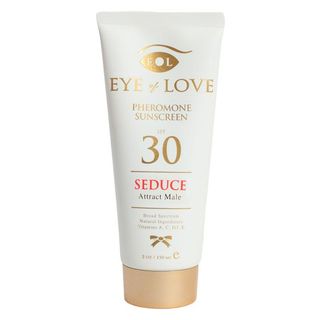
Eye of Love Love in the Sun Sunscreen SPF30 - Seduce
Works for
0 of 1 advertised claim delivered
Sun protectionSPF 30 · 1 UV filter · Partial spectrumWeak protection
This product does not offer good protection against UVA rays.
This product can be considered "reef safe" because it does not contain the UV filters (oxybenzone and octinoxate) that can be harmful to coral reefs when present in the water in high concentrations.
MoisturizingNot advertised by the brand · 8 ingredients credited for this claimGood evidence
This product can help soften the skin and reduce its moisture loss with emollients and occlusives: butyrospermum parkii butter, glycine soja oil.
Keep in mind that this product does not contain effective ingredients to attract water to the upper layer of the skin. This is why an additional product with humectants like glycerin or hyaluronic acid can be helpful (apply it before this product for the best results).
Anti-oxidationNot advertised by the brand · 5 ingredients credited for this claimModerate evidence
This product contains antioxidants (rubus idaeus seed oil) that might be able to help neutralize free radicals in skin to lessen the damage it gets from the UV light (sun). There is not enough evidence to confirm their effectiveness in skin though.
Can it cause trouble?
Irritancy1 strong irritant: ParfumMedium risk
Comedogenic3 ingredients rated 2 or more on the 0–5 pore-clogging scale3 flagged
User reviews
Be the first — your take helps the next person decide.
Ingredients
Filter by role to see what each ingredient is doing.
Titanium dioxide~26–39%
- Irritation risk
- Low
Works as a UV filter when used in high concentrations. It is photostable and is effective mostly against the UVB light, with some protection in the UVA range. In small concentrations, used for its ability to improve the color of cosmetic products. Is usually well tolerated by the skin
More about Titanium dioxideGlycine soja oil~5.4–8.1%
- Irritation risk
- Medium
- Comedogenicity
- 2/5
A good emollient that helps soften the skin and helps repair its barrier function. It can clog pores if used in high concentrations.
More about Glycine soja oilZea mays starch~4.6–7%
- Irritation risk
- Medium
- Comedogenicity
- 3/5
Used to thicken the product's consistency
More about Zea mays starchCyclopentasiloxane~3.6–5.4%
- Irritation risk
- Low
A silicone that helps improve the product texture and spreadability. Can absorb oil creating a short-term mattifying effect on the skin
More about CyclopentasiloxaneButyrospermum parkii butter~2.9–4.4%
- Irritation risk
- Low
- Comedogenicity
- 3/5
A great moisturising ingredient that softens the skin and reduces water loss from its upper layer. It also can be helpful in protecting skin from free radicals
More about Butyrospermum parkii butterSucrose tetrastearate triacetate~2.3–3.5%
Silica~1.8–2.7%
C12-15 alkyl benzoate~1.5–2.3%
- Irritation risk
- Low
Enhances the product texture and makes it more spreadable. Helps reduce water loss from the outer layer of skin. Extands the shelf life by preventing bacteria growth
More about C12-15 alkyl benzoateParfum~1–1.45%
- Irritation risk
- High
An aromatic blend of unspecified and possibly irritating ingredients
More about ParfumMacadamia ternifolia seed oil~0.85–1.3%
- Irritation risk
- Medium
Plant oil from nuts that helps soften the upper layer of the skin. Contains a high concentration of oleic acid that can weaken skin's barrier function and increase water-loss while enhancing penetration of other ingredients
More about Macadamia ternifolia seed oilAloe barbadensis extract~0.5–1.1%
- Irritation risk
- Medium
Traditionally used to treat sunburns, dermatitis and inflammation, but evidence for its effectiveness is lacking. The extract can contain humectants that help attract water into the skin
More about Aloe barbadensis extractPrunus armeniaca kernel oil~0.5–1.15%
- Irritation risk
- Medium
An emollient that helps soften the skin
More about Prunus armeniaca kernel oilRubus idaeus seed oil~0.35–0.85%
- Irritation risk
- Medium
A plant oil that might be able to help neutralize free radicals in skin
More about Rubus idaeus seed oilAscorbyl palmitate~0.1–0.5%
- Irritation risk
- Medium
Being a lipid soluble form of vitamin C, it is more stable and can penetrate the skin better than L-Ascorbic acid. It is effective in protecting the skin from free radicals, as well as evening the skin tone, but is less effective in stimulating collagen production compared to L-Ascorbic acid.
More about Ascorbyl palmitateTocopherol~0.05–0.25%
- Irritation risk
- Low
Pure form of vitamin E. Can help moisturise and protect the skin from free radicals. Often used to help stabilise other ingredients or the formula itself
More about TocopherolIngredient list view
Titanium dioxide, Glycine soja oil, Zea mays starch, Cyclopentasiloxane, Butyrospermum parkii butter, Sucrose tetrastearate triacetate, Silica, C12-15 alkyl benzoate, Parfum, Macadamia ternifolia seed oil, Aloe barbadensis extract, Unknown, Prunus armeniaca kernel oil, Rubus idaeus seed oil, Ascorbyl palmitate, Tocopherol
Compare prices
Retailers ranked by price — lowest first.
Product summary
We do not recommend "Eye of Love - Love in the Sun Sunscreen SPF30 - Seduce" because it does not provide good UVA protection. UVA sun rays don't burn the skin, but they still lead to photoaging and hyperpigmentation.
Its formula is also hydrating, so you might not need an additional moistruizer during the day.
Sunscreen filters
This product is a mineral sunscreen. It uses titanium dioxide for sun protection. Titanium dioxide almost never irritates the skin or stings eyes, but it can leave a white cast.
Irritation risk
There are some common irritants in this product, including ingredients that do not have benefits for the skin. We assess the overall irritancy of it to be medium. For a detailed overview of all potential irritants: click here
You can see the detailed formula review with the breakdown of all actives in the product and the full ingredient list with estimated concentrations in the tables below.
Sources cited in this review
Every concentration estimate and effectiveness label is anchored to one of these 3 studies and safety reviews.
- 1
- 2Vitamin E in dermatologyncbi.nlm.nih.gov
- 3Vitamin E and Skin Healthlpi.oregonstate.edu

Affiliate links · As an Amazon Associate, WIMJ earns from qualifying purchases.