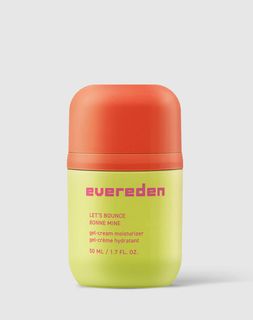
Evereden Lets Bounce Gel-Cream Moisturizer
Works for
2 of 2 advertised claims delivered
Anti-blemish3 ingredients credited for this claimGood support
“oily and blemish prone skin”
This product might be able to help reduce blemishes and clogged pores because it contains ethyl linoleate.
Moisturizing12 ingredients credited for this claimGood support
“lightweight gel-cream moisturizer hydrates skin”
This product can help improve hydration of the skin with the two types of ingredients.
The first type is called “humectants”:
these ingredients help attract water.
When humectants are on the surface of the skin, they “pull in” the moisture from the outside environment, or from
within deeper layers of the skin. The following ingredients in this product do the job:
arginine, glycerin.
This product also contains ingredients called “occlusives”. They help reduce the speed with which our skin loses moisture to the outside environment. These ingredients also help soften the upper layer of the skin, so it feels less tight and nicer to the touch. The following ingredients in this product do the job: arginine, squalane.
Anti-oxidationNot advertised by the brand · 5 ingredients credited for this claimStrong support
This product contains antioxidants (epigallocatechin gallatyl glucoside) that can help neutralize free radicals in skin. By doing so, they can lessen the damage the skin gets from the UV light (sun).
Evens skin toneNot advertised by the brand · 3 ingredients credited for this claimModerate support
The following ingredient (ingredients) in this product might be helpful, but there is no evidence to confirm that it actually works: ethyl linoleate, stearyl glycyrrhetinate.
Anti-agingNot advertised by the brand · 3 ingredients credited for this claimModerate support
This product contains epigallocatechin gallatyl glucoside. This ingredient might be able to help reduce and prevent fine lines and wrinkles, improve skin elasticity and firmness, but there is not enough evidence that it actually works.
Can it cause trouble?
Irritancy1 strong irritant: Citrus reticulata peel extractMedium risk
Comedogenic3 ingredients rated 2 or more on the 0–5 pore-clogging scale3 flagged
User reviews
Be the first — your take helps the next person decide.
Ingredients
Filter by role to see what each ingredient is doing.
Water~45–55%
Glycerin~4.3–5.3%
- Irritation risk
- Low
One of the best moisturizing ingredients. Naturally present in skin. It attracts water to the upper layer of the skin working as a humectant
More about GlycerinPropanediol~3.9–4.8%
- Irritation risk
- Low
Acts as a solvent for other ingredients. Speeds up the absorption of other ingredients into the skin
More about PropanediolSilica~3.1–3.8%
Coco-caprylate/caprate~2.3–2.8%
- Irritation risk
- Low
Helps to soften the upper layer of the skin without creating a greasy texture
More about Coco-caprylate/caprateZea mays starch~1.8–2.3%
- Irritation risk
- Medium
- Comedogenicity
- 3/5
Used to thicken the product's consistency
More about Zea mays starchSaccharide isomerate~1.6–1.9%
- Irritation risk
- Low
Helps attract water to the upper layer of the skin
More about Saccharide isomerate1,2-hexanediol~0.65–1%
Ethyl linoleate~1.2–1.4%
- Irritation risk
- Medium
Helps reduce acne and blemishes. Helps to soften the upper layer of the skin and reduce inflammation. Might be helpful in reducing hyperpigmentation and evening out the skin tone, but evidence of effectiveness in skin are lacking
More about Ethyl linoleate2,3-butanediol~0.9–1.1%
- Irritation risk
- Low
Cetearyl olivate~0.65–1%
Squalane~0.6–0.95%
- Irritation risk
- Low
An oil naturally present in skin. Works as an emollient to soften the skin and form a protective layer on its surface without a greasy feeling.
More about SqualaneHydroxyacetophenone~0.5–0.75%
Acrylates/c10-30 alkyl acrylate crosspolymer~0.5–0.7%
- Irritation risk
- Medium
Maintains the texture of skincare products. Allows the product to spread evenly. Helps oil and water mix together
More about Acrylates/c10-30 alkyl acrylate crosspolymerSorbitan olivate~0.45–0.65%
Microcrystalline cellulose~0.5–0.75%
Arginine~0.4–0.6%
- Irritation risk
- Low
An amino acid that is naturally present in skin and helps keep it hydrated. When used together with AHAs, it can reduce their irritating effect on the skin
More about ArginineGlyceryl stearate se~0.4–0.6%
- Irritation risk
- Low
- Comedogenicity
- 2/5
Used to stabilize the product formulations and works as an emollient
More about Glyceryl stearate seLauroyl lysine~0.3–0.55%
- Irritation risk
- Low
Helps soften the upper layer of the skin and creates a nice product texture
More about Lauroyl lysineCamellia sinensis leaf extract~0.3–0.6%
- Irritation risk
- Low
Can contain potent anti-oxidant compounds (abbreviated ECG, GCG, EGC, and EGCG) that might help protect the skin from free radicals. Can help calm down inflammation and has some anti-bacterial properties. Unfortunately, these antioxidants are unstable and lose their effectiveness very quickly in products. The concentration of the antioxidant compounds in the extract also tends to be low to be effective in topical formulation
More about Camellia sinensis leaf extractXanthan gum~0.3–0.55%
- Irritation risk
- Low
Used to create a thicker product consistency
More about Xanthan gumAnthemis nobilis flower extract~0.25–0.45%
- Irritation risk
- High
A plant extract that one one hand, can contain compounds that can help calm down skin irritation, but, on the other hand, its other compounds (especially fragrant ones) can themselves be irritating
More about Anthemis nobilis flower extractSodium phytate~0.25–0.5%
Stearyl glycyrrhetinate~0.25–0.5%
- Irritation risk
- Medium
A fatty acid derived from licorice. Works as an emollient and can help calm down inflammation
More about Stearyl glycyrrhetinateCucumis sativus fruit extract~0.25–0.5%
- Irritation risk
- Medium
Might be somewhat helpful in reducing hyperpigmentation and neutralizing free radicals but its typical concentration in a product is too low for having an effect
More about Cucumis sativus fruit extractCellulose gum~0.25–0.5%
- Irritation risk
- Low
Used to create thicker product consistency and stabilize emulsions
More about Cellulose gumSodium citrate~0.25–0.45%
- Irritation risk
- Medium
Helps to control the skin's pH level. Maintains the skin's natural film of amino-lactic acids and oils. Helps to preserve products
More about Sodium citrateCitric acid~0.25–0.45%
- Irritation risk
- Medium
Can work as an exfoliant but is typically used to adjust the product pH
More about Citric acidBioflavonoids~0.2–0.4%
- Irritation risk
- Low
Polyglyceryl-6 oleate~0.25–0.45%
Polyglyceryl-10 laurate~0.25–0.45%
- Irritation risk
- Medium
Helps water and oil mix together
More about Polyglyceryl-10 laurateOleanolic acid~0.2–0.4%
- Irritation risk
- Low
Might be helpful against blemishes, work as an anti-oxidant, reduce inflammation and improve skin's ability to hold on to moisture, but more research is needed to confirm its effectiveness when applied topically to human skin
More about Oleanolic acidSerenoa serrulata fruit extract~0.15–0.3%
- Irritation risk
- Medium
A plant extract that might help calm down inflammation in skin but evidence of effectiveness is lacking
More about Serenoa serrulata fruit extractCitrus reticulata peel extract~0.15–0.25%
- Irritation risk
- High
A likely irritant. Might have some anti-oxidant activity, but is mostly used as a fragrance in cosmetic products
More about Citrus reticulata peel extractEpigallocatechin gallatyl glucoside~0.1–0.2%
- Irritation risk
- Low
A synthetic version of green tea polyphenol that helps neutralize free radicals in skin
More about Epigallocatechin gallatyl glucosideSorbitan oleate~0.1–0.2%
- Irritation risk
- Medium
- Comedogenicity
- 2/5
Helps oil and water mix together
More about Sorbitan oleateMagnolol~0.1–0.15%
- Irritation risk
- Low
Honokiol~0.05–0.1%
- Irritation risk
- Low
Ingredient list view
Water, Glycerin, Propanediol, Silica, Coco-caprylate/caprate, Zea mays starch, Saccharide isomerate, 1,2-hexanediol, Ethyl linoleate, 2,3-butanediol, Cetearyl olivate, Squalane, Hydroxyacetophenone, Acrylates/c10-30 alkyl acrylate crosspolymer, Sorbitan olivate, Microcrystalline cellulose, Arginine, Glyceryl stearate se, Lauroyl lysine, Camellia sinensis leaf extract, Xanthan gum, Anthemis nobilis flower extract, Sodium phytate, Stearyl glycyrrhetinate, Cucumis sativus fruit extract, Cellulose gum, Sodium citrate, Citric acid, Bioflavonoids, Polyglyceryl-6 oleate, Polyglyceryl-10 laurate, Oleanolic acid, Serenoa serrulata fruit extract, Citrus reticulata peel extract, Epigallocatechin gallatyl glucoside, Sorbitan oleate, Magnolol, Honokiol
Compare prices
Retailers ranked by price — lowest first.

Sources cited in this review
Every concentration estimate and effectiveness label is anchored to one of these 10 studies and safety reviews.
- 1
- 2Safety Assessment of Alkyl Esters as Used in Cosmeticscir-safety.org
- 3
- 4
- 5
- 6

Affiliate links · As an Amazon Associate, WIMJ earns from qualifying purchases.