Works for:
based on ingredients and %- Evens skin tone
- Anti-aging
- Moisturizing
- Anti-oxidation
Doesn't work for:
based on ingredients and %- Sun protection
Can it cause trouble?
- Irritation risk: medium
- Comedogenic risk ingredients: 1
Key actives
Evens skin tone
What does the product description say?
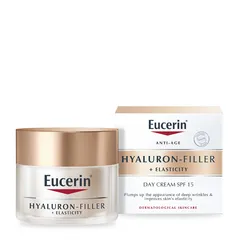
Eucerin Hyaluron-Filler + Elasticity Day Cream SPF15 is an anti-aging day cream that delivers multiple benefits; it reduces the appearance of age-spots, plumps up wrinkles & improves skin elasticity.
Source: Supderdrug
This product can help reduce hypepigmentation and even out the skin tone because it contains the following effective ingredients: isobutylamido thiazolyl resorcinol.
Keep in mind that you would need to apply any topical skincare targetted at hypigmentation consistently for a couple of months to get a result. No topical skincare product can help get rid of hyperpigmentation (including post-acne marks and age spots) instantly.
This product can also help with skin tone because it offers sun protection. Sun damage is the main factor causing age spots, darkening of post-acne marks and other discolorations. This is why sun protection is the best strategy for maintaining an even skin tone. We, however, do not recommend using this product as a sunscreen because the protection it offers is not strong enough).
Sometimes referred to as Thiamidol (patented by Beiersdorf). A compound that can reduce melanin production in skin. Can help to fade pigmentation spots quicker and even out the skin tone. It is a relatively new compound and the research on it is ongoing. The first studies show that it might be as effective in reducing hyperpigmentation as hydroquinone but with fewer side effects
Anti-aging
What does the product description say?
Eucerin Hyaluron-Filler + Elasticity Day Cream SPF15 is an anti-aging day cream that delivers multiple benefits; it reduces the appearance of age-spots, plumps up wrinkles & improves skin elasticity.
Source: Supderdrug
This product contains creatine. This ingredient might be able to help reduce and prevent fine lines and wrinkles, improve skin elasticity and firmness, but there is not enough evidence that it actually works. The biggest anti-aging effect in this product comes from sun protection. Sun damage is the main factor causing early signs of skin aging. We, however, do not recommend using this product as a sunscreen because the protection it offers is not strong enough).
Can support skin's ability to neutralize free radicals and produce collagen, though further research is needed to confirm effectiveness
Pure form of vitamin E. Can help moisturise and protect the skin from free radicals. Often used to help stabilise other ingredients or the formula itself
Anti-oxidation
This product contains antioxidants (creatine) that might be able to help neutralize free radicals in skin to lessen the damage it gets from the UV light (sun). There is not enough evidence to confirm their effectiveness in skin though.
Can support skin's ability to neutralize free radicals and produce collagen, though further research is needed to confirm effectiveness
Pure form of vitamin E. Can help moisturise and protect the skin from free radicals. Often used to help stabilise other ingredients or the formula itself
Moisturizing
What does the product description say?
The Moisturising Cream Contains Hyaluronic Acid To Penetrate And Hydrate Different Layers Of The Skin While Also Enhancing Skin Elasticity With Added Collagen-Elastin Complex.
Source: Supderdrug
This product can help improve hydration of the skin with the two types of ingredients.
The first type is called “humectants”:
these ingredients help attract water.
When humectants are on the surface of the skin, they “pull in” the moisture from the outside environment, or from
within deeper layers of the skin. The following ingredients in this product do the job:
glycerin, sodium hyaluronate.
This product also contains ingredients called “occlusives”. They help reduce the speed with which our skin loses moisture to the outside environment. These ingredients also help soften the upper layer of the skin, so it feels less tight and nicer to the touch. The following ingredients in this product do the job: caprylic/capric triglyceride, butylene glycol dicaprylate/dicaprate.
A good mix of fatty acids that forms a protective layer on the skin. Improves the shelf life of products. Derived from coconut and glycerin
One of the best moisturizing ingredients. Naturally present in skin. It attracts water to the upper layer of the skin working as a humectant
One of the best moisturizing ingredients. Attracts water into the upper layer of the skin
A non-drying alcohol. Works as an emollient. Helps water and oil mix together and creates a nice product texture
Helps soften the upper layer of the skin
Helps oil and water mix together while softening the upper layer of the skin
An emollient that helps to soften the skin and create a pleasant product texture and stabilize the formulation
Non-drying alcohol that helps water and oil mix together. Also serves as an emollient
Helps preserve products and creates a nice product texture
Helps soften the upper layer of the skin while creating a non-greasy feel on the skin. Helps to dissolve other ingredients
Used to create a nice product texture and help delivery of other ingredients. Might be somewhat helpful in attracting water to the upper layer of the skin
Pure form of vitamin E. Can help moisturise and protect the skin from free radicals. Often used to help stabilise other ingredients or the formula itself
Sun protection
What does the product description say?
Eucerin Hyaluron-Filler + Elasticity Day Cream SPF15 is an anti-aging day cream that delivers multiple benefits; it reduces the appearance of age-spots, plumps up wrinkles & improves skin elasticity.
Source: Supderdrug
This product offers broad spectrum sun protection, but it is weak. We recommend to use a broad spectrum sunscreen with at least SPF 30.
This product can be considered "reef safe" because it does not contain the UV filters (oxybenzone and octinoxate) that can be harmful to coral reefs when present in the water in high concentrations.
Tinosorb S. One of the most effective broad spectrum sunscreen ingredients. Protects from both UVA and UVB rays. It is photostable. Unfortunately, not approved by FDA (US) yet.
Avobenzone. An organic, or so-called "chemical" UV filter. Protects against both UVA and UVB rays. Needs to be combined with other filters in a formulation to be stable.
Uvinul A Plus. A new generation broad spectrum sunscreen that offers an effective protection especially in the UVA range. It is stable in formulations. Unfortunately, is not approved by the FDA (US) yet
Uvinul T. A UV filter. Effective against UVB rays. It is photostable. Can increase water resistance properties of the sunscreen. Unfortunately, not approved by the FDA (US) yet
Ensulizole. A UV filter that is effective against UVB rays. Does not protect against UVA light. It is photostable and can be used to help stabilize other sunscreen ingredients. It is water-soluble meaning that it can help create lighter sunscreen formulations
How honest is this product?
| Promise | Can it deliver? |
|---|---|
| Sun protection | |
| Evens skin tone | |
| Anti-aging | |
| Moisturizing |
Total Promises Fulfilled score: 75/100.
We receive a small commission for purchases made through these links at no cost for you. Thank you for your support! Learn more
Affiliate link · supports WIMJ at no cost to you
Potential irritants
Comedogenic ingredients
User reviews (0)
Averages from community submissions.
No reviews yet for this product.
Be the first to share your experience!
Tried this product?
Help capture what the ingredient list can't—texture, finish, pilling, scent, and more. Answer what you can, skip the rest.
Takes ~30 seconds.
Reviews are shown in aggregate. No personal details.
| Product | Similarity | Price | Irritancy |
|---|---|---|---|
 Eucerin Elasticity + Filler Day Cream | Current | ≈ $40.15 | |
 Nivea Cellular Luminous 630 Anti-Dark Spot Day Cream Face Moisturiser SPF50 | 59% | ≈ $40.19 |
Key Actives
Pure form of vitamin E. Can help moisturise and protect the skin from free radicals. Often used to help stabilise other ingredients or the formula itself
Can support skin's ability to neutralize free radicals and produce collagen, though further research is needed to confirm effectiveness
One of the best moisturizing ingredients. Naturally present in skin. It attracts water to the upper layer of the skin working as a humectant
Avobenzone. An organic, or so-called "chemical" UV filter. Protects against both UVA and UVB rays. Needs to be combined with other filters in a formulation to be stable.
A good mix of fatty acids that forms a protective layer on the skin. Improves the shelf life of products. Derived from coconut and glycerin
Tinosorb S. One of the most effective broad spectrum sunscreen ingredients. Protects from both UVA and UVB rays. It is photostable. Unfortunately, not approved by FDA (US) yet.
Uvinul T. A UV filter. Effective against UVB rays. It is photostable. Can increase water resistance properties of the sunscreen. Unfortunately, not approved by the FDA (US) yet
Ensulizole. A UV filter that is effective against UVB rays. Does not protect against UVA light. It is photostable and can be used to help stabilize other sunscreen ingredients. It is water-soluble meaning that it can help create lighter sunscreen formulations
One of the best moisturizing ingredients. Attracts water into the upper layer of the skin
Sometimes referred to as Thiamidol (patented by Beiersdorf). A compound that can reduce melanin production in skin. Can help to fade pigmentation spots quicker and even out the skin tone. It is a relatively new compound and the research on it is ongoing. The first studies show that it might be as effective in reducing hyperpigmentation as hydroquinone but with fewer side effects
Uvinul A Plus. A new generation broad spectrum sunscreen that offers an effective protection especially in the UVA range. It is stable in formulations. Unfortunately, is not approved by the FDA (US) yet
Potential irritants
An aromatic blend of unspecified and possibly irritating ingredients
Avobenzone. An organic, or so-called "chemical" UV filter. Protects against both UVA and UVB rays. Needs to be combined with other filters in a formulation to be stable.
A good mix of fatty acids that forms a protective layer on the skin. Improves the shelf life of products. Derived from coconut and glycerin
Tinosorb S. One of the most effective broad spectrum sunscreen ingredients. Protects from both UVA and UVB rays. It is photostable. Unfortunately, not approved by FDA (US) yet.
Uvinul T. A UV filter. Effective against UVB rays. It is photostable. Can increase water resistance properties of the sunscreen. Unfortunately, not approved by the FDA (US) yet
Ensulizole. A UV filter that is effective against UVB rays. Does not protect against UVA light. It is photostable and can be used to help stabilize other sunscreen ingredients. It is water-soluble meaning that it can help create lighter sunscreen formulations
Helps oil and water mix together and used to stabilize product formulations
Sometimes referred to as Thiamidol (patented by Beiersdorf). A compound that can reduce melanin production in skin. Can help to fade pigmentation spots quicker and even out the skin tone. It is a relatively new compound and the research on it is ongoing. The first studies show that it might be as effective in reducing hyperpigmentation as hydroquinone but with fewer side effects
Uvinul A Plus. A new generation broad spectrum sunscreen that offers an effective protection especially in the UVA range. It is stable in formulations. Unfortunately, is not approved by the FDA (US) yet
Helps oil and water mix together while creating a nice finish on the skin
Helps preserve products and creates a nice product texture
Comedogenic ingredients
A non-drying alcohol. Works as an emollient. Helps water and oil mix together and creates a nice product texture
All ingredients
One of the best moisturizing ingredients. Naturally present in skin. It attracts water to the upper layer of the skin working as a humectant
An emollient that helps to soften the skin and create a pleasant product texture and stabilize the formulation
Avobenzone. An organic, or so-called "chemical" UV filter. Protects against both UVA and UVB rays. Needs to be combined with other filters in a formulation to be stable.
A non-drying alcohol. Works as an emollient. Helps water and oil mix together and creates a nice product texture
Used to create a nice product texture and help delivery of other ingredients. Might be somewhat helpful in attracting water to the upper layer of the skin
Helps oil and water mix together while softening the upper layer of the skin
A good mix of fatty acids that forms a protective layer on the skin. Improves the shelf life of products. Derived from coconut and glycerin
Tinosorb S. One of the most effective broad spectrum sunscreen ingredients. Protects from both UVA and UVB rays. It is photostable. Unfortunately, not approved by FDA (US) yet.
Uvinul T. A UV filter. Effective against UVB rays. It is photostable. Can increase water resistance properties of the sunscreen. Unfortunately, not approved by the FDA (US) yet
Ensulizole. A UV filter that is effective against UVB rays. Does not protect against UVA light. It is photostable and can be used to help stabilize other sunscreen ingredients. It is water-soluble meaning that it can help create lighter sunscreen formulations
Helps oil and water mix together and used to stabilize product formulations
Helps soften the upper layer of the skin while creating a non-greasy feel on the skin. Helps to dissolve other ingredients
Helps soften the upper layer of the skin
Non-drying alcohol that helps water and oil mix together. Also serves as an emollient
One of the best moisturizing ingredients. Attracts water into the upper layer of the skin
Can support skin's ability to neutralize free radicals and produce collagen, though further research is needed to confirm effectiveness
Sometimes referred to as Thiamidol (patented by Beiersdorf). A compound that can reduce melanin production in skin. Can help to fade pigmentation spots quicker and even out the skin tone. It is a relatively new compound and the research on it is ongoing. The first studies show that it might be as effective in reducing hyperpigmentation as hydroquinone but with fewer side effects
Pure form of vitamin E. Can help moisturise and protect the skin from free radicals. Often used to help stabilise other ingredients or the formula itself
Uvinul A Plus. A new generation broad spectrum sunscreen that offers an effective protection especially in the UVA range. It is stable in formulations. Unfortunately, is not approved by the FDA (US) yet
Helps oil and water mix together while creating a nice finish on the skin
Helps preserve products and creates a nice product texture
A preservative. It helps prevent bacterial growth in cosmetic products
Used to increase stability of product formulations
An aromatic blend of unspecified and possibly irritating ingredients
Ingredient list view
Water, Glycerin, Octyldodecanol, Butyl methoxydibenzoylmethane, Cetearyl alcohol, Butylene glycol, Methylpropanediol, Glyceryl stearate citrate, Caprylic/capric triglyceride, Bis-ethylhexyloxyphenol methoxyphenyl triazine, Ethylhexyl triazone, Phenylbenzimidazole sulfonic acid, Hydroxypropyl starch phosphate, Dicaprylyl ether, Butylene glycol dicaprylate/dicaprate, Behenyl alcohol, Distarch phosphate, Sodium hyaluronate, Arctium lappa fruit extract, Creatine, 1-methylhydantoin-2-imide, Isobutylamido thiazolyl resorcinol, Tocopherol, Xanthan gum, Sodium hydroxide, Diethylamino hydroxybenzoyl hexyl benzoate, Hydrogenated coco-glycerides, Trisodium edta, Caprylyl glycol, 1,2-hexanediol, Ethylhexylglycerin, Phenoxyethanol, Pentaerythrityl tetra-di-t-butyl hydroxyhydrocinnamate, Parfum
- Glycerol and the skin: holistic approach to its origin and functions
- Hyaluronic acid: A key molecule in skin aging
- Hyaluronan (Hyaluronic Acid): a natural moisturizer for skin care
- Dermal penetration of creatine from a face-care formulation containing creatine, guarana and glycerol is linked to effective antiwrinkle and antisagging efficacy in male subjects
- Folic acid and creatine improve the firmness of human skin in vivo
- The Creatine Kinase System in Human Skin: Protective Effects of Creatine Against Oxidative and UV Damage In Vitro and In Vivo
- Effective Tyrosinase Inhibition by Thiamidol Results in Significant Improvement of Mild to Moderate Melasma
- Effective reduction of post-inflammatory hyperpigmentation with the tyrosinase inhibitor isobutylamido-thiazolyl-resorcinol (Thiamidol)
- Efficacy and safety of topical isobutylamido thiazolyl resorcinol (Thiamidol) vs. 4% hydroquinone cream for facial melasma: an evaluator-blinded, randomized controlled trial
- Vitamin E in dermatology
- Vitamin E and Skin Health
- Final report on the safety assessment of EDTA, calcium disodium EDTA, diammonium EDTA, dipotassium EDTA, disodium EDTA, TEA-EDTA, tetrasodium EDTA, tripotassium EDTA, trisodium EDTA, HEDTA, and trisodium HEDTA
- The influence of alkane chain length on the skin irritation potential of 1,2-alkanediols
- Safety Assessment of Pentaerythrityl Tetra-Di-t-Butyl Hydroxyhydrocinnamate as Used in Cosmetics