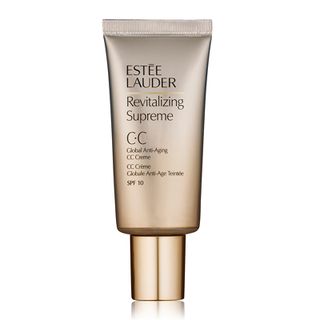
Estée Lauder Revitalizing Supreme Global Anti-Aging CC Creme SPF10
Works for
1 of 2 advertised claims delivered
Sun protectionSPF 10 · 4 UV filters · Partial spectrumNo real protectionSPF too low
This product does not offer sun protection, or it is very low.
This product can be considered "reef safe" because it does not contain the UV filters (oxybenzone and octinoxate) that can be harmful to coral reefs when present in the water in high concentrations.
Anti-aging4 ingredients credited for this claimStrong support
“Revitalizing Supreme Global Anti-Aging CC Creme SPF10”
This product can help reduce and prevent fine lines and wrinkles, improve skin elasticity and firmness because it contains acetyl glucosamine.
These ingredients in the product can also be helpful, even though there is less evidence for their effectiveness: acetyl hexapeptide-8.
Keep in mind that it typically takes at least 6 weeks to notice any results because the changes that are needed to improve fine lines and elasticity happen in the deeper layers of the skin. No topical anti-aging product can “erase” wrinkles or fully reverse signs of aging.
Evens skin toneNot advertised by the brand · 3 ingredients credited for this claimStrong support
This product can help reduce hypepigmentation and even out the skin tone because it contains the following effective ingredients: acetyl glucosamine
Keep in mind that you would need to apply any topical skincare targetted at hypigmentation consistently for a couple of months to get a result. No topical skincare product can help get rid of hyperpigmentation (including post-acne marks and age spots) instantly.
MoisturizingNot advertised by the brand · 24 ingredients credited for this claimStrong support
This product can help improve hydration of the skin with the two types of ingredients.
The first type is called “humectants”:
these ingredients help attract water.
When humectants are on the surface of the skin, they “pull in” the moisture from the outside environment, or from
within deeper layers of the skin. The following ingredients in this product do the job:
artemia extract, sodium hyaluronate.
This product also contains ingredients called “occlusives”. They help reduce the speed with which our skin loses moisture to the outside environment. These ingredients also help soften the upper layer of the skin, so it feels less tight and nicer to the touch. The following ingredients in this product do the job: squalane, cholesterol.
The following ingredients in this product are especially good for supporting the skin barrier and helping with the hydration level: acetyl glucosamine, acetyl hexapeptide-8
Can it cause trouble?
Irritancy1 strong irritant: ParfumMedium risk
Comedogenic3 ingredients rated 2 or more on the 0–5 pore-clogging scale3 flagged
User reviews
Be the first — your take helps the next person decide.
Ingredients
Filter by role to see what each ingredient is doing.
Water~45–55%
Ethyl macadamiate~4.6–5.6%
Butylene glycol~4.3–5.2%
- Irritation risk
- Low
Used to create a nice product texture and help delivery of other ingredients. Might be somewhat helpful in attracting water to the upper layer of the skin
More about Butylene glycolMethyl trimethicone~3.2–3.9%
- Irritation risk
- Low
A type of silicone that helps create a silky product finish and dissolve other ingredients
More about Methyl trimethiconeEthylhexyl salicylate~3.3–4%
- Irritation risk
- Low
Octisalate. A UV filter. It offers some protection against the sun rays that cause sunburn (UVB), but does not protect against the most aging sun rays (UVA). It loses its effectiveness quickly when exposed to sunlight. It is an organic, or so called "chemical" sunscreen
More about Ethylhexyl salicylateOctocrylene~2.6–3.2%
- Irritation risk
- Medium
A weak sunscreen that protects against the sun rays that cause sunburn (UVB) and is somewhat effective against the UVA rays. It is quite stable and can help stabilize other, more vulnerable, sunscreen ingredients like Avobenzone. It is an organic, or so called "chemical" sunscreen
More about OctocryleneLauryl peg-9 polydimethylsiloxyethyl dimethicone~1.7–2.1%
- Irritation risk
- Low
A type of silicone that helps to soften upper layer of the skin and create a nice product texture
More about Lauryl peg-9 polydimethylsiloxyethyl dimethiconePeg-100 stearate~1.5–1.8%
- Irritation risk
- Low
Helps oil and water mix togehter and creates a nice product texture
More about Peg-100 stearateButyloctyl salicylate~1.1–1.4%
- Irritation risk
- Medium
A synthetic ester of salicylic acid that is used to help disperse pigments and boost effectiveness of sunscreen ingredients. It is able to absorb UV light (working as an organic, or chemical filter), but is not approved as a sunscreen ingredient on its own
More about Butyloctyl salicylateJojoba esters~1–1.2%
- Irritation risk
- Medium
An emollient made of jojoba oil. Helps soften the skin and support its barrier function
More about Jojoba estersGlyceryl stearate~0.7–1.05%
- Irritation risk
- Low
An emollient that softens the skin and forms a protective layer on its surface. Helps water and oil mix together
More about Glyceryl stearatePhyllostachys nigra extract~0.55–0.85%
- Irritation risk
- Low
Cucumis sativus extract~0.5–0.75%
- Irritation risk
- Medium
Cladosiphon okamuranus extract~0.45–0.7%
- Irritation risk
- Low
Artemia extract~0.45–0.65%
- Irritation risk
- Low
Zooplankton extract that can attract water to the upper level of the skin and might have some anti-oxidant effect
More about Artemia extractNarcissus tazetta bulb extract~0.45–0.65%
- Irritation risk
- Medium
Might contain compounds called dormins that in theory could help lighten skin and reduce hyperpigmentation, but solid research is lacking
More about Narcissus tazetta bulb extractTriticum vulgare germ oil~0.45–0.7%
- Irritation risk
- Low
- Comedogenicity
- 3/5
A good emoillient. Contains vitamin E which can help neutralise free radicals, however the oil is unstable. Avoid if you have gluten or wheat sensitivity (including food allergies).
More about Triticum vulgare germ oilWhey protein~0.4–0.6%
- Irritation risk
- Low
A protein derived from milk. In skincare products, might help to soften the upper layer of the skin
More about Whey proteinHordeum vulgare extract~0.35–0.65%
- Irritation risk
- Medium
A plant extract that might have some anti-oxidant properties. Avoid if you are sensitive to gluten
More about Hordeum vulgare extractButyrospermum parkii butter~0.35–0.65%
- Irritation risk
- Low
- Comedogenicity
- 3/5
A great moisturising ingredient that softens the skin and reduces water loss from its upper layer. It also can be helpful in protecting skin from free radicals
More about Butyrospermum parkii butterCaffeine~0.3–0.5%
- Irritation risk
- Medium
Might be helpful in neutralizing free radicals. Can have a dehydration effect that might somewhat decrease the look of puffy eyes
More about CaffeineSucrose~0.25–0.45%
- Irritation risk
- Low
Can help attract water to the upper layer of the skin. In crystal form, it can work as a gentle exfoliant, gentler than the salt scrub. Helps stabilize the emulsion
More about SucroseCholesterol~0.3–0.55%
- Irritation risk
- Low
An emollient that is naturally found in skin
More about CholesterolAcetyl hexapeptide-8~0.25–0.45%
- Irritation risk
- Low
A type of peptide. Peptides are excellent moisturizers and might be able support collagen production reducing fine lines and wrinkles
More about Acetyl hexapeptide-8Ergothioneine~0.25–0.45%
- Irritation risk
- Low
Can help neutralize free radicals in skin. Preliminary studies show that it can be more effective than coenzyme Q10 but studies on effective concentration for topical applications are lacking
More about ErgothioneineTrehalose~0.25–0.45%
- Irritation risk
- Low
A sugar that attracts water to the upper layer of the skin
More about TrehaloseAcetyl glucosamine~0.25–0.45%
- Irritation risk
- Low
An effective moisturizing ingredient that also has been shown to be effective in evening out the skin tone and reducing hyperpigmentation. It can help somewhat reduce wrinkles in skin
More about Acetyl glucosamineLinoleic acid~0.4–0.6%
- Irritation risk
- Low
An excellent emollient. Helps soften the skin, restore its barrier function, and can help to calm down inflammation. It can be helpful to prevent blemishes and clogged pores
More about Linoleic acidSodium hyaluronate~0.25–0.45%
- Irritation risk
- Low
One of the best moisturizing ingredients. Attracts water into the upper layer of the skin
More about Sodium hyaluronatePotassium cetyl phosphate~0.3–0.5%
- Irritation risk
- Medium
Helps oil and water mix together
More about Potassium cetyl phosphateGlyceryl polymethacrylate~0.3–0.5%
- Irritation risk
- Low
Used to create a nice product texture
More about Glyceryl polymethacrylateCetyl alcohol~0.3–0.55%
- Irritation risk
- Low
A non-drying alcohol that works to soften the skin and stabilize product formulations helping oil and water mix together
More about Cetyl alcoholStearic acid~0.4–0.6%
- Irritation risk
- Low
Helps oil and water mix together and works as an emollient
More about Stearic acidIsopropyl myristate~0.3–0.55%
- Irritation risk
- Low
- Comedogenicity
- 3/5
An emollient that helps soften the skin. Could be comedogenic
More about Isopropyl myristateCaprylyl glycol~0.3–0.5%
- Irritation risk
- Medium
Helps preserve products and creates a nice product texture
More about Caprylyl glycolEthylhexylglycerin~0.25–0.5%
Tocopheryl acetate~0.25–0.5%
- Irritation risk
- Medium
A more stable but less bio-available form of vitamin E compared to Tocopherol. Might help moisturize and protect the skin from free radicals, but mostly used in low concentrations to stabilize other ingredients.
More about Tocopheryl acetatePolymethyl methacrylate~0.3–0.55%
- Irritation risk
- Low
Is used to enhance product texture and can help to optically mask skin imperfections
More about Polymethyl methacrylateSqualane~0.3–0.55%
- Irritation risk
- Low
An oil naturally present in skin. Works as an emollient to soften the skin and form a protective layer on its surface without a greasy feeling.
More about SqualanePropylene glycol dicaprate~0.3–0.55%
- Irritation risk
- Low
An emollient that helps soften the upper layer of the skin
More about Propylene glycol dicaprateDehydroxanthan gum~0.25–0.5%
- Irritation risk
- Low
Helps create thicker product formulations and stabilize emulsions
More about Dehydroxanthan gumDextrin~0.25–0.5%
- Irritation risk
- Low
A sugar that is used to stabilize the product formulation. Can help attract water to the upper layer of the skin
More about DextrinAmmonium polyacryloyldimethyl taurate~0.25–0.45%
- Irritation risk
- Low
Used to create a thicker product consistency
More about Ammonium polyacryloyldimethyl taurateHelianthus annuus extract~0.3–0.55%
- Irritation risk
- Low
Helps soften the upper layer of the skin
More about Helianthus annuus extractSilica~0.35–0.65%
Tetrahexyldecyl ascorbate~0.25–0.45%
- Irritation risk
- Medium
Being a lipid soluble form of vitamin C, it is more stable than ascorbic acid, but still degrades quickly and needs to be stabilized in a formulation with another ingredient. It is claimed to penetrate skin better than pure vitamin C and have the the similar benefits, but solid studies of its effectiveness are lacking. Is likely to require a higher concentration in a product than pure vitamin C to be effective. It might be able to help reduce pore clogging.
More about Tetrahexyldecyl ascorbateParfum~0.2–0.4%
- Irritation risk
- High
An aromatic blend of unspecified and possibly irritating ingredients
More about ParfumCitric acid~0.2–0.4%
- Irritation risk
- Medium
Can work as an exfoliant but is typically used to adjust the product pH
More about Citric acidSodium hydroxide~0.2–0.4%
Bht~0.2–0.4%
Phenoxyethanol~0.2–0.35%
- Irritation risk
- Low
A preservative. It helps prevent bacterial growth in cosmetic products
More about PhenoxyethanolMica~0.2–0.4%
- Irritation risk
- Low
Creates an illusion of smoother and more radiant skin tone. Adds shimmer to the skin by reflecting light
More about MicaIron oxides~0.15–0.25%
- Irritation risk
- Low
An umbrella term for the following three colorants: CI 77491, CI 77492, CI 77499. They might be able to offer some protection against visible light, but the degree of the protection is not clear
More about Iron oxidesCi 77492~0.15–0.3%
Ci 77499~0.15–0.3%
Titanium dioxide~0.1–0.2%
- Irritation risk
- Low
Works as a UV filter when used in high concentrations. It is photostable and is effective mostly against the UVB light, with some protection in the UVA range. In small concentrations, used for its ability to improve the color of cosmetic products. Is usually well tolerated by the skin
More about Titanium dioxideIngredient list view
Water, Ethyl macadamiate, Butylene glycol, Methyl trimethicone, Ethylhexyl salicylate, Unknown, Octocrylene, Lauryl peg-9 polydimethylsiloxyethyl dimethicone, Peg-100 stearate, Butyloctyl salicylate, Jojoba esters, Glyceryl stearate, Phyllostachys nigra extract, Cucumis sativus extract, Cladosiphon okamuranus extract, Artemia extract, Narcissus tazetta bulb extract, Triticum vulgare germ oil, Whey protein, Hordeum vulgare extract, Butyrospermum parkii butter, Caffeine, Sucrose, Cholesterol, Acetyl hexapeptide-8, Ergothioneine, Trehalose, Acetyl glucosamine, Linoleic acid, Sodium hyaluronate, Potassium cetyl phosphate, Glyceryl polymethacrylate, Cetyl alcohol, Stearic acid, Isopropyl myristate, Caprylyl glycol, Ethylhexylglycerin, Tocopheryl acetate, Polymethyl methacrylate, Squalane, Propylene glycol dicaprate, Dehydroxanthan gum, Dextrin, Ammonium polyacryloyldimethyl taurate, Helianthus annuus extract, Silica, Tetrahexyldecyl ascorbate, Parfum, Citric acid, Sodium hydroxide, Bht, Phenoxyethanol, Mica, Iron oxides, Ci 77492, Ci 77499, Titanium dioxide
Compare prices
Retailers ranked by price — lowest first.
Affiliate links · prices updated regularly · As an Amazon Associate, WIMJ earns from qualifying purchases.
Product summary
We do not recommend "Estée Lauder - Revitalizing Supreme Global Anti-Aging CC Creme SPF10" because it does not provide good UVA protection. UVA sun rays don't burn the skin, but they still lead to photoaging and hyperpigmentation.
It should also be hydrating enough to use without an additional moisturizer during the day. Like all broad-spectrum sunscreens, this product helps prevent early signs of aging.
Sunscreen filters
This sunscreen uses so-called "chemical", or organic UV filters (organic simply means that their molecules contain atoms of carbon). These filters typically give good sun protection and rarely leave a white cast, but they can be irritating for sensitive skin. The UV filters in this sunscreen are: butyloctyl salicylate 1.10% - 1.40%, octisalate 3.30% - 4.00% and octocrylene 2.60% - 3.20%.
Irritation risk
This product contains some common irritants, including those without a benefit for the skin. We assess the overall irritancy of this product to be medium. For a detailed overview of all potential irritants: click here
You can see the detailed formula review with the breakdown of all actives in the product and the full ingredient list with estimated concentrations in the tables below.
Price
The product retails for 104.04A$ in Australia and for 74.96$ in the United States.
For a detailed price comparison: click here.
Sources cited in this review
Every concentration estimate and effectiveness label is anchored to one of these 19 studies and safety reviews.
- 1
- 2
- 3TOPICAL COMPOSITIONS CONTAINING WHEY PROTEINS patentimages.storage.googleapis.com
- 4Celiac Disease & Skin Care Productsbadgut.org
- 5
- 6A comparison of the relative antioxidant potency of L‐ergothioneine and idebenoneonlinelibrary.wiley.com

Affiliate links · As an Amazon Associate, WIMJ earns from qualifying purchases.