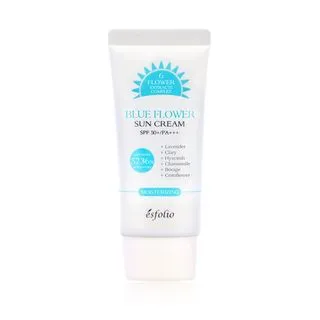
esfolio Blue Flower Sun Cream
Works for
Sun protectionSPF 50 · 7 UV filtersBroad spectrum
This product offers a good level of protection against both UVB and UVA rays.
This sunscreen uses organic (so-called "chemical") sunscreen filters. Organic, or "chemical" filters usually provide reliable sun protection and rarely leave a white cast. Sunscreens with organic filters can sting eyes.
MoisturizingSide benefit the brand mentions · Glycerin, Dimethicone + 4 moreWorks
“Enriched with six kinds of vegetable extracts, this sun cream’s nourishing and moisturizing formula boasts a non-sticky texture and leaves no white cast.”
This product can help improve hydration of the skin with the two types of ingredients.
The first type is called “humectants”:
these ingredients help attract water.
When humectants are on the surface of the skin, they “pull in” the moisture from the outside environment, or from
within deeper layers of the skin. The following ingredients in this product do the job:
arginine, glycerin.
This product also contains ingredients called “occlusives”. They help reduce the speed with which our skin loses moisture to the outside environment. These ingredients also help soften the upper layer of the skin, so it feels less tight and nicer to the touch. The following ingredients in this product do the job: arginine, dimethicone.
Can it cause trouble?
Irritancy4 strong irritants: Lavandula angustifolia flower extract, Salvia sclarea extract + 2 more — patch-test recommendedHigh risk
Comedogenic1 ingredient rated 2 or more on the 0–5 pore-clogging scale1 flagged
User reviews
Be the first — your take helps the next person decide.
Ingredients
Filter by role to see what each ingredient is doing.
Lavandula angustifolia flower extract9.56%
- Irritation risk
- High
Essential oil that can be irritating
More about Lavandula angustifolia flower extractSalvia sclarea extract9.56%
- Irritation risk
- High
Used as a fragrance. Can be irritating
More about Salvia sclarea extractHyacinthus orientalis flower extract9.56%
- Irritation risk
- Low
Chamomilla recutita flower/leaf extract9.56%
- Irritation risk
- High
Borago officinalis extract9.56%
- Irritation risk
- Low
Centaurea cyanus flower extract9.56%
- Irritation risk
- High
A plant extract that might have antibacterial effect and help neutralize free radicals
More about Centaurea cyanus flower extractEthylhexyl methoxycinnamate~22–33%
- Irritation risk
- High
Octinoxate. When used in higher concentrations, works as a sunscreen protecting the skin from UVB rays. When used in lower concentration, helps to preserve the product formulation. Is shown to be harmful to coral reefs - consider avoiding bathing in coral reef areas when wearing a product with this ingredient. It can be irritating
More about Ethylhexyl methoxycinnamateDipropylene glycol~7.2–10.8%
- Irritation risk
- Low
Helps to dissolve other ingredients in a formulation. Slows down the rate of product drying
More about Dipropylene glycolEthylhexyl salicylate~4.6–6.9%
- Irritation risk
- Low
Octisalate. A UV filter. It offers some protection against the sun rays that cause sunburn (UVB), but does not protect against the most aging sun rays (UVA). It loses its effectiveness quickly when exposed to sunlight. It is an organic, or so called "chemical" sunscreen
More about Ethylhexyl salicylateTitanium dioxide~3.8–5.7%
- Irritation risk
- Low
Works as a UV filter when used in high concentrations. It is photostable and is effective mostly against the UVB light, with some protection in the UVA range. In small concentrations, used for its ability to improve the color of cosmetic products. Is usually well tolerated by the skin
More about Titanium dioxideGlycerin~2.8–4.2%
- Irritation risk
- Low
One of the best moisturizing ingredients. Naturally present in skin. It attracts water to the upper layer of the skin working as a humectant
More about GlycerinDimethicone~2.2–3.3%
- Irritation risk
- Low
A silicone that helps to reduce water loss from the surface of the skin. Can temporarily "fill in" lines and wrinkles, absorb oil, and create a nice product finish
More about Dimethicone4-methylbenzylidene camphor~2–3%
- Irritation risk
- High
A UVB filter. Banned in the EU since 1 May 2025: it may no longer be used in cosmetics sold there.
More about 4-methylbenzylidene camphorOctocrylene~1.8–2.7%
- Irritation risk
- Medium
A weak sunscreen that protects against the sun rays that cause sunburn (UVB) and is somewhat effective against the UVA rays. It is quite stable and can help stabilize other, more vulnerable, sunscreen ingredients like Avobenzone. It is an organic, or so called "chemical" sunscreen
More about OctocryleneCetearyl alcohol~1.2–1.8%
- Irritation risk
- Low
- Comedogenicity
- 2/5
A non-drying alcohol. Works as an emollient. Helps water and oil mix together and creates a nice product texture
More about Cetearyl alcoholStearic acid~0.95–1.45%
- Irritation risk
- Low
Helps oil and water mix together and works as an emollient
More about Stearic acidDiethylamino hydroxybenzoyl hexyl benzoate~0.95–1.4%
- Irritation risk
- Medium
Uvinul A Plus. A new generation broad spectrum sunscreen that offers an effective protection especially in the UVA range. It is stable in formulations. Unfortunately, is not approved by the FDA (US) yet
More about Diethylamino hydroxybenzoyl hexyl benzoateBis-ethylhexyloxyphenol methoxyphenyl triazine~0.8–1.25%
- Irritation risk
- Medium
Tinosorb S. One of the most effective broad spectrum sunscreen ingredients. Protects from both UVA and UVB rays. It is photostable. Approved by the US FDA in 2026 (listed as bemotrizinol on US labels).
More about Bis-ethylhexyloxyphenol methoxyphenyl triazine1,2-hexanediol~0.35–0.85%
Sorbitan stearate~0.35–0.85%
Glyceryl stearate~0.4–0.9%
- Irritation risk
- Low
An emollient that softens the skin and forms a protective layer on its surface. Helps water and oil mix together
More about Glyceryl stearatePeg-100 stearate~0.4–0.9%
- Irritation risk
- Low
Helps oil and water mix togehter and creates a nice product texture
More about Peg-100 stearatePolysorbate 60~0.35–0.75%
Hydroxyacetophenone~0.15–0.7%
Aluminum starch octenylsuccinate~0.15–0.6%
- Irritation risk
- Medium
Used to thicken the product's consistency
More about Aluminum starch octenylsuccinateAcrylates/c10-30 alkyl acrylate crosspolymer~0.3–0.7%
- Irritation risk
- Medium
Maintains the texture of skincare products. Allows the product to spread evenly. Helps oil and water mix together
More about Acrylates/c10-30 alkyl acrylate crosspolymerArginine~0.1–0.45%
- Irritation risk
- Low
An amino acid that is naturally present in skin and helps keep it hydrated. When used together with AHAs, it can reduce their irritating effect on the skin
More about ArginineEthylhexylglycerin~0.1–0.4%
Aluminum hydroxide~0.15–0.65%
- Irritation risk
- Low
Is used to add opaque (non-transparent) appearance to formulations. Can be used to coat other ingredients for even dispersion. This is a different ingredient compared to the ones used in antipersperants (aluminium chloride and aluminium chlorohydrate)
More about Aluminum hydroxideDisodium edta~0.1–0.35%
Xanthan gum~0.05–0.3%
- Irritation risk
- Low
Used to create a thicker product consistency
More about Xanthan gumChlorphenesin~0.05–0.25%
Parfum~0.05–0.15%
- Irritation risk
- High
An aromatic blend of unspecified and possibly irritating ingredients
More about ParfumIngredient list view
Lavandula angustifolia flower extract, Salvia sclarea extract, Hyacinthus orientalis flower extract, Chamomilla recutita flower/leaf extract, Borago officinalis extract, Centaurea cyanus flower extract, Ethylhexyl methoxycinnamate, Dipropylene glycol, Ethylhexyl salicylate, Titanium dioxide, Glycerin, Dimethicone, 4-methylbenzylidene camphor, Octocrylene, Cetearyl alcohol, Stearic acid, Diethylamino hydroxybenzoyl hexyl benzoate, Bis-ethylhexyloxyphenol methoxyphenyl triazine, 1,2-hexanediol, Sorbitan stearate, Glyceryl stearate, Peg-100 stearate, Polysorbate 60, Hydroxyacetophenone, Aluminum starch octenylsuccinate, Acrylates/c10-30 alkyl acrylate crosspolymer, Arginine, Ethylhexylglycerin, Aluminum hydroxide, Disodium edta, Xanthan gum, Chlorphenesin, Parfum
Compare prices
Retailers ranked by price — lowest first.

Product summary
We believe that this product can provide reliable sun protection based on the ingredients listed. It can protect from both UVA and UVB rays. This is great news because not all sunscreens with SPF ratings give UVA protection. (UVA rays do not cause sunburn, but still damage our skin and lead to early aging).
Its formula is also hydrating, so you might find that you do not need an additional moisturizer during the day.
Sunscreen filters
This sunscreen uses a mixture of both mineral and organic (so-called "chemical") UV filters. Here are the organic filters this product uses: tinosorb s, uvinul a plus, octinoxate, octisalate and octocrylene. As for the mineral filters, this sunscreen uses titanium dioxide.
Irritation risk
This product contains a bunch of common irritants, including ingredients that do not provide any known benefit for the skin. It might not be the best choice if your skin is sensitive. We assess the overall irritancy of this sunscreen to be high. For a detailed overview of all potential irritants: click here
You can see the detailed formula review with the breakdown of all actives in the product and the full ingredient list with estimated concentrations in the tables below.
Price
The product retails for 8.40$ in the United States.
For a detailed price comparison: click here.
Sources cited in this review
Every concentration estimate and effectiveness label is anchored to one of these 7 studies and safety reviews.
- 1
- 2
- 3
- 4
- 5Final Report on the Safety Assessment of Dimethicone Copolyoljournals.sagepub.com
- 6

Affiliate links · As an Amazon Associate, WIMJ earns from qualifying purchases.