Works for
MoisturizingHelianthus annuus seed oil, Glycerin + 5 moreWorks
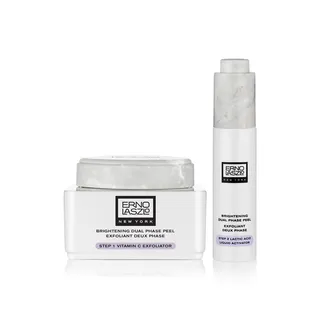
“Step 2: Lactic Acid liquid activates deeper exfoliation, while Carrot Oil softens and hydrates”
This product can help improve hydration of the skin with the two types of ingredients.
The first type is called “humectants”:
these ingredients help attract water.
When humectants are on the surface of the skin, they “pull in” the moisture from the outside environment, or from
within deeper layers of the skin. The following ingredients in this product do the job:
glycerin, butylene glycol.
This product also contains ingredients called “occlusives”. They help reduce the speed with which our skin loses moisture to the outside environment. These ingredients also help soften the upper layer of the skin, so it feels less tight and nicer to the touch. The following ingredients in this product do the job: helianthus annuus seed oil, caprylyl glycol.
ExfoliationPolylactic acid, Lactic acidNot delivered
“Two-step exfoliation to visibly smooth and brighten”
This product might help exfoliate the skin with polylactic acid, but This ingredient is not the most effective.
Can it cause trouble?
Irritancy4 strong irritants: Citrus aurantium dulcis peel oil, Citrus tangerina peel oil + 2 more — patch-test recommendedHigh risk
ComedogenicClean of flagged comedogenic ingredientsNone flagged


User reviews
Be the first — your take helps the next person decide.
Ingredients
Filter by role to see what each ingredient is doing.
Peg-8~22–34%
- Irritation risk
- Medium
Used to create a nice product consistency
More about Peg-8Sodium bicarbonate~6–9%
Butylene glycol~4.8–7.2%
- Irritation risk
- Low
Used to create a nice product texture and help delivery of other ingredients. Might be somewhat helpful in attracting water to the upper layer of the skin
More about Butylene glycolSilica~3.8–5.8%
Glyceryl stearate~3–4.5%
- Irritation risk
- Low
An emollient that softens the skin and forms a protective layer on its surface. Helps water and oil mix together
More about Glyceryl stearatePolylactic acid~2.3–3.4%
- Irritation risk
- Medium
Used as an abrasive ingredient for physical (mechanical) exfoliation
More about Polylactic acidSteareth-20~1.8–2.6%
Helianthus annuus seed oil~1.7–2.5%
- Irritation risk
- Low
A great emollient due to its high linoleic acid content. One of the most effective plant oils in helping skin hydration and repairing skin barrier function
More about Helianthus annuus seed oilCitrus aurantium dulcis peel oil~1.2–1.8%
- Irritation risk
- High
An essentil oil from orange peel. Potential allergen and can be irritating
More about Citrus aurantium dulcis peel oilCitrus tangerina peel oil~1–1.5%
- Irritation risk
- High
Essential oil that can be irritating. Can lead to photosensitivity
More about Citrus tangerina peel oilDaucus carota sativa root extract~0.85–1.3%
- Irritation risk
- Low
Carrot extract. Might have anti-oxidant properties and be used to add orange color
More about Daucus carota sativa root extractDaucus carota sativa seed oil~0.85–1.25%
- Irritation risk
- Low
A plant oil that might help neutralize free radicals and have an anti-bacterial effect
More about Daucus carota sativa seed oilBeta-carotene~0.55–1.25%
Tocopheryl acetate~0.5–1.15%
- Irritation risk
- Medium
A more stable but less bio-available form of vitamin E compared to Tocopherol. Might help moisturize and protect the skin from free radicals, but mostly used in low concentrations to stabilize other ingredients.
More about Tocopheryl acetateAscorbyl palmitate~0.45–1.05%
- Irritation risk
- Medium
Being a lipid soluble form of vitamin C, it is more stable and can penetrate the skin better than L-Ascorbic acid. It is effective in protecting the skin from free radicals, as well as evening the skin tone, but is less effective in stimulating collagen production compared to L-Ascorbic acid.
More about Ascorbyl palmitateMagnesium ascorbyl phosphate~0.45–1.1%
- Irritation risk
- Medium
A derivative of vitamin C that is more stable, but less bioavailable than the pure form of vitamin C. It does not penetrate the skin well, but has been shown to convert to pure vitamin C once in skin. It can be helpful in stimulating collagen production and lightening the skin tone, but the required concentration is likely to be very high
More about Magnesium ascorbyl phosphatePotassium stearate~0.55–1.25%
Phenoxyethanol~0.5–1%
- Irritation risk
- Low
A preservative. It helps prevent bacterial growth in cosmetic products
More about PhenoxyethanolLimonene~0.4–0.95%
- Irritation risk
- High
A common frangrance that can easily irritate skin, especially if exposed to air, light or heat
More about LimoneneWater~0.4–0.95%
Sorbitan oleate decylglucoside crosspolymer~0.45–1.05%
- Irritation risk
- Medium
Helps oil and water mix together. Used as a cleansing agent
More about Sorbitan oleate decylglucoside crosspolymerSodium ascorbyl phosphate~0.4–0.9%
- Irritation risk
- Medium
A stable derivative of vitamin C. It is oil-soluble which means it is more likely to penetrate the skin compared to the pure form of vitamin C (which is water-soluble), but it is less bio-available and is way less effective in stimulating collagen and reducing wrinkles compared to the pure form of vitamin C (L-ascorbic acid) and its other derivatives (for example, magnesium ascorbyl phosphate). At the same time, this vitamin C derivative has been shown in studies to be effective in reducing acne, blemishes and clogged pores. It is less irritating then the pure form of vitamin C
More about Sodium ascorbyl phosphateLinoleamidopropyl pg-dimonium chloride phosphate~0.4–0.9%
- Irritation risk
- Low
Lactic acid~0.4–0.9%
- Irritation risk
- Medium
An exfoliating and moisturizing alpha-hydroxy acid (AHA). Typically causes less irritation than other AHAs, for example, glycolic acid. At high concentrations (about 15%), lactic acid can help reduce lines and wrinkles. Recent studies show that lactic acid can support the "good" bacteria living on skin's surface (healthy skin microbiome)
More about Lactic acidPolyquaternium-10~0.5–1.15%
- Irritation risk
- Low
Helps soften the upper layer of the skin and create a nice product finish
More about Polyquaternium-10Hydroxyethylcellulose~0.5–1.15%
- Irritation risk
- Low
Used to thicken product formulations and create gel-like textures
More about HydroxyethylcellulosePolysorbate 20~0.4–0.95%
Sodium chloride~0.4–0.95%
- Irritation risk
- Low
Used to stabilize mixtures of oil and water, and create thicker, gel-like product textures
More about Sodium chlorideButylene glycol~0.35–0.85%
- Irritation risk
- Low
Used to create a nice product texture and help delivery of other ingredients. Might be somewhat helpful in attracting water to the upper layer of the skin
More about Butylene glycolGlycerin~0.4–0.9%
- Irritation risk
- Low
One of the best moisturizing ingredients. Naturally present in skin. It attracts water to the upper layer of the skin working as a humectant
More about GlycerinCitric acid~0.35–0.8%
- Irritation risk
- Medium
Can work as an exfoliant but is typically used to adjust the product pH
More about Citric acidSodium hydroxide~0.35–0.8%
Disodium edta~0.2–0.7%
Sodium dehydroacetate~0.15–0.6%
1,2-hexanediol~0.1–0.45%
Caprylyl glycol~0.15–0.65%
- Irritation risk
- Medium
Helps preserve products and creates a nice product texture
More about Caprylyl glycolPhenoxyethanol~0.1–0.45%
- Irritation risk
- Low
A preservative. It helps prevent bacterial growth in cosmetic products
More about PhenoxyethanolPotassium sorbate~0.1–0.4%
Parfum~0.05–0.3%
- Irritation risk
- High
An aromatic blend of unspecified and possibly irritating ingredients
More about ParfumLimonene~0.05–0.3%
- Irritation risk
- High
A common frangrance that can easily irritate skin, especially if exposed to air, light or heat
More about LimoneneIngredient list view
Peg-8, Sodium bicarbonate, Butylene glycol, Silica, Glyceryl stearate, Polylactic acid, Steareth-20, Helianthus annuus seed oil, Citrus aurantium dulcis peel oil, Citrus tangerina peel oil, Daucus carota sativa root extract, Daucus carota sativa seed oil, Unknown, Beta-carotene, Tocopheryl acetate, Ascorbyl palmitate, Magnesium ascorbyl phosphate, Potassium stearate, Phenoxyethanol, Limonene, Water, Sorbitan oleate decylglucoside crosspolymer, Sodium ascorbyl phosphate, Linoleamidopropyl pg-dimonium chloride phosphate, Lactic acid, Polyquaternium-10, Hydroxyethylcellulose, Polysorbate 20, Sodium chloride, Butylene glycol, Glycerin, Citric acid, Sodium hydroxide, Disodium edta, Sodium dehydroacetate, 1,2-hexanediol, Caprylyl glycol, Phenoxyethanol, Potassium sorbate, Parfum, Limonene
Compare prices
Retailers ranked by price — lowest first.

Worth comparing, line by line.
Match % combines shared ingredients, the first five ingredients, shared actives and hero ingredients, irritancy (lower counts in the alternative's favour), texture and body area. Only products in the same routine step are compared.
| Erno LaszloBrightening Dual Phase PeelYOUR PRODUCT | NaturiumVegan Lactic Acid Emulsion 5% | DermalogicaBrighten and Defend | CliniqueiD: Moisturizer + Concentrate for Pores & Uneven Texture | |
|---|---|---|---|---|
| Match | — | 59% | 56% | 55% |
| Price | $28.77 | — | $79.00+$50.23 | $50.00+$21.23 |
| Shared key ingredients | — | 3 of 3 | 3 of 3 | 2 of 3 |
| Key difference | — | Niacinamide | Arginine/Lysine Polypeptide | Glycolic Acid |
| Irritancy | High | Low | High | Medium |
| Drying alcohol | — | — | — | — |
| View product | Shop | Shop | Shop |


More alternatives: NIP+FAB Vitamin C TonicKerstin Florian Correcting At-Home Professional Peel 50 pc
Product summary
"Erno Laszlo - Brightening Dual Phase Peel" could be helpful for: Moisturizing, but its actives are not the most effective or are not well-studied.
Ingredient callouts
- Humectants (glycerin 0.40% - 0.90%). These ingredients help attract water to the upper layer of the skin and improve the skin hydration.
Price
The product retails for 128.00$ in the United States.
For a detailed price comparison: click here.
Sources cited in this review
Every concentration estimate and effectiveness label is anchored to one of these 21 studies and safety reviews.
- 1
- 2
- 3Effect of topically applied lipids on surfactant-irritated skinonlinelibrary.wiley.com
- 4
- 5Biological Activities and Safety of Citrus spp. Essential Oilsncbi.nlm.nih.gov
- 6

Affiliate links · As an Amazon Associate, WIMJ earns from qualifying purchases.