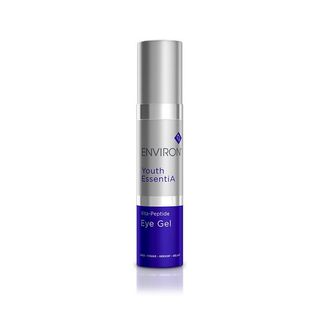
Environ Youth EssentiA Vita-Peptide Eye Gel
Works for
2 of 2 advertised claims delivered
Moisturizing13 ingredients credited for this claimStrong support
“Environ Youth EssentiA (C-Quence) Vita-Peptide Eye Gel is a light gel formula containing a variety of vitamins, antioxidants and peptides to help improve the appearance of fine lines and assist in moisturising the skin around the eye area.”
This product can help improve hydration of the skin with the two types of ingredients.
The first type is called “humectants”:
these ingredients help attract water.
When humectants are on the surface of the skin, they “pull in” the moisture from the outside environment, or from
within deeper layers of the skin. The following ingredients in this product do the job:
glycerin, butylene glycol.
This product also contains ingredients called “occlusives”. They help reduce the speed with which our skin loses moisture to the outside environment. These ingredients also help soften the upper layer of the skin, so it feels less tight and nicer to the touch. The following ingredients in this product do the job: helianthus annuus seed oil, glycine soja oil.
The following ingredients in this product are especially good for supporting the skin barrier and helping with the hydration level: acetyl hexapeptide-8, ceramide 2, palmitoyl oligopeptide, palmitoyl tetrapeptide-7, panthenol
Anti-aging6 ingredients credited for this claimModerate support
“Environ Youth EssentiA (C-Quence) Vita-Peptide Eye Gel is a light gel formula containing a variety of vitamins, antioxidants and peptides to help improve the appearance of fine lines and assist in moisturising the skin around the eye area.”
This product contains acetyl hexapeptide-8, palmitoyl oligopeptide, palmitoyl tetrapeptide-7. These ingredients might be able to help reduce and prevent fine lines and wrinkles, improve skin elasticity and firmness, but there is not enough evidence that it actually works.
Can it cause trouble?
Irritancy2 strong irritants: Retinyl palmitate, Rosmarinus officinalis leaf extractMedium risk
Comedogenic1 ingredient rated 2 or more on the 0–5 pore-clogging scale1 flagged
User reviews
Ingredients
Filter by role to see what each ingredient is doing.
Water~40–60%
Glycerin~4.2–6.3%
- Irritation risk
- Low
One of the best moisturizing ingredients. Naturally present in skin. It attracts water to the upper layer of the skin working as a humectant
More about GlycerinPeg-40 hydrogenated castor oil~3.2–4.8%
- Irritation risk
- Medium
Helps oil and water mix together
More about Peg-40 hydrogenated castor oilEthoxydiglycol~2.4–3.6%
Pentaerythrityl tetraisostearate~1.9–2.9%
- Irritation risk
- Medium
Used to create a thicker product consistency
More about Pentaerythrityl tetraisostearatePanthenol~1.5–2.2%
- Irritation risk
- Low
Helps attract water to the upper layer of the skin and can help improve skin barrier function
More about PanthenolC12-15 alkyl benzoate~1.3–2%
- Irritation risk
- Low
Enhances the product texture and makes it more spreadable. Helps reduce water loss from the outer layer of skin. Extands the shelf life by preventing bacteria growth
More about C12-15 alkyl benzoateButylene glycol~1.2–1.7%
- Irritation risk
- Low
Used to create a nice product texture and help delivery of other ingredients. Might be somewhat helpful in attracting water to the upper layer of the skin
More about Butylene glycolPalmitoyl tetrapeptide-7~1–1.5%
- Irritation risk
- Low
A type of peptide. Peptides are excellent moisturizers and might be able support collagen production reducing fine lines and wrinkles
More about Palmitoyl tetrapeptide-7Ceramide 2~0.8–1.2%
- Irritation risk
- Low
A type of lipid similar to ceramides naturally present in skin. Helps to soften the upper layer of the skin and supports the skin barrier function to keep it hydrated. Can help to prevent inflammation in skin
More about Ceramide 2Palmitoyl oligopeptide~0.5–1.2%
- Irritation risk
- Low
A type of peptide. Peptides are excellent moisturizers and might be able support collagen production reducing fine lines and wrinkles
More about Palmitoyl oligopeptidePeg-10 rapeseed sterol~0.45–1.05%
Tribehenin~0.35–0.8%
- Irritation risk
- Low
Used to create a thicker product consistency and soften the upper layer of the skin
More about TribeheninTocopheryl acetate~0.3–0.75%
- Irritation risk
- Medium
A more stable but less bio-available form of vitamin E compared to Tocopherol. Might help moisturize and protect the skin from free radicals, but mostly used in low concentrations to stabilize other ingredients.
More about Tocopheryl acetateAscorbyl tetraisopalmitate~0.2–0.8%
- Irritation risk
- Medium
A vitamin C derivative. Studies show that is might be effective in reducing hyperpigmentation, but there are no studies confirming that it is effectively converted into the bioavailable form of Vitamin C in skin. It is not clear how this derivative compares in effectiveness to the topical application of bioavailable form of vitamin C (L-ascorbic acid)
More about Ascorbyl tetraisopalmitateRetinyl palmitate~0.15–0.7%
- Irritation risk
- High
Three steps removed from the active form of vitamin A - retinoic acid. To have an effect in the skin, it first needs to be converted twice to become the retinoic acid. This means it is less potent than retinol, but could also be less irritating. Once converted to the retinoic acid in the skin, it helps against all signs of aging, improves skin cell turnover and helps fight blemishes and clogged pores. However, in many cosmetic formulations, it is used in a concentration that is too low to have the full effect
More about Retinyl palmitateAcetyl hexapeptide-8~0.15–0.65%
- Irritation risk
- Low
A type of peptide. Peptides are excellent moisturizers and might be able support collagen production reducing fine lines and wrinkles
More about Acetyl hexapeptide-8Sodium hydroxide~0.15–0.65%
Acrylates/c10-30 alkyl acrylate crosspolymer~0.15–0.6%
- Irritation risk
- Medium
Maintains the texture of skincare products. Allows the product to spread evenly. Helps oil and water mix together
More about Acrylates/c10-30 alkyl acrylate crosspolymerPolysorbate 20~0.15–0.6%
Carbomer~0.15–0.5%
- Irritation risk
- Low
Helps create a thicker or gel-like product texture. It is not a surfactant but can be used in gentle cleansing formulations
More about CarbomerGlycine soja oil~0.1–0.5%
- Irritation risk
- Medium
- Comedogenicity
- 2/5
A good emollient that helps soften the skin and helps repair its barrier function. It can clog pores if used in high concentrations.
More about Glycine soja oilDisodium edta~0.1–0.45%
Rosmarinus officinalis leaf extract~0.1–0.4%
- Irritation risk
- High
Can be helpful in reducing inflammation in skin, including inflamed acne. It can be irritating
More about Rosmarinus officinalis leaf extractPhenoxyethanol~0.1–0.5%
- Irritation risk
- Low
A preservative. It helps prevent bacterial growth in cosmetic products
More about PhenoxyethanolMethylparaben~0.15–0.3%
Propylparaben~0.1–0.35%
Ethylparaben~0.2–0.4%
Tocopherol~0.1–0.45%
- Irritation risk
- Low
Pure form of vitamin E. Can help moisturise and protect the skin from free radicals. Often used to help stabilise other ingredients or the formula itself
More about TocopherolHelianthus annuus seed oil~0.1–0.45%
- Irritation risk
- Low
A great emollient due to its high linoleic acid content. One of the most effective plant oils in helping skin hydration and repairing skin barrier function
More about Helianthus annuus seed oilPolyglyceryl-10 laurate~0.1–0.45%
- Irritation risk
- Medium
Helps water and oil mix together
More about Polyglyceryl-10 laurateButylparaben~0.1–0.3%
Isobutylparaben~0.1–0.35%
Ethoxydiglycol~0.05–0.25%
Acetyl hexapeptide-8~0.05–0.25%
- Irritation risk
- Low
A type of peptide. Peptides are excellent moisturizers and might be able support collagen production reducing fine lines and wrinkles
More about Acetyl hexapeptide-8Palmitoyl tetrapeptide-7~0.05–0.3%
- Irritation risk
- Low
A type of peptide. Peptides are excellent moisturizers and might be able support collagen production reducing fine lines and wrinkles
More about Palmitoyl tetrapeptide-7Palmitoyl oligopeptide~0.1–0.35%
- Irritation risk
- Low
A type of peptide. Peptides are excellent moisturizers and might be able support collagen production reducing fine lines and wrinkles
More about Palmitoyl oligopeptideCeramide 2~0.05–0.2%
- Irritation risk
- Low
A type of lipid similar to ceramides naturally present in skin. Helps to soften the upper layer of the skin and supports the skin barrier function to keep it hydrated. Can help to prevent inflammation in skin
More about Ceramide 2Ascorbyl tetraisopalmitate~0.05–0.15%
- Irritation risk
- Medium
A vitamin C derivative. Studies show that is might be effective in reducing hyperpigmentation, but there are no studies confirming that it is effectively converted into the bioavailable form of Vitamin C in skin. It is not clear how this derivative compares in effectiveness to the topical application of bioavailable form of vitamin C (L-ascorbic acid)
More about Ascorbyl tetraisopalmitateIngredient list view
Water, Glycerin, Peg-40 hydrogenated castor oil, Ethoxydiglycol, Pentaerythrityl tetraisostearate, Panthenol, C12-15 alkyl benzoate, Butylene glycol, Palmitoyl tetrapeptide-7, Ceramide 2, Palmitoyl oligopeptide, Peg-10 rapeseed sterol, Tribehenin, Tocopheryl acetate, Ascorbyl tetraisopalmitate, Retinyl palmitate, Acetyl hexapeptide-8, Sodium hydroxide, Acrylates/c10-30 alkyl acrylate crosspolymer, Polysorbate 20, Carbomer, Glycine soja oil, Disodium edta, Rosmarinus officinalis leaf extract, Phenoxyethanol, Methylparaben, Propylparaben, Ethylparaben, Tocopherol, Helianthus annuus seed oil, Polyglyceryl-10 laurate, Butylparaben, Isobutylparaben, Ethoxydiglycol, Acetyl hexapeptide-8, Palmitoyl tetrapeptide-7, Palmitoyl oligopeptide, Ceramide 2, Ascorbyl tetraisopalmitate
Compare prices
Retailers ranked by price — lowest first.

Product summary
Judging from the ingredient list, "Environ - Youth EssentiA Vita-Peptide Eye Gel" works well for improving skin hydration This moisturizer uses a good combo of humectants and emollients. These both types of ingredients are essentials for improving the skin hydration and keeping the skin barrier healthy. Humectants in this product (acetyl hexapeptide-8, panthenol, glycerin and butylene glycol) help to increase the water content in the upper layer of the skin. (These ingredients do so by "capturing" water molecules from the outside air or from within the deeper layers of the skin). Emollients in this formulation (ceramide 2, palmitoyl tetrapeptide-7, glycine soja oil, helianthus annuus seed oil and c12-15 alkyl benzoate) help to reduce the moisture loss from the skin. They also soften the skin surface and relieve the feeling of dryness and tightness.
Ingredient callouts
- this moisturizer includes a form of retinoids (vitamin A) - retinyl palmitate 0.15% - 0.70%, but this type of vitamin A is not very effective. It could in theory help with fine lines and wrinkles, but the effect is most likely minimal.
- As a plus, this moisturizer also contains ceramides (ceramide 2 0.05% - 0.20% and ceramide 2 0.80% - 1.20%). Ceramides are a type of lipids that our skin produces itself. They are a building block of the skin's barrier. Ceramides used in skincare are synthetic or extracted from plants. They work well for softening the skin surface and "patch holes" in the skin's barrier.
- This moistruizer also contains peptides (palmitoyl oligopeptide 0.10% - 0.35%, palmitoyl tetrapeptide-7 0.05% - 0.30%, acetyl hexapeptide-8 0.05% - 0.25%, palmitoyl tetrapeptide-7 1.00% - 1.50%, palmitoyl oligopeptide 0.50% - 1.20% and acetyl hexapeptide-8 0.15% - 0.65%). Peptides is a very big group of ingredients. They all consist of a different combination of amino-acids. Our skin produces peptides naturally. Some of them work as natural anti-biotics, promote wound-healing and production of collagen. The scientists are still studying how effective the topical application of peptides is, but it is very likely that peptides in skincare are helpful. They might be able to support skin barrier restoration and even have an anti-aging benefit. At the very least, they certainly help attract water to the skin and support the hydration in this way.
- This formulation also uses an effective concentration of panthenol (pro-vitamin B5) - about 1.50% - 2.20%. Panthenol helps strengthen the skin barrier, improve hydration and reduce inflammation in skin.
Irritation risk
There are actives in this product that can be irritating. We assess the overall irritancy of this moisturizer to be medium. For a detailed overview of all potential irritants: click here
You can see the detailed formula review with the breakdown of all actives in the product and the full ingredient list with estimated concentrations in the tables below.
Price
The product retails for 101.99$ in the United States and for 59.00£ in the United Kingdom.
For a detailed price comparison: click here.
Sources cited in this review
Every concentration estimate and effectiveness label is anchored to one of these 21 studies and safety reviews.
- 1
- 2
- 3
- 4Skin moisturizing effects of panthenol-based formulationspdfs.semanticscholar.org
- 5
- 6

Affiliate links · As an Amazon Associate, WIMJ earns from qualifying purchases.