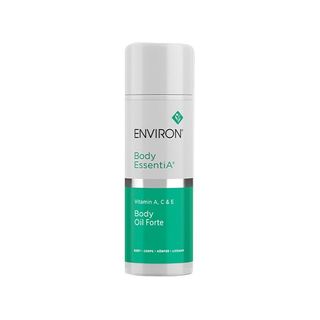
Environ Vitamin A, C & E Body Oil Forte
Works for
2 of 3 advertised claims delivered
Moisturizing4 ingredients credited for this claimGood support
“Assists in intensely nourishing as well as supplying and retaining moisture, leaving the skin looking soft and supple.”
This product can help soften the skin and reduce its moisture loss with emollients and occlusives: caprylic/capric triglyceride, helianthus annuus seed oil.
Keep in mind that this product does not contain effective ingredients to attract water to the upper layer of the skin. This is why an additional product with humectants like glycerin or hyaluronic acid can be helpful (apply it before this product for the best results).
Anti-aging2 ingredients credited for this claimModerate support
“Assists in improving the appearance of fine lines, uneven skin tone and sun damaged skin resulting in a healthy nurtured appearance.”
This product contains retinyl acetate. This ingredient might be able to help reduce and prevent fine lines and wrinkles, improve skin elasticity and firmness, but there is not enough evidence that it actually works.
Evens skin tone1 ingredient credited for this claimWeak support
“Assists in improving the appearance of fine lines, uneven skin tone and sun damaged skin resulting in a healthy nurtured appearance.”
Effective ingredients missing or their concentration is too low
Can it cause trouble?
Irritancy1 strong irritant: Retinyl acetateMedium risk
ComedogenicClean of flagged comedogenic ingredientsNone flagged
User reviews
Be the first — your take helps the next person decide.
Ingredients
Filter by role to see what each ingredient is doing.
Caprylic/capric triglyceride~23–35%
- Irritation risk
- Medium
A good mix of fatty acids that forms a protective layer on the skin. Improves the shelf life of products. Derived from coconut and glycerin
More about Caprylic/capric triglycerideSimmondsia chinensis seed oil~7.9–11.8%
- Irritation risk
- Medium
Softens the upper layer of skin and helps restore the healthy skin barrier. Has shown to help calm down inflammation in skin. It is a stable oil, meaning that it retains its properties even when exposed to air.
More about Simmondsia chinensis seed oilTocopheryl acetate~4.4–6.5%
- Irritation risk
- Medium
A more stable but less bio-available form of vitamin E compared to Tocopherol. Might help moisturize and protect the skin from free radicals, but mostly used in low concentrations to stabilize other ingredients.
More about Tocopheryl acetateAscorbyl tetraisopalmitate~3.3–5%
- Irritation risk
- Medium
A vitamin C derivative. Studies show that is might be effective in reducing hyperpigmentation, but there are no studies confirming that it is effectively converted into the bioavailable form of Vitamin C in skin. It is not clear how this derivative compares in effectiveness to the topical application of bioavailable form of vitamin C (L-ascorbic acid)
More about Ascorbyl tetraisopalmitateEthylhexyl methoxycinnamate~2.7–4.1%
- Irritation risk
- High
Octinoxate. When used in higher concentrations, works as a sunscreen protecting the skin from UVB rays. When used in lower concentration, helps to preserve the product formulation. Is shown to be harmful to coral reefs - consider avoiding bathing in coral reef areas when wearing a product with this ingredient. It can be irritating
More about Ethylhexyl methoxycinnamateRetinyl acetate~1.2–1.8%
Butyl methoxydibenzoylmethane~1.6–2.5%
- Irritation risk
- Medium
Avobenzone. An organic, or so-called "chemical" UV filter. Protects against both UVA and UVB rays. Needs to be combined with other filters in a formulation to be stable.
More about Butyl methoxydibenzoylmethaneHelianthus annuus seed oil~1.4–2.1%
- Irritation risk
- Low
A great emollient due to its high linoleic acid content. One of the most effective plant oils in helping skin hydration and repairing skin barrier function
More about Helianthus annuus seed oilBht~0.15–0.5%
Ingredient list view
Caprylic/capric triglyceride, Simmondsia chinensis seed oil, Tocopheryl acetate, Ascorbyl tetraisopalmitate, Ethylhexyl methoxycinnamate, Retinyl acetate, Butyl methoxydibenzoylmethane, Helianthus annuus seed oil, Bht
Compare prices
Retailers ranked by price — lowest first.

Affiliate links · prices updated regularly
Sources cited in this review
Every concentration estimate and effectiveness label is anchored to one of these 8 studies and safety reviews.
- 1
- 2
- 3
- 4
- 5
- 6

Affiliate links · As an Amazon Associate, WIMJ earns from qualifying purchases.