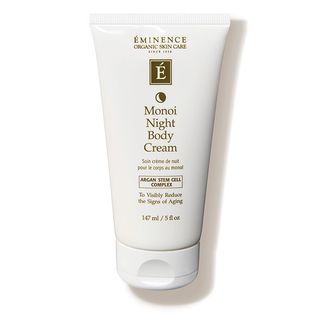
Eminence Organics Monoi Night Body Cream
Works for
2 of 2 advertised claims delivered
Anti-aging10 ingredients credited for this claimModerate support
“Enticing monoi unites with their exclusive Argan Stem Cell Complex to reveal softer, smoother and more youthful-looking skin, while shea butter and jojoba oil help to deeply hydrate and repair dry skin from head to toe.”
This product contains vitis vinifera seed extract. This ingredient might be able to help reduce and prevent fine lines and wrinkles, improve skin elasticity and firmness, but there is not enough evidence that it actually works.
Moisturizing25 ingredients credited for this claimGood support
“Replenish your skin's moisture and enjoy a luxurious night's sleep with this ultra-rich night body cream from Eminence Organic Skin Care.”
This product can help improve hydration of the skin with the two types of ingredients.
The first type is called “humectants”:
these ingredients help attract water.
When humectants are on the surface of the skin, they “pull in” the moisture from the outside environment, or from
within deeper layers of the skin. The following ingredients in this product do the job:
glycerin, isomalt.
This product also contains ingredients called “occlusives”. They help reduce the speed with which our skin loses moisture to the outside environment. These ingredients also help soften the upper layer of the skin, so it feels less tight and nicer to the touch. The following ingredients in this product do the job: cocos nucifera oil, helianthus annuus seed oil.
Anti-oxidationNot advertised by the brand · 22 ingredients credited for this claimStrong support
This product contains antioxidants (thioctic acid, ubiquinone, vitis vinifera seed extract) that can help neutralize free radicals in skin. By doing so, they can lessen the damage the skin gets from the UV light (sun).
The following ingredients - emblica officinalis fruit extract also can have an antioxidant effect, but there is less evidence to confirm their effectiveness in skin.
Can it cause trouble?
Irritancy6 strong irritants: Citrus limon juice, Calendula officinalis flower extract + 4 more — patch-test recommendedHigh risk
Comedogenic5 ingredients rated 2 or more on the 0–5 pore-clogging scale5 flagged
User reviews
Be the first — your take helps the next person decide.
Ingredients
Filter by role to see what each ingredient is doing.
Aloe barbadensis leaf juice~23–35%
- Irritation risk
- Medium
Traditionally used to treat sunburns, dermatitis and inflammation, but evidence for its effectiveness is lacking. The extract can contain humectants that help attract water into the skin
More about Aloe barbadensis leaf juiceHelianthus annuus seed oil~4.1–6.1%
- Irritation risk
- Low
A great emollient due to its high linoleic acid content. One of the most effective plant oils in helping skin hydration and repairing skin barrier function
More about Helianthus annuus seed oilCocos nucifera fruit extract~4.5–6.7%
- Irritation risk
- Low
- Comedogenicity
- 3/5
An emollient. Found to be as effective as a moisturizer for dry skin as mineral oil. Could be comedogenic
More about Cocos nucifera fruit extractTerminalia ferdinandiana fruit extract~3.7–5.6%
- Irritation risk
- Medium
A plant extract that might have some anti-oxidant effect in skin, but evidence is lacking
More about Terminalia ferdinandiana fruit extractPrunus cerasus juice~2.7–4%
- Irritation risk
- Low
Myrciaria dubia fruit extract~1.9–2.9%
- Irritation risk
- Medium
A plant extract that might help neutralize free radicals in skin, but research on its effectiveness is lacking
More about Myrciaria dubia fruit extractCitrus limon juice~1.4–2.1%
- Irritation risk
- High
Pyrus malus juice~1.1–1.6%
- Irritation risk
- High
Apple juice. Might help attract water to the skin. Can be irritating
More about Pyrus malus juiceCalendula officinalis flower extract~0.9–1.35%
- Irritation risk
- High
A plant extract that has some anti-oxidant and anti-bacterial properties. Can be irritating
More about Calendula officinalis flower extractDaucus carota sativa root extract~0.6–1.35%
- Irritation risk
- Low
Carrot extract. Might have anti-oxidant properties and be used to add orange color
More about Daucus carota sativa root extractTrifolium pratense flower extract~0.45–1.1%
- Irritation risk
- High
Red clover flower extract. Can contain anti-oxidants but also potential irritant compounds
More about Trifolium pratense flower extractVitis vinifera seed extract~0.5–1.2%
- Irritation risk
- Low
A plant extract that contains resveratrol and other anti-oxidant compounds that can help neutralize free radicals, reduce inflammation in skin and even out its tone. Can be also used to stabilize the product formulation
More about Vitis vinifera seed extractDioscorea villosa root extract~0.35–0.8%
- Irritation risk
- Low
Rosmarinus officinalis leaf extract~0.2–0.8%
- Irritation risk
- High
Can be helpful in reducing inflammation in skin, including inflamed acne. It can be irritating
More about Rosmarinus officinalis leaf extractZea mays silk extract~0.2–0.75%
- Irritation risk
- Low
Glycine soja germ extract~0.35–0.8%
- Irritation risk
- Low
Maltodextrin~0.3–0.75%
- Irritation risk
- Low
Used to stabilize the product formulation and can help absorb oil
More about MaltodextrinAcacia senegal gum~0.35–0.75%
- Irritation risk
- Medium
Helps mask the small of other ingredients and improve the product texture
More about Acacia senegal gumCetearyl alcohol~0.3–0.7%
- Irritation risk
- Low
- Comedogenicity
- 2/5
A non-drying alcohol. Works as an emollient. Helps water and oil mix together and creates a nice product texture
More about Cetearyl alcoholButyrospermum parkii butter~0.2–0.75%
- Irritation risk
- Low
- Comedogenicity
- 3/5
A great moisturising ingredient that softens the skin and reduces water loss from its upper layer. It also can be helpful in protecting skin from free radicals
More about Butyrospermum parkii butterZea mays germ oil~0.2–0.7%
- Irritation risk
- Low
- Comedogenicity
- 2/5
Caprylic/capric triglyceride~0.2–0.75%
- Irritation risk
- Medium
A good mix of fatty acids that forms a protective layer on the skin. Improves the shelf life of products. Derived from coconut and glycerin
More about Caprylic/capric triglycerideGlycerin~0.15–0.6%
- Irritation risk
- Low
One of the best moisturizing ingredients. Naturally present in skin. It attracts water to the upper layer of the skin working as a humectant
More about GlycerinSimmondsia chinensis seed oil~0.15–0.7%
- Irritation risk
- Medium
Softens the upper layer of skin and helps restore the healthy skin barrier. Has shown to help calm down inflammation in skin. It is a stable oil, meaning that it retains its properties even when exposed to air.
More about Simmondsia chinensis seed oilWater~0.15–0.5%
Glycerin~0.15–0.6%
- Irritation risk
- Low
One of the best moisturizing ingredients. Naturally present in skin. It attracts water to the upper layer of the skin working as a humectant
More about GlycerinMethyl glucose sesquistearate~0.15–0.7%
- Irritation risk
- Medium
Helps water and oil mix together
More about Methyl glucose sesquistearateGardenia taitensis flower extract~0.15–0.5%
Benzyl alcohol~0.1–0.45%
- Irritation risk
- High
A preservative. Can be used to mask unpleasant smell. Can be irritating
More about Benzyl alcoholDehydroacetic acid~0.15–0.5%
Althaea officinalis root extract~0.15–0.5%
- Irritation risk
- High
A plant extract that can help attract water to the upper layer of the skin and might help to reduce inflammation
More about Althaea officinalis root extractDimethyl isosorbide~0.15–0.55%
- Irritation risk
- Low
Used to dissolve other ingredients in a product and can enhance their ability to penetrate the skin
More about Dimethyl isosorbideSesamum indicum seed extract~0.1–0.45%
- Irritation risk
- Low
Plant oil that due to its high content of linoleic acid can help support skin's barrier function improving its hydration
More about Sesamum indicum seed extractArgania spinosa kernel oil~0.15–0.65%
- Irritation risk
- Medium
An emollient that helps soften the upper layer of the skin. Might have some weak anti-oxidant properties
More about Argania spinosa kernel oilHydrolyzed caesalpinia spinosa gum~0.15–0.65%
- Irritation risk
- Medium
Helps softent the upper layer of the skin and create a thicker product consistency
More about Hydrolyzed caesalpinia spinosa gumCaesalpinia spinosa gum~0.3–0.75%
Oenothera biennis oil~0.15–0.65%
- Irritation risk
- Medium
Helps soften the upper layer of the skin and can support skin barrier function
More about Oenothera biennis oilSodium cetearyl sulfate~0.2–0.75%
- Irritation risk
- Medium
Helps water and oil mix together and works as a cleansing agent
More about Sodium cetearyl sulfateXanthan gum~0.15–0.55%
- Irritation risk
- Low
Used to create a thicker product consistency
More about Xanthan gumArgania spinosa sprout cell extract~0.15–0.5%
- Irritation risk
- Low
Plant stem cell extract. Can help attract water to the upper layer of the skin and might be helpful in neutralizing free radicals
More about Argania spinosa sprout cell extractIsomalt~0.15–0.5%
- Irritation risk
- Low
Helps attract water to the upper layer of the skin
More about IsomaltLecithin~0.15–0.7%
- Irritation risk
- Low
Used mostly for creating emulsions - helping oil and water mix together. Helps soften the upper layer of the skin
More about LecithinVitis vinifera seed oil~0.15–0.65%
- Irritation risk
- Medium
A great emollient that can also have anti-oxidant properties
More about Vitis vinifera seed oilCocos nucifera oil~0.15–0.55%
- Irritation risk
- Low
- Comedogenicity
- 3/5
An emollient. Found to be as effective as a moisturizer for dry skin as mineral oil. Could be comedogenic
More about Cocos nucifera oilHelianthus annuus seed oil~0.15–0.65%
- Irritation risk
- Low
A great emollient due to its high linoleic acid content. One of the most effective plant oils in helping skin hydration and repairing skin barrier function
More about Helianthus annuus seed oilLactic acid~0.1–0.5%
- Irritation risk
- Medium
An exfoliating and moisturizing alpha-hydroxy acid (AHA). Typically causes less irritation than other AHAs, for example, glycolic acid. At high concentrations (about 15%), lactic acid can help reduce lines and wrinkles. Recent studies show that lactic acid can support the "good" bacteria living on skin's surface (healthy skin microbiome)
More about Lactic acidAscorbyl palmitate~0.15–0.7%
- Irritation risk
- Medium
Being a lipid soluble form of vitamin C, it is more stable and can penetrate the skin better than L-Ascorbic acid. It is effective in protecting the skin from free radicals, as well as evening the skin tone, but is less effective in stimulating collagen production compared to L-Ascorbic acid.
More about Ascorbyl palmitateTocopheryl acetate~0.2–0.75%
- Irritation risk
- Medium
A more stable but less bio-available form of vitamin E compared to Tocopherol. Might help moisturize and protect the skin from free radicals, but mostly used in low concentrations to stabilize other ingredients.
More about Tocopheryl acetateHeptyl glucoside~0.15–0.55%
1,2-hexanediol~0.15–0.5%
Caprylyl glycol~0.15–0.65%
- Irritation risk
- Medium
Helps preserve products and creates a nice product texture
More about Caprylyl glycolTropolone~0.15–0.5%
- Irritation risk
- Low
Propanediol~0.15–0.55%
- Irritation risk
- Low
Acts as a solvent for other ingredients. Speeds up the absorption of other ingredients into the skin
More about PropanediolTocopherol~0.2–0.7%
- Irritation risk
- Low
Pure form of vitamin E. Can help moisturise and protect the skin from free radicals. Often used to help stabilise other ingredients or the formula itself
More about TocopherolParfum~0.1–0.45%
- Irritation risk
- High
An aromatic blend of unspecified and possibly irritating ingredients
More about ParfumEuterpe oleracea fruit extract~0.15–0.5%
- Irritation risk
- Medium
A plant extract that can have some anti-oxidant effect in skin
More about Euterpe oleracea fruit extractCitrus limon juice~0.15–0.5%
- Irritation risk
- High
Malpighia glabra fruit extract~0.15–0.65%
- Irritation risk
- Medium
A plant extract that might help neutralize free radicals in skin, but research on its effectiveness is lacking
More about Malpighia glabra fruit extractEmblica officinalis fruit extract~0.15–0.65%
- Irritation risk
- Medium
A plant extract that might be helping in neutralizing free radicals in skin. It could help reduce hyperpigmentation. There is some research to confirm its effectiveness in skin
More about Emblica officinalis fruit extractAdansonia digitata fruit extract~0.3–0.7%
- Irritation risk
- Low
Myrciaria dubia fruit extract~0.15–0.65%
- Irritation risk
- Medium
A plant extract that might help neutralize free radicals in skin, but research on its effectiveness is lacking
More about Myrciaria dubia fruit extractDaucus carota sativa root extract~0.15–0.65%
- Irritation risk
- Low
Carrot extract. Might have anti-oxidant properties and be used to add orange color
More about Daucus carota sativa root extractCocos nucifera water~0.15–0.55%
- Irritation risk
- Low
Might help to attract water to the upper layer of the skin
More about Cocos nucifera waterLycium barbarum fruit extract~0.15–0.55%
- Irritation risk
- Medium
A plant extract that can help neutralize free radicals in skin and attract water to its upper layer
More about Lycium barbarum fruit extractHelianthus annuus seed oil~0.15–0.6%
- Irritation risk
- Low
A great emollient due to its high linoleic acid content. One of the most effective plant oils in helping skin hydration and repairing skin barrier function
More about Helianthus annuus seed oilMaltodextrin~0.15–0.6%
- Irritation risk
- Low
Used to stabilize the product formulation and can help absorb oil
More about MaltodextrinGlycerin~0.1–0.5%
- Irritation risk
- Low
One of the best moisturizing ingredients. Naturally present in skin. It attracts water to the upper layer of the skin working as a humectant
More about GlycerinThioctic acid~0.1–0.4%
Ubiquinone~0.1–0.4%
- Irritation risk
- Low
Coenzyme Q10. It helps neutralize free radicals in skin, improves skin hydration and might be helpful agains fine lines and wrinkles. It can be an allergen
More about UbiquinoneIngredient list view
Aloe barbadensis leaf juice, Helianthus annuus seed oil, Cocos nucifera fruit extract, Terminalia ferdinandiana fruit extract, Prunus cerasus juice, Myrciaria dubia fruit extract, Citrus limon juice, Pyrus malus juice, Calendula officinalis flower extract, Daucus carota sativa root extract, Trifolium pratense flower extract, Vitis vinifera seed extract, Dioscorea villosa root extract, Rosmarinus officinalis leaf extract, Zea mays silk extract, Glycine soja germ extract, Maltodextrin, Acacia senegal gum, Cetearyl alcohol, Butyrospermum parkii butter, Zea mays germ oil, Caprylic/capric triglyceride, Glycerin, Simmondsia chinensis seed oil, Water, Glycerin, Methyl glucose sesquistearate, Gardenia taitensis flower extract, Benzyl alcohol, Dehydroacetic acid, Unknown, Althaea officinalis root extract, Dimethyl isosorbide, Sesamum indicum seed extract, Argania spinosa kernel oil, Hydrolyzed caesalpinia spinosa gum, Caesalpinia spinosa gum, Oenothera biennis oil, Sodium cetearyl sulfate, Xanthan gum, Argania spinosa sprout cell extract, Isomalt, Lecithin, Vitis vinifera seed oil, Cocos nucifera oil, Helianthus annuus seed oil, Lactic acid, Ascorbyl palmitate, Tocopheryl acetate, Heptyl glucoside, 1,2-hexanediol, Caprylyl glycol, Tropolone, Propanediol, Tocopherol, Parfum, Euterpe oleracea fruit extract, Citrus limon juice, Malpighia glabra fruit extract, Emblica officinalis fruit extract, Adansonia digitata fruit extract, Myrciaria dubia fruit extract, Daucus carota sativa root extract, Cocos nucifera water, Lycium barbarum fruit extract, Helianthus annuus seed oil, Maltodextrin, Glycerin, Thioctic acid, Ubiquinone
Compare prices
Retailers ranked by price — lowest first.

Affiliate links · prices updated regularly
Sources cited in this review
Every concentration estimate and effectiveness label is anchored to one of these 35 studies and safety reviews.
- 1
- 2
- 3Effect of topically applied lipids on surfactant-irritated skinonlinelibrary.wiley.com
- 4
- 5
- 6

Affiliate links · As an Amazon Associate, WIMJ earns from qualifying purchases.