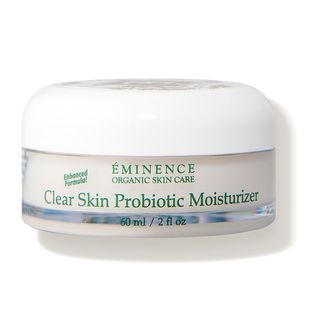
Eminence Organics Clear Skin Probiotic Moisturizer
Works for
1 of 1 advertised claim delivered
Moisturizing18 ingredients credited for this claimStrong support
“Clear Skin Probiotic Moisturizer”
This product contains good ingredients to attract water to the upper layer of the skin. These ingredients are called "humectants": glycerin, aloe barbadensis leaf juice.
When humectants are on the surface of the skin, they “pull in” the moisture from the outside environment, or from within deeper layers of the skin. If the air is dry, humectants can speed up the moisture loss from the skin. This is why it is a good idea to use another product on top of this one to help "seal in" the moisture (look for ingredients like dimethicone, squalane, oils and butters).
The following ingredients in this product are especially good for supporting the skin barrier and helping with the hydration level: panthenol
Anti-blemishNot advertised by the brand · 3 ingredients credited for this claimStrong support
This product can help reduce breakouts and clogged pores because it contains the following ingredient: salicylic acid. This ingredient is used for treating acne and can have a noticeable effect.
ExfoliationNot advertised by the brand · 3 ingredients credited for this claimStrong support
This product can help exfoliate the skin. In other words, it helps break down the bonds between dead cells on the surface of the skin and speed up the skin turnover. Skin often appears softer and brighter after exfoliation, but overdoing it can result in disrupted skin barrier. The following ingredient is doing the exfoliating job in this product: salicylic acid.
Anti-oxidationNot advertised by the brand · 10 ingredients credited for this claimStrong support
This product contains antioxidants (thioctic acid, ubiquinone) that can help neutralize free radicals in skin. By doing so, they can lessen the damage the skin gets from the UV light (sun).
The following ingredients - lycium barbarum fruit extract also can have an antioxidant effect, but there is less evidence to confirm their effectiveness in skin.
Anti-agingNot advertised by the brand · 6 ingredients credited for this claimModerate support
This product contains thioctic acid, ubiquinone. These ingredients help neutralize free radicals in skin. By doing so, they might be able to prevent early signs of aging (like fine lines and wrinkles), at least to some extent. These ingredients will not be able to "reverse" signs of aging.
Can it cause trouble?
Irritancy8 strong irritants: Citrus grandis peel extract, Lavandula angustifolia flower extract + 6 more — patch-test recommendedHigh risk
Comedogenic2 ingredients rated 2 or more on the 0–5 pore-clogging scale2 flagged


User reviews
Be the first — your take helps the next person decide.
Ingredients
Filter by role to see what each ingredient is doing.
Aloe barbadensis leaf juice~23–34%
- Irritation risk
- Medium
Traditionally used to treat sunburns, dermatitis and inflammation, but evidence for its effectiveness is lacking. The extract can contain humectants that help attract water into the skin
More about Aloe barbadensis leaf juiceCucumis sativus juice~3.1–4.6%
- Irritation risk
- Low
Cucumber juice. Might help attract water to the upper layer of the skin, but mostly works as plain water in skincare
More about Cucumis sativus juiceSalix alba bark extract~4.5–6.8%
- Irritation risk
- High
A plant extract that can help neutralize free radicals in skin. It contains a compound salicin that can theoretically be converted into salicylic acid that, in turn, helps reduce inflammation in skin, but the evidence of effectiveness in skin is lacking and the extract is usually not used in a concentration that would enable an exfoliating effect
More about Salix alba bark extractRosa canina seed extract~3.6–5.4%
- Irritation risk
- Low
Citrus grandis peel extract~2.6–3.8%
- Irritation risk
- High
An aromatic irritating plant extract that can cause photosensitivity in skin
More about Citrus grandis peel extractSymphytum officinale leaf extract~2–2.9%
- Irritation risk
- High
A plant extract that has an anti-bacterial effect
More about Symphytum officinale leaf extractLavandula angustifolia flower extract~1.6–2.4%
- Irritation risk
- High
Essential oil that can be irritating
More about Lavandula angustifolia flower extractEquisetum arvense leaf extract~1.1–1.7%
- Irritation risk
- Low
Mentha piperita leaf extract~1.1–1.6%
- Irritation risk
- High
Used as a fragrance and can be irritating
More about Mentha piperita leaf extractCalendula officinalis flower extract~0.85–1.3%
- Irritation risk
- High
A plant extract that has some anti-oxidant and anti-bacterial properties. Can be irritating
More about Calendula officinalis flower extractBeta vulgaris extract~0.55–1.3%
- Irritation risk
- Low
Glycerin~0.5–1.2%
- Irritation risk
- Low
One of the best moisturizing ingredients. Naturally present in skin. It attracts water to the upper layer of the skin working as a humectant
More about GlycerinCetearyl alcohol~0.55–1.3%
- Irritation risk
- Low
- Comedogenicity
- 2/5
A non-drying alcohol. Works as an emollient. Helps water and oil mix together and creates a nice product texture
More about Cetearyl alcoholCetearyl glucoside~0.4–0.95%
- Irritation risk
- Medium
Helps water and oil in the product mix well together and improves product texture
More about Cetearyl glucosidePropanediol~0.4–0.9%
- Irritation risk
- Low
Acts as a solvent for other ingredients. Speeds up the absorption of other ingredients into the skin
More about PropanediolUndecane~0.45–1%
- Irritation risk
- Medium
Helps create a non-greasy finish on the skin
More about UndecaneTridecane~0.35–0.85%
Panthenol~0.35–0.85%
- Irritation risk
- Low
Helps attract water to the upper layer of the skin and can help improve skin barrier function
More about PanthenolYogurt~0.35–0.8%
- Irritation risk
- Low
Glycerin~0.35–0.85%
- Irritation risk
- Low
One of the best moisturizing ingredients. Naturally present in skin. It attracts water to the upper layer of the skin working as a humectant
More about GlycerinCaesalpinia spinosa gum~0.45–1.05%
Lactic acid~0.3–0.7%
- Irritation risk
- Medium
An exfoliating and moisturizing alpha-hydroxy acid (AHA). Typically causes less irritation than other AHAs, for example, glycolic acid. At high concentrations (about 15%), lactic acid can help reduce lines and wrinkles. Recent studies show that lactic acid can support the "good" bacteria living on skin's surface (healthy skin microbiome)
More about Lactic acidGlyceryl stearate~0.35–0.85%
- Irritation risk
- Low
An emollient that softens the skin and forms a protective layer on its surface. Helps water and oil mix together
More about Glyceryl stearateCetyl palmitate~0.35–0.8%
- Irritation risk
- Low
An emollient that helps soften the skin and is used to improve product texture and stability
More about Cetyl palmitateCocoglycerides~0.35–0.85%
- Irritation risk
- High
Help soften the upper layer of the skin and make it easier for oil and water mix together. Recently, a rising number of allergic reactions to cocoglycerides and other coconut-derived surfactants has been reported. As there is a significant overlap between frequent irritants and allergens, we flag this ingredient for attention of those with very sensitive, reactive skin
More about CocoglyceridesSodium cetearyl sulfate~0.35–0.85%
- Irritation risk
- Medium
Helps water and oil mix together and works as a cleansing agent
More about Sodium cetearyl sulfateCalendula officinalis flower oil~0.2–0.7%
- Irritation risk
- High
A plant oil that might have an antibacterial and some antioxidant effect. Is a common allergen and irritant
More about Calendula officinalis flower oilSalix alba bark extract~0.2–0.75%
- Irritation risk
- High
A plant extract that can help neutralize free radicals in skin. It contains a compound salicin that can theoretically be converted into salicylic acid that, in turn, helps reduce inflammation in skin, but the evidence of effectiveness in skin is lacking and the extract is usually not used in a concentration that would enable an exfoliating effect
More about Salix alba bark extractCellulose~0.35–0.8%
- Irritation risk
- Low
Can be used to help absorb oil as well as add volume and imporve texture of products.
More about CelluloseCyclodextrin~0.2–0.75%
- Irritation risk
- Low
A type of sugar that is used to support delivery of active ingredients and can enhance their penetration into the skin without disrupting the skin's barrier
More about CyclodextrinMelaleuca alternifolia leaf oil~0.2–0.75%
- Irritation risk
- High
An essential oil that can be irritating. Has some anti-bacterial properties
More about Melaleuca alternifolia leaf oilStearic acid~0.4–0.95%
- Irritation risk
- Low
Helps oil and water mix together and works as an emollient
More about Stearic acidBenzyl alcohol~0.2–0.7%
- Irritation risk
- High
A preservative. Can be used to mask unpleasant smell. Can be irritating
More about Benzyl alcoholDehydroacetic acid~0.3–0.6%
Tocopherol~0.2–0.8%
- Irritation risk
- Low
Pure form of vitamin E. Can help moisturise and protect the skin from free radicals. Often used to help stabilise other ingredients or the formula itself
More about TocopherolAlgin~0.2–0.8%
- Irritation risk
- Low
- Comedogenicity
- 3/5
Used to thicken product formulation. Can help attract water to the upper layer of the skin
More about AlginSalicylic acid~0.2–0.75%
- Irritation risk
- High
Used for skin exfoliation. It has an anti-inflammatory and anti-bacterial effect, helps to unclog pores, prevent blemishes and speed up healing of the existing ones. Sometimes referred to as a BHA (beta-hydroxy acid)
More about Salicylic acidSodium benzoate~0.25–0.5%
Potassium sorbate~0.3–0.6%
Cucumis sativus extract~0.2–0.8%
- Irritation risk
- Medium
Menthol~0.2–0.75%
- Irritation risk
- High
Unspecified form of vitamin c~0.2–0.7%
- Irritation risk
- Low
Lecithin~0.35–0.85%
- Irritation risk
- Low
Used mostly for creating emulsions - helping oil and water mix together. Helps soften the upper layer of the skin
More about LecithinEuterpe oleracea fruit extract~0.2–0.8%
- Irritation risk
- Medium
A plant extract that can have some anti-oxidant effect in skin
More about Euterpe oleracea fruit extractCitrus limon fruit extract~0.2–0.8%
- Irritation risk
- High
Used as a fragrance. Can be irritating and cause photosensitivity
More about Citrus limon fruit extractMalpighia glabra fruit extract~0.3–0.7%
- Irritation risk
- Medium
A plant extract that might help neutralize free radicals in skin, but research on its effectiveness is lacking
More about Malpighia glabra fruit extractPhyllanthus emblica extract~0.2–0.8%
- Irritation risk
- Low
Adansonia digitata seed extract~0.2–0.75%
- Irritation risk
- Low
Myrciaria dubia fruit extract~0.2–0.75%
- Irritation risk
- Medium
A plant extract that might help neutralize free radicals in skin, but research on its effectiveness is lacking
More about Myrciaria dubia fruit extractDaucus carota sativa extract~0.15–0.7%
- Irritation risk
- Medium
Cocos nucifera water~0.15–0.7%
- Irritation risk
- Low
Might help to attract water to the upper layer of the skin
More about Cocos nucifera waterLycium barbarum fruit extract~0.2–0.7%
- Irritation risk
- Medium
A plant extract that can help neutralize free radicals in skin and attract water to its upper layer
More about Lycium barbarum fruit extractTapioca starch~0.15–0.65%
Thioctic acid~0.15–0.65%
Ubiquinone~0.15–0.55%
- Irritation risk
- Low
Coenzyme Q10. It helps neutralize free radicals in skin, improves skin hydration and might be helpful agains fine lines and wrinkles. It can be an allergen
More about UbiquinoneGlycerin~0.15–0.65%
- Irritation risk
- Low
One of the best moisturizing ingredients. Naturally present in skin. It attracts water to the upper layer of the skin working as a humectant
More about GlycerinIngredient list view
Aloe barbadensis leaf juice, Cucumis sativus juice, Salix alba bark extract, Rosa canina seed extract, Citrus grandis peel extract, Symphytum officinale leaf extract, Lavandula angustifolia flower extract, Equisetum arvense leaf extract, Mentha piperita leaf extract, Calendula officinalis flower extract, Beta vulgaris extract, Glycerin, Cetearyl alcohol, Cetearyl glucoside, Propanediol, Undecane, Tridecane, Panthenol, Yogurt, Glycerin, Caesalpinia spinosa gum, Lactic acid, Glyceryl stearate, Cetyl palmitate, Cocoglycerides, Sodium cetearyl sulfate, Calendula officinalis flower oil, Salix alba bark extract, Cellulose, Cyclodextrin, Melaleuca alternifolia leaf oil, Stearic acid, Benzyl alcohol, Dehydroacetic acid, Tocopherol, Algin, Salicylic acid, Sodium benzoate, Potassium sorbate, Cucumis sativus extract, Menthol, Unspecified form of vitamin c, Lecithin, Euterpe oleracea fruit extract, Citrus limon fruit extract, Malpighia glabra fruit extract, Phyllanthus emblica extract, Adansonia digitata seed extract, Myrciaria dubia fruit extract, Daucus carota sativa extract, Cocos nucifera water, Lycium barbarum fruit extract, Tapioca starch, Thioctic acid, Ubiquinone, Glycerin
Compare prices
Retailers ranked by price — lowest first.

Worth comparing, line by line.
Match % combines shared ingredients, the first five ingredients, shared actives and hero ingredients, irritancy (lower counts in the alternative's favour), texture and body area. Only products in the same routine step are compared.
| Eminence OrganicsClear Skin Probiotic MoisturizerYOUR PRODUCT | Colleen Rothschild BeautyWeightless Moisturizer | Dr.OrganicAloe Vera Hydrating Moisture Cream | Om OrganicsCoconut Dew Hyaluronic Moisture Cream | |
|---|---|---|---|---|
| Match | — | 72% | 69% | 69% |
| Price | $69.00 | — | $15.99−$53.01 | $58.17−$10.83 |
| Shared key ingredients | — | 3 of 8 | 2 of 8 | 2 of 8 |
| Key difference | — | Niacinamide | Oatmeal Extract | Cocos Nucifera Fruit Extract |
| Irritancy | High | Low | Medium | Medium |
| Drying alcohol | — | — | — | — |
| View product | Shop | Shop | Shop |
Product summary
"Eminence Organics - Clear Skin Probiotic Moisturizer" has a good moisturizing formula. As we expect from a proper moisturizer, the formula includes a combo of effective humectants and emollients. These are the two different types of ingredients that are essential for improving the skin hydration and supporting a healthy skin barrier. Humectants in this product (panthenol, glycerin, lactic acid and aloe barbadensis extract) help to increase the water content in the upper layer of the skin. (These ingredients do so by "capturing" water molecules from the outside air or from within the deeper layers of the skin). Emollients in this formulation (butyrospermum parkii butter, adansonia digitata seed oil, cetearyl alcohol, cetyl palmitate and undecane) help to reduce the moisture loss from the skin. They also soften the skin surface and relieve the feeling of dryness and tightness.
Ingredient callouts
- This formulation also uses an effective concentration of panthenol (pro-vitamin B5) - about 3.40% - 5.10%. Panthenol helps strengthen the skin barrier, improve hydration and reduce inflammation in skin.
Irritation risk
There are quite a few common irritants in this product, including ingredients without particular skin benefits. We would not recommend it for sensitive skin. We assess the overall irritancy of this moisturizer to be high. For a detailed overview of all potential irritants: click here
You can see the detailed formula review with the breakdown of all actives in the product and the full ingredient list with estimated concentrations in the tables below.
Price
The product retails for 108.95A$ in Australia and from 65.00$ up to 68.38$ in the United States.
For a detailed price comparison: click here.
Sources cited in this review
Every concentration estimate and effectiveness label is anchored to one of these 34 studies and safety reviews.
- 1Efficacy and Safety of White Willow Bark (Salix alba) Extractonlinelibrary.wiley.com
- 2
- 3
- 4
- 5
- 6

Affiliate links · As an Amazon Associate, WIMJ earns from qualifying purchases.