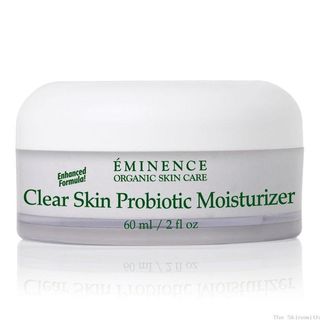
Eminence Organics Clear Skin Probiotic Moisturiser

Eminence Organics Clear Skin Probiotic Moisturiser

Efficacy100/100IrritancyHigh
Edit

Works for

2 of 2 advertised claims delivered

Anti-blemish
Salicylic acid, Salix alba bark extract + 1 more
Strong evidence
What the product description says
“This clarifying moisturiser for oily to normal skin types, especially those prone to acne, treats and prevents acne breakouts, calms skin with soothing Cucumber, balances oil production and reduces acne breakouts with Tea Tree Oil and Probiotics.”
Source: Face the future

This product can help reduce breakouts and clogged pores because it contains the following ingredient: salicylic acid. This ingredient is used for treating acne and can have a noticeable effect.

Salicylic acidHeroEffect: HighUsed for skin exfoliation. It has an anti-inflammatory and anti-bacterial effect, helps to unclog pores, prevent blemishes and speed up healing of the existing ones. Sometimes referred to as a BHA (beta-hydroxy acid)~0.2–0.8%
Salix alba bark extractEffect: LowA plant extract that can help neutralize free radicals in skin. It contains a compound salicin that can theoretically be converted into salicylic acid that, in turn, helps reduce inflammation in skin, but the evidence of effectiveness in skin is lacking and the extract is usually not used in a concentration that would enable an exfoliating effect~0.3–0.7%
Aloe barbadensis leaf juiceEffect: LowTraditionally used to treat sunburns, dermatitis and inflammation, but evidence for its effectiveness is lacking. The extract can contain humectants that help attract water into the skin~23–34%
Moisturizing
Panthenol, Ubiquinone + 15 more
Strong evidence
What the product description says
“Clear Skin Probiotic Moisturiser”
Source: Face the future

This product contains good ingredients to attract water to the upper layer of the skin. These ingredients are called "humectants": glycerin, aloe barbadensis leaf juice.

When humectants are on the surface of the skin, they “pull in” the moisture from the outside environment, or from within deeper layers of the skin. If the air is dry, humectants can speed up the moisture loss from the skin. This is why it is a good idea to use another product on top of this one to help "seal in" the moisture (look for ingredients like dimethicone, squalane, oils and butters).

The following ingredients in this product are especially good for supporting the skin barrier and helping with the hydration level: panthenol

PanthenolHero· HumectantEffect: HighHelps attract water to the upper layer of the skin and can help improve skin barrier function~0.35–0.85%
UbiquinoneKey activeEffect: HighCoenzyme Q10. It helps neutralize free radicals in skin, improves skin hydration and might be helpful agains fine lines and wrinkles. It can be an allergen~0.15–0.55%
GlycerinKey active· HumectantEffect: HighOne of the best moisturizing ingredients. Naturally present in skin. It attracts water to the upper layer of the skin working as a humectant~0.15–0.55%
Cetyl palmitateKey active· EmollientEffect: MediumAn emollient that helps soften the skin and is used to improve product texture and stability~0.35–0.85%
Cetearyl alcoholKey active· EmollientEffect: MediumA non-drying alcohol. Works as an emollient. Helps water and oil mix together and creates a nice product texture~0.55–1.3%
UndecaneKey active· EmollientEffect: MediumHelps create a non-greasy finish on the skin~0.45–1.05%
Lycium barbarum fruit extractKey activeEffect: MediumA plant extract that can help neutralize free radicals in skin and attract water to its upper layer~0.15–0.65%
Aloe barbadensis leaf juice· HumectantEffect: LowTraditionally used to treat sunburns, dermatitis and inflammation, but evidence for its effectiveness is lacking. The extract can contain humectants that help attract water into the skin~23–34%
Glyceryl stearate· EmollientEffect: LowAn emollient that softens the skin and forms a protective layer on its surface. Helps water and oil mix together~0.35–0.85%
Cocoglycerides· EmollientEffect: LowHelp soften the upper layer of the skin and make it easier for oil and water mix together. Recently, a rising number of allergic reactions to cocoglycerides and other coconut-derived surfactants has been reported. As there is a significant overlap between frequent irritants and allergens, we flag this ingredient for attention of those with very sensitive, reactive skin~0.35–0.85%
Caesalpinia spinosa gum· EmollientEffect: Low~0.45–1.05%
AlginEffect: LowUsed to thicken product formulation. Can help attract water to the upper layer of the skin~0.3–0.7%
Cucumis sativus juice· EmollientEffect: LowCucumber juice. Might help attract water to the upper layer of the skin, but mostly works as plain water in skincare~3.3–4.9%
Cocos nucifera water· HumectantEffect: LowMight help to attract water to the upper layer of the skin~0.15–0.65%
Lactic acidUnder-dosedEffect: HighAn exfoliating and moisturizing alpha-hydroxy acid (AHA). Typically causes less irritation than other AHAs, for example, glycolic acid. At high concentrations (about 15%), lactic acid can help reduce lines and wrinkles. Recent studies show that lactic acid can support the "good" bacteria living on skin's surface (healthy skin microbiome)~0.3–0.7%
Stearic acidEffect: Low, below effective doseHelps oil and water mix together and works as an emollient~0.4–0.95%
LecithinEffect: Low, below effective doseUsed mostly for creating emulsions - helping oil and water mix together. Helps soften the upper layer of the skin~0.35–0.85%
Exfoliation
Not advertised by the brand · Salicylic acid, Salix alba bark extract + 1 more
Strong evidence

This product can help exfoliate the skin. In other words, it helps break down the bonds between dead cells on the surface of the skin and speed up the skin turnover. Skin often appears softer and brighter after exfoliation, but overdoing it can result in disrupted skin barrier. The following ingredient is doing the exfoliating job in this product: salicylic acid.

Salicylic acidKey activeEffect: HighUsed for skin exfoliation. It has an anti-inflammatory and anti-bacterial effect, helps to unclog pores, prevent blemishes and speed up healing of the existing ones. Sometimes referred to as a BHA (beta-hydroxy acid)~0.2–0.8%
Salix alba bark extractEffect: LowA plant extract that can help neutralize free radicals in skin. It contains a compound salicin that can theoretically be converted into salicylic acid that, in turn, helps reduce inflammation in skin, but the evidence of effectiveness in skin is lacking and the extract is usually not used in a concentration that would enable an exfoliating effect~0.3–0.7%
Lactic acidUnder-dosedEffect: HighAn exfoliating and moisturizing alpha-hydroxy acid (AHA). Typically causes less irritation than other AHAs, for example, glycolic acid. At high concentrations (about 15%), lactic acid can help reduce lines and wrinkles. Recent studies show that lactic acid can support the "good" bacteria living on skin's surface (healthy skin microbiome)~0.3–0.7%
Anti-oxidation
Not advertised by the brand · Thioctic acid, Ubiquinone + 10 more
Strong evidence

This product contains antioxidants (thioctic acid, ubiquinone) that can help neutralize free radicals in skin. By doing so, they can lessen the damage the skin gets from the UV light (sun).

The following ingredients - emblica officinalis fruit extract, lycium barbarum fruit extract also can have an antioxidant effect, but there is less evidence to confirm their effectiveness in skin.

Thioctic acidKey activeEffect: High~0.15–0.6%
UbiquinoneKey activeEffect: HighCoenzyme Q10. It helps neutralize free radicals in skin, improves skin hydration and might be helpful agains fine lines and wrinkles. It can be an allergen~0.15–0.55%
Lycium barbarum fruit extractKey activeEffect: MediumA plant extract that can help neutralize free radicals in skin and attract water to its upper layer~0.15–0.65%
Emblica officinalis fruit extractKey activeEffect: MediumA plant extract that might be helping in neutralizing free radicals in skin. It could help reduce hyperpigmentation. There is some research to confirm its effectiveness in skin~0.2–0.8%
Malpighia glabra fruit extractEffect: LowA plant extract that might help neutralize free radicals in skin, but research on its effectiveness is lacking~0.2–0.8%
Euterpe oleracea fruit extractEffect: LowA plant extract that can have some anti-oxidant effect in skin~0.3–0.7%
Calendula officinalis flower oilEffect: LowA plant oil that might have an antibacterial and some antioxidant effect. Is a common allergen and irritant~0.2–0.75%
Salix alba bark extractEffect: LowA plant extract that can help neutralize free radicals in skin. It contains a compound salicin that can theoretically be converted into salicylic acid that, in turn, helps reduce inflammation in skin, but the evidence of effectiveness in skin is lacking and the extract is usually not used in a concentration that would enable an exfoliating effect~0.3–0.7%
Myrciaria dubia fruit extractEffect: LowA plant extract that might help neutralize free radicals in skin, but research on its effectiveness is lacking~0.2–0.75%
Calendula officinalis flower extractEffect: LowA plant extract that has some anti-oxidant and anti-bacterial properties. Can be irritating~0.85–1.3%
Tocopheryl acetateEffect: Low, below effective doseA more stable but less bio-available form of vitamin E compared to Tocopherol. Might help moisturize and protect the skin from free radicals, but mostly used in low concentrations to stabilize other ingredients.~0.3–0.75%
Ascorbyl palmitateEffect: Low, below effective doseBeing a lipid soluble form of vitamin C, it is more stable and can penetrate the skin better than L-Ascorbic acid. It is effective in protecting the skin from free radicals, as well as evening the skin tone, but is less effective in stimulating collagen production compared to L-Ascorbic acid.~0.2–0.8%
Anti-aging
Not advertised by the brand · Ubiquinone, Thioctic acid + 4 more
Moderate evidence

This product contains thioctic acid, ubiquinone. These ingredients help neutralize free radicals in skin. By doing so, they might be able to prevent early signs of aging (like fine lines and wrinkles), at least to some extent. These ingredients will not be able to "reverse" signs of aging.

UbiquinoneEffect: LowCoenzyme Q10. It helps neutralize free radicals in skin, improves skin hydration and might be helpful agains fine lines and wrinkles. It can be an allergen~0.15–0.55%
Thioctic acidEffect: Low~0.15–0.6%
Lycium barbarum fruit extractEffect: LowA plant extract that can help neutralize free radicals in skin and attract water to its upper layer~0.15–0.65%
Aloe barbadensis leaf juiceEffect: LowTraditionally used to treat sunburns, dermatitis and inflammation, but evidence for its effectiveness is lacking. The extract can contain humectants that help attract water into the skin~23–34%
Lactic acidUnder-dosedEffect: MediumAn exfoliating and moisturizing alpha-hydroxy acid (AHA). Typically causes less irritation than other AHAs, for example, glycolic acid. At high concentrations (about 15%), lactic acid can help reduce lines and wrinkles. Recent studies show that lactic acid can support the "good" bacteria living on skin's surface (healthy skin microbiome)~0.3–0.7%
Ascorbyl palmitateEffect: Low, below effective doseBeing a lipid soluble form of vitamin C, it is more stable and can penetrate the skin better than L-Ascorbic acid. It is effective in protecting the skin from free radicals, as well as evening the skin tone, but is less effective in stimulating collagen production compared to L-Ascorbic acid.~0.2–0.8%

Can it cause trouble?

Irritancy
8 strong irritants: Citrus paradisi peel extract, Lavandula angustifolia flower extract + 6 more — patch-test recommended
High risk
We flagged 32 ingredients with irritancy potential. Severity depends on your sensitivity threshold; the table lists the worst offenders first.
IngredientFunctionIrritationEst. amount
Salix alba bark extractA plant extract that can help neutralize free radicals in skin. It contains a compound salicin that can theoretically be converted into salicylic acid that, in turn, helps reduce inflammation in skin, but the evidence of effectiveness in skin is lacking and the extract is usually not used in a concentration that would enable an exfoliating effectHigh~4.5–6.8%est.
Citrus paradisi peel extract—High~2.6–3.9%est.
Symphytum officinale leaf extractA plant extract that has an anti-bacterial effectHigh~2–2.9%est.
Lavandula angustifolia flower extractEssential oil that can be irritatingHigh~1.6–2.4%est.
Mentha piperita leaf extractUsed as a fragrance and can be irritatingHigh~1.1–1.6%est.
Calendula officinalis flower extractA plant extract that has some anti-oxidant and anti-bacterial properties. Can be irritatingHigh~0.85–1.3%est.
CocoglyceridesHelp soften the upper layer of the skin and make it easier for oil and water mix together. Recently, a rising number of allergic reactions to cocoglycerides and other coconut-derived surfactants has been reported. As there is a significant overlap between frequent irritants and allergens, we flag this ingredient for attention of those with very sensitive, reactive skinHigh~0.35–0.85%est.
Calendula officinalis flower oilA plant oil that might have an antibacterial and some antioxidant effect. Is a common allergen and irritantHigh~0.2–0.75%est.
Melaleuca alternifolia leaf oilAn essential oil that can be irritating. Has some anti-bacterial propertiesHigh~0.2–0.75%est.
Benzyl alcoholA preservative. Can be used to mask unpleasant smell. Can be irritatingHigh~0.2–0.75%est.
Salicylic acidUsed for skin exfoliation. It has an anti-inflammatory and anti-bacterial effect, helps to unclog pores, prevent blemishes and speed up healing of the existing ones. Sometimes referred to as a BHA (beta-hydroxy acid)High~0.2–0.8%est.
Menthol—High~0.2–0.8%est.
Citrus limon fruit extractUsed as a fragrance. Can be irritating and cause photosensitivityHigh~0.2–0.8%est.
Aloe barbadensis leaf juiceTraditionally used to treat sunburns, dermatitis and inflammation, but evidence for its effectiveness is lacking. The extract can contain humectants that help attract water into the skinMedium~23–34%est.
Cetearyl glucosideHelps water and oil in the product mix well together and improves product textureMedium~0.4–0.95%est.
UndecaneHelps create a non-greasy finish on the skinMedium~0.45–1.05%est.
TridecaneHelps create a dry, non-greasy finish of the skinMedium~0.35–0.85%est.
Caesalpinia spinosa gum—Medium~0.45–1.05%est.
Lactic acidAn exfoliating and moisturizing alpha-hydroxy acid (AHA). Typically causes less irritation than other AHAs, for example, glycolic acid. At high concentrations (about 15%), lactic acid can help reduce lines and wrinkles. Recent studies show that lactic acid can support the "good" bacteria living on skin's surface (healthy skin microbiome)Medium~0.3–0.7%est.
Sodium cetearyl sulfateHelps water and oil mix together and works as a cleansing agentMedium~0.4–0.9%est.
Dehydroacetic acidA preservativeMedium~0.3–0.6%est.
Tocopheryl acetateA more stable but less bio-available form of vitamin E compared to Tocopherol. Might help moisturize and protect the skin from free radicals, but mostly used in low concentrations to stabilize other ingredients.Medium~0.3–0.75%est.
Potassium sorbateA preservativeMedium~0.3–0.6%est.
Cucumis sativus extract—Medium~0.3–0.7%est.
Ascorbyl palmitateBeing a lipid soluble form of vitamin C, it is more stable and can penetrate the skin better than L-Ascorbic acid. It is effective in protecting the skin from free radicals, as well as evening the skin tone, but is less effective in stimulating collagen production compared to L-Ascorbic acid.Medium~0.2–0.8%est.
Euterpe oleracea fruit extractA plant extract that can have some anti-oxidant effect in skinMedium~0.3–0.7%est.
Malpighia glabra fruit extractA plant extract that might help neutralize free radicals in skin, but research on its effectiveness is lackingMedium~0.2–0.8%est.
Emblica officinalis fruit extractA plant extract that might be helping in neutralizing free radicals in skin. It could help reduce hyperpigmentation. There is some research to confirm its effectiveness in skinMedium~0.2–0.8%est.
Myrciaria dubia fruit extractA plant extract that might help neutralize free radicals in skin, but research on its effectiveness is lackingMedium~0.2–0.75%est.
Daucus carota sativa extract—Medium~0.15–0.7%est.
Lycium barbarum fruit extractA plant extract that can help neutralize free radicals in skin and attract water to its upper layerMedium~0.15–0.65%est.
Tapioca starchUsed to create a thicker product consistencyMedium~0.15–0.55%est.
Comedogenic
2 ingredients rated 2 or more on the 0–5 pore-clogging scale
2 flagged
These ingredients have a comedogenic rating of 2 or more on a 0–5 scale; the table shows each one's rating. In leave-on products they can clog pores in acne-prone skin.
IngredientFunctionRatingEst. amount
AlginUsed to thicken product formulation. Can help attract water to the upper layer of the skin3/5~0.3–0.7%est.
Cetearyl alcoholA non-drying alcohol. Works as an emollient. Helps water and oil mix together and creates a nice product texture2/5~0.55–1.3%est.
Edit

User reviews

Would you recommend?
No community reviews yet.

Be the first — your take helps the next person decide.

Write a review · ~30s

Ingredients

Filter by role to see what each ingredient is doing.

Aloe barbadensis leaf juice~23–34%
Irritant · medium
Irritation risk
Medium
Works for
MoisturizingReduces rednessReduces irritationAntibacterialAnti-inflammatoryAnti-blemishAnti-aging

Traditionally used to treat sunburns, dermatitis and inflammation, but evidence for its effectiveness is lacking. The extract can contain humectants that help attract water into the skin

More about Aloe barbadensis leaf juice
Cucumis sativus juice~3.3–4.9%
Formula
Irritation risk
Low
Works for
Moisturizing

Cucumber juice. Might help attract water to the upper layer of the skin, but mostly works as plain water in skincare

More about Cucumis sativus juice
Salix alba bark extract~4.5–6.8%
Irritant · high
Irritation risk
High
Works for
Anti-oxidationAnti-inflammatoryAnti-blemishExfoliation

A plant extract that can help neutralize free radicals in skin. It contains a compound salicin that can theoretically be converted into salicylic acid that, in turn, helps reduce inflammation in skin, but the evidence of effectiveness in skin is lacking and the extract is usually not used in a concentration that would enable an exfoliating effect

More about Salix alba bark extract
Rosa canina seed extract~3.6–5.4%
Formula
Citrus paradisi peel extract~2.6–3.9%
Irritant · high
Symphytum officinale leaf extract~2–2.9%
Irritant · high
Irritation risk
High
Works for
Antibacterial

A plant extract that has an anti-bacterial effect

More about Symphytum officinale leaf extract
Lavandula angustifolia flower extract~1.6–2.4%
Irritant · high
Irritation risk
High

Essential oil that can be irritating

More about Lavandula angustifolia flower extract
Equisetum arvense leaf extract~1.1–1.7%
Formula
Mentha piperita leaf extract~1.1–1.6%
Irritant · high
Irritation risk
High

Used as a fragrance and can be irritating

More about Mentha piperita leaf extract
Calendula officinalis flower extract~0.85–1.3%
Irritant · high
Irritation risk
High
Works for
Anti-oxidation

A plant extract that has some anti-oxidant and anti-bacterial properties. Can be irritating

More about Calendula officinalis flower extract
Beta vulgaris extract~0.55–1.3%
Formula
Glycerin~0.5–1.2%
Key active
Irritation risk
Low
Works for
Moisturizing

One of the best moisturizing ingredients. Naturally present in skin. It attracts water to the upper layer of the skin working as a humectant

More about Glycerin
Cetearyl alcohol~0.55–1.3%
Key activeComedogenic 2/5
Irritation risk
Low
Comedogenicity
2/5
Works for
CleansingMoisturizing

A non-drying alcohol. Works as an emollient. Helps water and oil mix together and creates a nice product texture

More about Cetearyl alcohol
Cetearyl glucoside~0.4–0.95%
Irritant · medium
Irritation risk
Medium
Works for
Cleansing

Helps water and oil in the product mix well together and improves product texture

More about Cetearyl glucoside
Propanediol~0.4–0.95%
Formula
Irritation risk
Low

Acts as a solvent for other ingredients. Speeds up the absorption of other ingredients into the skin

More about Propanediol
Undecane~0.45–1.05%
Key activeIrritant · medium
Irritation risk
Medium
Works for
Moisturizing

Helps create a non-greasy finish on the skin

More about Undecane
Tridecane~0.35–0.85%
Irritant · medium
Irritation risk
Medium

Helps create a dry, non-greasy finish of the skin

More about Tridecane
Panthenol~0.35–0.85%
Hero · Moisturizing
Irritation risk
Low
Works for
MoisturizingReduces rednessReduces irritation

Helps attract water to the upper layer of the skin and can help improve skin barrier function

More about Panthenol
Yogurt~0.35–0.8%
Formula
Irritation risk
Low
More about Yogurt
Glycerin~0.35–0.85%
Key active
Irritation risk
Low
Works for
Moisturizing

One of the best moisturizing ingredients. Naturally present in skin. It attracts water to the upper layer of the skin working as a humectant

More about Glycerin
Caesalpinia spinosa gum~0.45–1.05%
Irritant · medium
Irritation risk
Medium
Works for
Moisturizing
More about Caesalpinia spinosa gum
Lactic acid~0.3–0.7%
Under-dosedIrritant · medium
Irritation risk
Medium
Works for
ExfoliationEvens skin toneMoisturizingAnti-aging

An exfoliating and moisturizing alpha-hydroxy acid (AHA). Typically causes less irritation than other AHAs, for example, glycolic acid. At high concentrations (about 15%), lactic acid can help reduce lines and wrinkles. Recent studies show that lactic acid can support the "good" bacteria living on skin's surface (healthy skin microbiome)

More about Lactic acid
Glyceryl stearate~0.35–0.85%
Formula
Irritation risk
Low
Works for
CleansingMoisturizing

An emollient that softens the skin and forms a protective layer on its surface. Helps water and oil mix together

More about Glyceryl stearate
Cetyl palmitate~0.35–0.85%
Key active
Irritation risk
Low
Works for
Moisturizing

An emollient that helps soften the skin and is used to improve product texture and stability

More about Cetyl palmitate
Cocoglycerides~0.35–0.85%
Irritant · high
Irritation risk
High
Works for
CleansingMoisturizing

Help soften the upper layer of the skin and make it easier for oil and water mix together. Recently, a rising number of allergic reactions to cocoglycerides and other coconut-derived surfactants has been reported. As there is a significant overlap between frequent irritants and allergens, we flag this ingredient for attention of those with very sensitive, reactive skin

More about Cocoglycerides
Sodium cetearyl sulfate~0.4–0.9%
Irritant · medium
Irritation risk
Medium
Works for
Cleansing

Helps water and oil mix together and works as a cleansing agent

More about Sodium cetearyl sulfate
Calendula officinalis flower oil~0.2–0.75%
Irritant · high
Irritation risk
High
Works for
Anti-inflammatoryAnti-oxidation

A plant oil that might have an antibacterial and some antioxidant effect. Is a common allergen and irritant

More about Calendula officinalis flower oil
Salix alba bark extract~0.3–0.7%
Irritant · high
Irritation risk
High
Works for
Anti-oxidationAnti-inflammatoryAnti-blemishExfoliation

A plant extract that can help neutralize free radicals in skin. It contains a compound salicin that can theoretically be converted into salicylic acid that, in turn, helps reduce inflammation in skin, but the evidence of effectiveness in skin is lacking and the extract is usually not used in a concentration that would enable an exfoliating effect

More about Salix alba bark extract
Cellulose~0.35–0.8%
Formula
Irritation risk
Low
Works for
Mattifying

Can be used to help absorb oil as well as add volume and imporve texture of products.

More about Cellulose
Cyclodextrin~0.3–0.7%
Formula
Irritation risk
Low

A type of sugar that is used to support delivery of active ingredients and can enhance their penetration into the skin without disrupting the skin's barrier

More about Cyclodextrin
Melaleuca alternifolia leaf oil~0.2–0.75%
Irritant · high
Irritation risk
High
Works for
Antibacterial

An essential oil that can be irritating. Has some anti-bacterial properties

More about Melaleuca alternifolia leaf oil
Stearic acid~0.4–0.95%
Formula
Irritation risk
Low
Works for
CleansingMoisturizing

Helps oil and water mix together and works as an emollient

More about Stearic acid
Benzyl alcohol~0.2–0.75%
Irritant · high
Irritation risk
High

A preservative. Can be used to mask unpleasant smell. Can be irritating

More about Benzyl alcohol
Dehydroacetic acid~0.3–0.6%
Irritant · medium
Irritation risk
Medium

A preservative

More about Dehydroacetic acid
Tocopheryl acetate~0.3–0.75%
Irritant · medium
Irritation risk
Medium
Works for
Anti-oxidation

A more stable but less bio-available form of vitamin E compared to Tocopherol. Might help moisturize and protect the skin from free radicals, but mostly used in low concentrations to stabilize other ingredients.

More about Tocopheryl acetate
Algin~0.3–0.7%
Comedogenic 3/5
Irritation risk
Low
Comedogenicity
3/5
Works for
Moisturizing

Used to thicken product formulation. Can help attract water to the upper layer of the skin

More about Algin
Salicylic acid~0.2–0.8%
Hero · Anti-blemishIrritant · high
Irritation risk
High
Works for
Anti-blemishExfoliationAnti-inflammatoryAntibacterialEvens skin tone

Used for skin exfoliation. It has an anti-inflammatory and anti-bacterial effect, helps to unclog pores, prevent blemishes and speed up healing of the existing ones. Sometimes referred to as a BHA (beta-hydroxy acid)

More about Salicylic acid
Sodium benzoate~0.25–0.5%
Formula
Irritation risk
Low

A preservative

More about Sodium benzoate
Potassium sorbate~0.3–0.6%
Irritant · medium
Irritation risk
Medium

A preservative

More about Potassium sorbate
Cucumis sativus extract~0.3–0.7%
Irritant · medium
Menthol~0.2–0.8%
Irritant · high
Irritation risk
High
More about Menthol
Ascorbyl palmitate~0.2–0.8%
Irritant · medium
Irritation risk
Medium
Works for
Anti-oxidationAnti-aging

Being a lipid soluble form of vitamin C, it is more stable and can penetrate the skin better than L-Ascorbic acid. It is effective in protecting the skin from free radicals, as well as evening the skin tone, but is less effective in stimulating collagen production compared to L-Ascorbic acid.

More about Ascorbyl palmitate
Lecithin~0.35–0.85%
Formula
Irritation risk
Low
Works for
CleansingMoisturizing

Used mostly for creating emulsions - helping oil and water mix together. Helps soften the upper layer of the skin

More about Lecithin
Euterpe oleracea fruit extract~0.3–0.7%
Irritant · medium
Irritation risk
Medium
Works for
Anti-oxidation

A plant extract that can have some anti-oxidant effect in skin

More about Euterpe oleracea fruit extract
Citrus limon fruit extract~0.2–0.8%
Irritant · high
Irritation risk
High

Used as a fragrance. Can be irritating and cause photosensitivity

More about Citrus limon fruit extract
Malpighia glabra fruit extract~0.2–0.8%
Irritant · medium
Irritation risk
Medium
Works for
Anti-oxidation

A plant extract that might help neutralize free radicals in skin, but research on its effectiveness is lacking

More about Malpighia glabra fruit extract
Emblica officinalis fruit extract~0.2–0.8%
Key activeIrritant · medium
Irritation risk
Medium
Works for
Anti-oxidationEvens skin tone

A plant extract that might be helping in neutralizing free radicals in skin. It could help reduce hyperpigmentation. There is some research to confirm its effectiveness in skin

More about Emblica officinalis fruit extract
Adansonia digitata fruit extract~0.35–0.8%
Formula
Myrciaria dubia fruit extract~0.2–0.75%
Irritant · medium
Irritation risk
Medium
Works for
Anti-oxidation

A plant extract that might help neutralize free radicals in skin, but research on its effectiveness is lacking

More about Myrciaria dubia fruit extract
Daucus carota sativa extract~0.15–0.7%
Irritant · medium
Cocos nucifera water~0.15–0.65%
Formula
Irritation risk
Low
Works for
Moisturizing

Might help to attract water to the upper layer of the skin

More about Cocos nucifera water
Lycium barbarum fruit extract~0.15–0.65%
Key activeIrritant · medium
Irritation risk
Medium
Works for
MoisturizingAnti-oxidationAnti-agingAnti-inflammatory

A plant extract that can help neutralize free radicals in skin and attract water to its upper layer

More about Lycium barbarum fruit extract
Tapioca starch~0.15–0.55%
Irritant · medium
Irritation risk
Medium

Used to create a thicker product consistency

More about Tapioca starch
Thioctic acid~0.15–0.6%
Key active
Irritation risk
Low
Works for
Anti-oxidationAnti-aging
More about Thioctic acid
Ubiquinone~0.15–0.55%
Key active
Irritation risk
Low
Works for
Anti-oxidationMoisturizingAnti-aging

Coenzyme Q10. It helps neutralize free radicals in skin, improves skin hydration and might be helpful agains fine lines and wrinkles. It can be an allergen

More about Ubiquinone
Glycerin~0.15–0.55%
Key active
Irritation risk
Low
Works for
Moisturizing

One of the best moisturizing ingredients. Naturally present in skin. It attracts water to the upper layer of the skin working as a humectant

More about Glycerin
Ingredient list view

Aloe barbadensis leaf juice, Cucumis sativus juice, Salix alba bark extract, Rosa canina seed extract, Citrus paradisi peel extract, Symphytum officinale leaf extract, Lavandula angustifolia flower extract, Equisetum arvense leaf extract, Mentha piperita leaf extract, Calendula officinalis flower extract, Beta vulgaris extract, Glycerin, Cetearyl alcohol, Cetearyl glucoside, Propanediol, Undecane, Tridecane, Panthenol, Yogurt, Glycerin, Caesalpinia spinosa gum, Lactic acid, Glyceryl stearate, Cetyl palmitate, Cocoglycerides, Sodium cetearyl sulfate, Calendula officinalis flower oil, Salix alba bark extract, Cellulose, Cyclodextrin, Melaleuca alternifolia leaf oil, Stearic acid, Benzyl alcohol, Dehydroacetic acid, Tocopheryl acetate, Algin, Salicylic acid, Sodium benzoate, Potassium sorbate, Cucumis sativus extract, Menthol, Ascorbyl palmitate, Lecithin, Euterpe oleracea fruit extract, Citrus limon fruit extract, Malpighia glabra fruit extract, Emblica officinalis fruit extract, Adansonia digitata fruit extract, Myrciaria dubia fruit extract, Daucus carota sativa extract, Cocos nucifera water, Lycium barbarum fruit extract, Tapioca starch, Thioctic acid, Ubiquinone, Glycerin

Compare prices

Retailers ranked by price — lowest first.

Amazon UKPrice as of 10/17/2026 21:06 GMT
≈ $66.57
Buy
Face the future
≈ $81.23
Buy

Affiliate links · prices updated regularly · As an Amazon Associate, WIMJ earns from qualifying purchases.

Worth comparing, line by line.

Match % combines shared ingredients, the first five ingredients, shared actives and hero ingredients, irritancy (lower counts in the alternative's favour), texture and body area. Only products in the same routine step are compared.

Side-by-side comparison of this product against its closest alternatives
Eminence OrganicsClear Skin Probiotic MoisturiserYOUR PRODUCTColleen Rothschild BeautyWeightless MoisturizerAndalou NaturalsClear Skin Argan Stem Cell Recovery CreamMaya ChiaThe Advanced Response Complex Face | Neck Cream
Match—72%72%70%
Price$66.83——$9.86−$56.97
Shared key ingredients—3 of 83 of 83 of 8
Key difference—NiacinamideHamamelis Virginiana ExtractHexapeptide-11
Irritancy High Low High Medium
Drying alcohol————
View product Shop Shop Shop
Cheaper alternatives? See how this stacks up against similar formulas.
We compare ingredient profiles across our catalog — pick the closest match for your budget.
Open dupe finder

Product summary

"Eminence Organics - Clear Skin Probiotic Moisturiser" is a well-rounded moisturizing product. The formulation is based on a combination of good humectants and emollients. Both are needed to increase the skin hydration level. Panthenol, glycerin, aloe barbadensis leaf juice and cocos nucifera water in this product (humectants) attract water molecules to the upper layer of the skin (the water comes from the outside air or from the deeper layers of the skin if the air is dry). Emollients in this formulation (adansonia digitata seed oil, cetearyl alcohol, cetyl palmitate, undecane and caesalpinia spinosa gum) help to reduce the moisture loss from the skin. They also soften the skin surface and relieve the feeling of dryness and tightness.

Ingredient callouts

  • This formulation also includes panthenol (pro-vitamin B5) at about 0.35% - 0.80% concentration. In this concentration, panthenol works effectively to improve the skin barrier and reduce inflammation.

Irritation risk

There are quite a few common irritants in this product, including ingredients without particular skin benefits. We would not recommend it for sensitive skin. We assess the overall irritancy of this moisturizer to be high. For a detailed overview of all potential irritants: click here

You can see the detailed formula review with the breakdown of all actives in the product and the full ingredient list with estimated concentrations in the tables below.

Price

The product retails from 46.00£ up to 47.49£ in the United Kingdom.

For a detailed price comparison: click here.

Sources cited in this review

Every concentration estimate and effectiveness label is anchored to one of these 31 studies and safety reviews.

  1. 1
  2. 2
  3. 3
  4. 4
  5. 5
  6. 6
Eminence Organics Clear Skin Probiotic Moisturiser
Eminence OrganicsClear Skin Probiotic Moisturiser

Affiliate links · As an Amazon Associate, WIMJ earns from qualifying purchases.

As an Amazon Associate, WIMJ earns from qualifying purchases.