Works for:
based on ingredients and %- Sun protection
- Moisturizing
- Evens skin tone
- Anti-aging
Can it cause trouble?
- Irritation risk: medium
- Comedogenic risk ingredients: 2
Key actives

Product Summary
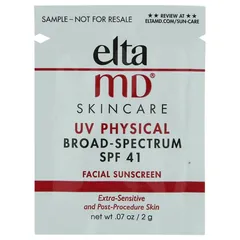
We assess that "EltaMD - UV Physical Broad-Spectrum SPF 41 Sunscreen" can provide reliable sun protection based on the ingredient list. It can protect from both UVA and UVB rays. This is great news because not all sunscreens with SPF ratings give UVA protection. (UVA rays do not cause sunburn, but still damage our skin and lead to early aging).
It should also be hydrating enough to use without an additional moisturizer during the day. Like all broad-spectrum sunscreens, this product helps prevent early signs of aging.
Sunscreen filters
It is a mineral sunscreen. It uses titanium dioxide and zinc oxide for sun protection. Both titanium dioxide and zinc oxide almost never irritate even the most sensitive skin and eyes, but can leave a white cast.
Irritation risk
There are some common irritants in this product, including ingredients that do not have benefits for the skin. We assess the overall irritancy of this sunscreen to be medium. For a detailed overview of all potential irritants: click here
You can see the detailed formula review with the breakdown of all actives in the product and the full ingredient list with estimated concentrations in the tables below.
Price
The product retails for 60.00CA$ in Canada, for 79.99A$ in Australia and from 29.99$ up to 36.50$ in the United States.
For a detailed price comparison: click here.
Anti-aging
What does the product description say?
help diminish the visible signs of aging
Source: Walmart
This product can help prevent early signs of skin aging because it offers a good level of broad spectrum sun protection. Sun damage is the main cause of premature skin aging, and protecting your skin from the sun is the best anti-aging strategy.
Anti-oxidation
This product contains antioxidants (thioctic acid) that can help neutralize free radicals in skin. By doing so, they can lessen the damage the skin gets from the UV light (sun).
The following ingredients - quercetin also can have an antioxidant effect, but there is less evidence to confirm their effectiveness in skin.
Might be able to help neutralize free radicals in skin
Evens skin tone
What does the product description say?
lightly tints your complexion to enhance the skin's radiance
Source: Dermstore
This product offers broad spectrum sun protection. It means that it can prevent hyperpigmentation and help keep the skin tone even (sun damage is the main factor causing age spots, darkening of post-acne marks and other discolorations).
Moisturizing
What does the product description say?
gentle-daily sunscreen that absorbs quickly
Source: Walmart
This product can help soften the skin and reduce its moisture loss with emollients and occlusives: octyldodecyl neopentanoate, isopropyl palmitate.
Keep in mind that this product does not contain effective ingredients to attract water to the upper layer of the skin. This is why an additional product with humectants like glycerin or hyaluronic acid can be helpful (apply it before this product for the best results).
The following ingredients in this product are especially good for supporting the skin barrier and helping with the hydration level: linoleic acid
An excellent emollient. Helps soften the skin, restore its barrier function, and can help to calm down inflammation. It can be helpful to prevent blemishes and clogged pores
An emollient that helps soften the skin. Often used to stabilize other ingredients, for example, sunscreen
Used to create a nice product texture and help delivery of other ingredients. Might be somewhat helpful in attracting water to the upper layer of the skin
Helps soften the upper layer of the skin and create a thicker product consistency
Used mostly for creating emulsions - helping oil and water mix together. Helps soften the upper layer of the skin
Sun protection
What does the product description say?
UV Physical Broad-Spectrum SPF 41 Sunscreen
Source: Walmart
This product offers a good level of protection against both UVB and UVA rays.
It is a mineral sunscreen. In other words, it contains non-organic UV filters. It will probably not sting your eyes but might leave a white cast.
This product can be considered "reef safe" because it does not contain the UV filters (oxybenzone and octinoxate) that can be harmful to coral reefs when present in the water in high concentrations.
Works as a UV filter when used in high concentrations. It is photostable and is effective mostly against the UVB light, with some protection in the UVA range. In small concentrations, used for its ability to improve the color of cosmetic products. Is usually well tolerated by the skin
A broad spectrum sunblock (protects from both UVA and UVB rays). Is suitable for most sensitive skins. In small concentrations, can be used as a colorant
An umbrella term for the following three colorants: CI 77491, CI 77492, CI 77499. They might be able to offer some protection against visible light, but the degree of the protection is not clear
How honest is this product?
| Promise | Can it deliver? |
|---|---|
| Sun protection | |
| Anti-aging | |
| Moisturizing | |
| Evens skin tone |
Total Promises Fulfilled score: 90/100.
We receive a small commission for purchases made through these links at no cost for you. Thank you for your support! Learn more
Potential irritants
Comedogenic ingredients
User reviews (0)
Averages from community submissions.
No reviews yet for this product.
Be the first to share your experience!
Tried this product?
Help capture what the ingredient list can't—texture, finish, pilling, scent, and more. Answer what you can, skip the rest.
Takes ~30 seconds.
Reviews are shown in aggregate. No personal details.
| Product | Similarity | Price | Irritancy |
|---|---|---|---|
 EltaMD UV Physical Broad-Spectrum SPF 41 Sunscreen | Current | $29.99 | |
 Clinique Moisture Surge CC Cream SPF 30 Medium | 56% | $35.00 | |
 Face Reality Skincare powerMineral™ SPF 50 | 54% | $38.00 | |
 coxir Ceramide Daily UV Sun Block | 52% | $18.10 | |
 The Ordinary Mineral UV Filters SPF 30 with Antioxidants | 50% | $6.70 |
Key Actives
An excellent emollient. Helps soften the skin, restore its barrier function, and can help to calm down inflammation. It can be helpful to prevent blemishes and clogged pores
A broad spectrum sunblock (protects from both UVA and UVB rays). Is suitable for most sensitive skins. In small concentrations, can be used as a colorant
Works as a UV filter when used in high concentrations. It is photostable and is effective mostly against the UVB light, with some protection in the UVA range. In small concentrations, used for its ability to improve the color of cosmetic products. Is usually well tolerated by the skin
An emollient that helps soften the skin. Often used to stabilize other ingredients, for example, sunscreen
Might be able to help neutralize free radicals in skin
Potential irritants
Can work as an exfoliant but is typically used to adjust the product pH
Helps soften the upper layer of the skin and create a thicker product consistency
Comedogenic ingredients
Helps soften the upper layer of the skin and create a thicker product consistency
All ingredients
A broad spectrum sunblock (protects from both UVA and UVB rays). Is suitable for most sensitive skins. In small concentrations, can be used as a colorant
Works as a UV filter when used in high concentrations. It is photostable and is effective mostly against the UVB light, with some protection in the UVA range. In small concentrations, used for its ability to improve the color of cosmetic products. Is usually well tolerated by the skin
The same compound that is used safely in dental implants and bone cements. In cosmetics, it is used to improve the consistency of products
Used to create a nice product texture and help delivery of other ingredients. Might be somewhat helpful in attracting water to the upper layer of the skin
Can work as an exfoliant but is typically used to adjust the product pH
An umbrella term for the following three colorants: CI 77491, CI 77492, CI 77499. They might be able to offer some protection against visible light, but the degree of the protection is not clear
Helps soften the upper layer of the skin and create a thicker product consistency
Used mostly for creating emulsions - helping oil and water mix together. Helps soften the upper layer of the skin
An excellent emollient. Helps soften the skin, restore its barrier function, and can help to calm down inflammation. It can be helpful to prevent blemishes and clogged pores
Helps the function of sunscreen and pigment ingredients in the formulation
An emollient that helps soften the skin. Often used to stabilize other ingredients, for example, sunscreen
A preservative. It helps prevent bacterial growth in cosmetic products
Used to create a thicker product consistency and stabilize the product formulation
A type of silicone that helps oil and water mix well together. Helps to disperse other ingredients, e.g. pigments, evenly in a formulation
Ingredient list view
Zinc oxide, Titanium dioxide, Alumina, Butylene glycol, Citric acid, Iodopropynyl butylcarbamate, Iron oxides, Isopropyl palmitate, Lecithin, Linoleic acid, Hydrogen dimethicone, Octyldodecyl neopentanoate, Cetyl stearate, Oleth-3 phosphate, Perfluorononyl dimethicone, Phenoxyethanol, Polyacrylate-13, Polyisobutene, Polysorbate 20, Water, Quercetin, Sodium hydroxide, Thioctic acid, Triethoxycaprylylsilane
- A review of inorganic UV filters zinc oxide and titanium dioxide
- Risk assessment of zinc oxide, a cosmetic ingredient used as a UV filter of sunscreens
- Characterization of the UVA protection provided by avobenzone, zinc oxide, and titanium dioxide in broad-spectrum sunscreen products
- Ultraviolet Protection Properties of Commercial Sunscreens and Sunscreens Containing Zno Nanorods
- ZnO nanoparticles and organic chemical UV-filters are equally well tolerated by human immune cells
- Safety Assessment of Alumina and Aluminum Hydroxide as Used in Cosmetics
- Safety Assessment of Iodopropynyl Butylcarbamate as Used in Cosmetics
- Final Report on the Safety Assessment of Isopropyl Isostearate
- The Permeability Barrier in Essential Fatty Acid Deficiency: Evidence for a Direct Role for Linoleic Acid in Barrier Function
- Digital image analysis of the effect of topically applied linoleic acid on acne microcomedones.
- Amended Safety Assessment of Alkyl Esters as Used in Cosmetics
- Sensitization to oleth-3-phosphate and oleth-5 in a hair wax
- Final report of the cosmetic ingredient review expert panel on the safety assessment of Polyisobutene and Hydrogenated Polyisobutene as used in cosmetics