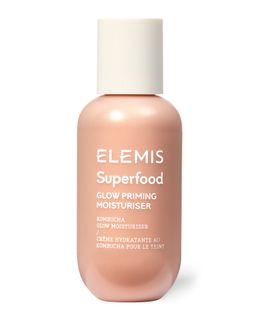
ELEMIS Superfood Glow Priming Moisturiser
Works for
1 of 3 advertised claims delivered
Moisturizing17 ingredients credited for this claimGood support
“Superfood Glow Priming Moisturiser”
This product can help improve hydration of the skin with the two types of ingredients.
The first type is called “humectants”:
these ingredients help attract water.
When humectants are on the surface of the skin, they “pull in” the moisture from the outside environment, or from
within deeper layers of the skin. The following ingredients in this product do the job:
glycerin, caprylyl glycol.
This product also contains ingredients called “occlusives”. They help reduce the speed with which our skin loses moisture to the outside environment. These ingredients also help soften the upper layer of the skin, so it feels less tight and nicer to the touch. The following ingredients in this product do the job: caprylic/capric triglyceride, cetearyl alcohol.
Evens skin tone1 ingredient credited for this claimWeak support
“Rich in vitamins and organic acids, Kombucha has been shown to reveal a more glowing complexion.”
Effective ingredients missing or their concentration is too low
Anti-aging2 ingredients credited for this claimWeak support
“Hydrate and prime skin with the Elemis Superfood Glow and Priming Moisturiser, a sheer, prebiotic moisturising cream that helps to reveal a smooth and radiant complexion.Enriched with a powerhouse duo of kombucha and fermented ginger, the moisturiser works to brighten and flood skin with nourishing hydration, and targets the appearance of enlarged pores, wrinkles and imperfections.”
Effective ingredients missing or their concentration is too low.
Can it cause trouble?
Irritancy6 strong irritants: Parfum, Linalool + 4 more — patch-test recommendedHigh risk
Comedogenic3 ingredients rated 2 or more on the 0–5 pore-clogging scale3 flagged
User reviews
Be the first — your take helps the next person decide.
Ingredients
Filter by role to see what each ingredient is doing.
Water~45–55%
Dicaprylyl carbonate~4.3–5.2%
- Irritation risk
- Low
Helps products spread more easily and works as an emollient to soften skin
More about Dicaprylyl carbonateCetearyl alcohol~3.7–4.5%
- Irritation risk
- Low
- Comedogenicity
- 2/5
A non-drying alcohol. Works as an emollient. Helps water and oil mix together and creates a nice product texture
More about Cetearyl alcoholGlycerin~3.1–3.8%
- Irritation risk
- Low
One of the best moisturizing ingredients. Naturally present in skin. It attracts water to the upper layer of the skin working as a humectant
More about GlycerinCaprylic/capric triglyceride~2.5–3%
- Irritation risk
- Medium
A good mix of fatty acids that forms a protective layer on the skin. Improves the shelf life of products. Derived from coconut and glycerin
More about Caprylic/capric triglycerideGlyceryl stearate se~1.9–2.4%
- Irritation risk
- Low
- Comedogenicity
- 2/5
Used to stabilize the product formulations and works as an emollient
More about Glyceryl stearate seOctyldodecanol~1.6–1.9%
- Irritation risk
- Low
An emollient that helps to soften the skin and create a pleasant product texture and stabilize the formulation
More about OctyldodecanolOlus oil~1.5–1.8%
- Irritation risk
- Low
An oil from a mixture of different vegetables. Helps soften the upper layer of the skin
More about Olus oilVegetable oil~1.2–1.5%
- Irritation risk
- Low
An oil from a mixture of different vegetables. Helps soften the upper layer of the skin
More about Vegetable oilCaprylyl glycol~0.95–1.2%
- Irritation risk
- Medium
Helps preserve products and creates a nice product texture
More about Caprylyl glycolMica~0.8–1.2%
- Irritation risk
- Low
Creates an illusion of smoother and more radiant skin tone. Adds shimmer to the skin by reflecting light
More about MicaPropylene glycol~0.55–0.8%
- Irritation risk
- High
Helps oil and water mix together and can enhance the penetration of other ingredients into the skin. It can be irritating
More about Propylene glycolCetyl palmitate~0.55–0.8%
- Irritation risk
- Low
An emollient that helps soften the skin and is used to improve product texture and stability
More about Cetyl palmitatePhenoxyethanol~0.45–0.65%
- Irritation risk
- Low
A preservative. It helps prevent bacterial growth in cosmetic products
More about PhenoxyethanolPolyacrylate-13~0.45–0.65%
- Irritation risk
- Low
Used to create a thicker product consistency and stabilize the product formulation
More about Polyacrylate-13Sorbitan palmitate~0.4–0.6%
- Irritation risk
- Medium
Helps water and oil mix together and stabilize the product formulation
More about Sorbitan palmitateTocopherol~0.35–0.65%
- Irritation risk
- Low
Pure form of vitamin E. Can help moisturise and protect the skin from free radicals. Often used to help stabilise other ingredients or the formula itself
More about TocopherolAlpha-glucan oligosaccharide~0.35–0.65%
- Irritation risk
- Low
Helps attract water to the upper layer of the skin
More about Alpha-glucan oligosaccharideParfum~0.25–0.5%
- Irritation risk
- High
An aromatic blend of unspecified and possibly irritating ingredients
More about ParfumPolyisobutene~0.3–0.55%
Disodium edta~0.25–0.45%
Xanthan gum~0.25–0.45%
- Irritation risk
- Low
Used to create a thicker product consistency
More about Xanthan gumSynthetic fluorphlogopite~0.2–0.4%
- Irritation risk
- Low
A mineral that is used as an optical filter (makes the skin looks nicer through light reflection) and to improve the texture of cosmetic products
More about Synthetic fluorphlogopiteSorbitan oleate~0.2–0.4%
- Irritation risk
- Medium
- Comedogenicity
- 2/5
Helps oil and water mix together
More about Sorbitan oleateSaccharomyces/xylinum/black tea ferment~0.2–0.35%
- Irritation risk
- Low
A fermented sweet black tea. There is no studies on particular benefits of this ingredient in skin. It can help attract water to the upper layer of the skin, and might have some anti-oxidant effect. It is used in skincare for mostly marketing purposes because of the popularity of kombucha drinks
More about Saccharomyces/xylinum/black tea fermentCamellia sinensis seed oil~0.2–0.4%
- Irritation risk
- Low
A plant oil that helps to soften the upper layer of the skin and can help restore the skin barrier. Might have some anti-oxidant effect
More about Camellia sinensis seed oilCandida bombicola/glucose/methyl rapeseedate ferment~0.25–0.5%
- Irritation risk
- Low
Helps water and oil mix together and preserve the product formulation
More about Candida bombicola/glucose/methyl rapeseedate fermentPolysorbate 20~0.2–0.4%
Sorbitan isostearate~0.2–0.4%
- Irritation risk
- Low
Helps oil and water mix together
More about Sorbitan isostearate1,2-hexanediol~0.2–0.35%
Tin oxide~0.3–0.5%
- Irritation risk
- Low
A colorant that can add a pearl-like appearance to the formulation
More about Tin oxideLinalool~0.15–0.3%
Limonene~0.15–0.3%
- Irritation risk
- High
A common frangrance that can easily irritate skin, especially if exposed to air, light or heat
More about LimoneneLactobacillus~0.2–0.35%
- Irritation risk
- Low
A non-living ingredient made by fermentation with the bacteria Lactobacillus. It can help attract water to the upper layer of the skin and might help reduce inflammation
More about LactobacillusZingiber officinale root extract~0.15–0.25%
- Irritation risk
- High
A plant extract that can contain an irritating essential oil. Might have some anti-oxidant effect, but evidence is lacking
More about Zingiber officinale root extractGeraniol~0.15–0.3%
Hydroxyethyl ethylcellulose~0.2–0.4%
- Irritation risk
- Medium
Helps water and oil mix together
More about Hydroxyethyl ethylcelluloseCitronellol~0.15–0.3%
Sodium hydroxide~0.2–0.35%
Sodium citrate~0.2–0.35%
- Irritation risk
- Medium
Helps to control the skin's pH level. Maintains the skin's natural film of amino-lactic acids and oils. Helps to preserve products
More about Sodium citrateCitric acid~0.15–0.3%
- Irritation risk
- Medium
Can work as an exfoliant but is typically used to adjust the product pH
More about Citric acidPotassium sorbate~0.15–0.3%
Ribes nigrum bud oil~0.15–0.3%
- Irritation risk
- Low
Biotin~0.15–0.3%
- Irritation risk
- Low
Might have some moisturising properties. Is not effective when applied topically beyond some moisturizing effect
More about BiotinCi 77891~0.15–0.3%
- Irritation risk
- Low
Titanium dioxide~0.15–0.3%
- Irritation risk
- Low
Works as a UV filter when used in high concentrations. It is photostable and is effective mostly against the UVB light, with some protection in the UVA range. In small concentrations, used for its ability to improve the color of cosmetic products. Is usually well tolerated by the skin
More about Titanium dioxideCi 77491~0.1–0.2%
- Irritation risk
- Low
A red colorant made of iron oxide. Typically is not irritating
More about Ci 77491Iron oxides~0.1–0.15%
- Irritation risk
- Low
An umbrella term for the following three colorants: CI 77491, CI 77492, CI 77499. They might be able to offer some protection against visible light, but the degree of the protection is not clear
More about Iron oxidesIngredient list view
Water, Dicaprylyl carbonate, Cetearyl alcohol, Glycerin, Caprylic/capric triglyceride, Glyceryl stearate se, Octyldodecanol, Olus oil, Vegetable oil, Caprylyl glycol, Mica, Propylene glycol, Cetyl palmitate, Phenoxyethanol, Polyacrylate-13, Sorbitan palmitate, Tocopherol, Alpha-glucan oligosaccharide, Parfum, Polyisobutene, Disodium edta, Xanthan gum, Synthetic fluorphlogopite, Sorbitan oleate, Saccharomyces/xylinum/black tea ferment, Camellia sinensis seed oil, Candida bombicola/glucose/methyl rapeseedate ferment, Polysorbate 20, Sorbitan isostearate, 1,2-hexanediol, Tin oxide, Linalool, Limonene, Lactobacillus, Zingiber officinale root extract, Geraniol, Hydroxyethyl ethylcellulose, Citronellol, Sodium hydroxide, Sodium citrate, Citric acid, Potassium sorbate, Ribes nigrum bud oil, Biotin, Ci 77891, Titanium dioxide, Ci 77491, Iron oxides
Compare prices
Retailers ranked by price — lowest first.


Sources cited in this review
Every concentration estimate and effectiveness label is anchored to one of these 12 studies and safety reviews.
- 1
- 2Surfactants and experimental irritant contact dermatitisncbi.nlm.nih.gov
- 3Propylene Glycolpubmed.ncbi.nlm.nih.gov
- 4Skin-sensitizing and irritant properties of propylene glycolonlinelibrary.wiley.com
- 5Vitamin E in dermatologyncbi.nlm.nih.gov
- 6Vitamin E and Skin Healthlpi.oregonstate.edu

Affiliate links · As an Amazon Associate, WIMJ earns from qualifying purchases.