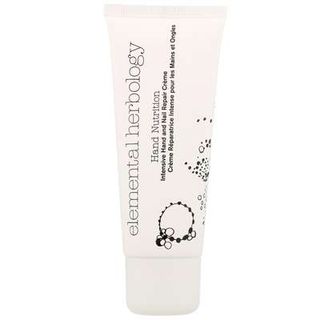
Elemental Herbology Body Moisturisers Hand Nutrition Intensive Hand & Nail Repair Cream
Works for
1 of 2 advertised claims delivered
Moisturizing18 ingredients credited for this claimGood support
“Body Moisturisers Hand Nutrition Intensive Hand & Nail Repair Cream”
This product can help improve hydration of the skin with the two types of ingredients.
The first type is called “humectants”:
these ingredients help attract water.
When humectants are on the surface of the skin, they “pull in” the moisture from the outside environment, or from
within deeper layers of the skin. The following ingredients in this product do the job:
anhydroxylitol, arginine.
This product also contains ingredients called “occlusives”. They help reduce the speed with which our skin loses moisture to the outside environment. These ingredients also help soften the upper layer of the skin, so it feels less tight and nicer to the touch. The following ingredients in this product do the job: arginine, myristyl myristate.
Anti-aging2 ingredients credited for this claimLimited support
“A botanical extract from peas helps to reduce the degradation of skin proteins such as collagen and elastin which are responsible for giving skin its firmness and elasticity.”
This product does not contain ingredients that are able to reduce fine lines and wrinkles or help with skin elasticity, but it can improve the look of the skin temporarily through moisturization. Well-moisturized skin might also be able to repair the sun damage better.This ingredient - thermus thermophillus ferment - could be helpful for preventing or repairing signs of aging in theory, but there is no evidence that it actually works.
Can it cause trouble?
Irritancy14 strong irritants: Linalool, Santalum album oil + 12 more — patch-test recommendedHigh risk
Comedogenic4 ingredients rated 2 or more on the 0–5 pore-clogging scale4 flagged

User reviews
Be the first — your take helps the next person decide.
Ingredients
Filter by role to see what each ingredient is doing.
Water~45–55%
Cetearyl alcohol~4.9–5.9%
- Irritation risk
- Low
- Comedogenicity
- 2/5
A non-drying alcohol. Works as an emollient. Helps water and oil mix together and creates a nice product texture
More about Cetearyl alcoholCetearyl ethylhexanoate~4.4–5.3%
- Irritation risk
- Low
An emollient that helps soften the skin
More about Cetearyl ethylhexanoateMyristyl myristate~3.2–3.9%
- Irritation risk
- Medium
- Comedogenicity
- 3/5
An emollient. Is not recommended for acne-prone skin as it can be comedogenic
More about Myristyl myristateHydrogenated apricot kernel oil~2.3–2.8%
- Irritation risk
- Low
Glycerin~2–2.5%
- Irritation risk
- Low
One of the best moisturizing ingredients. Naturally present in skin. It attracts water to the upper layer of the skin working as a humectant
More about GlycerinPentaclethra macroloba seed oil~1.7–2.1%
- Irritation risk
- Low
A plant oil that can help soften the upper layer of the skin. It mostly contains oleic acid that according to some studies can increase transepidermal water loss, but might have an anti-inflammatory effect
More about Pentaclethra macroloba seed oilPlukenetia volubilis seed oil~1.5–1.8%
- Irritation risk
- Low
A plant oil that works as a good moisturizer by softening the upper layer of the skin. Might be helpful in reducing inflammation in skin and reducing blemishes due to the large content of linoleic acid
More about Plukenetia volubilis seed oilCetearyl olivate~1.1–1.4%
Octyldodecanol~0.9–1.1%
- Irritation risk
- Low
An emollient that helps to soften the skin and create a pleasant product texture and stabilize the formulation
More about OctyldodecanolCetearyl glucoside~0.65–0.95%
- Irritation risk
- Medium
Helps water and oil in the product mix well together and improves product texture
More about Cetearyl glucosideCoco-caprylate/caprate~0.55–0.85%
- Irritation risk
- Low
Helps to soften the upper layer of the skin without creating a greasy texture
More about Coco-caprylate/caprateSorbitan olivate~0.5–0.7%
Caprylic/capric triglyceride~0.5–0.75%
- Irritation risk
- Medium
A good mix of fatty acids that forms a protective layer on the skin. Improves the shelf life of products. Derived from coconut and glycerin
More about Caprylic/capric triglycerideXylitylglucoside~0.35–0.65%
- Irritation risk
- Low
Helps attract water to the upper layer of the skin and repair the skin barrier function
More about XylitylglucosideBenzyl alcohol~0.3–0.6%
- Irritation risk
- High
A preservative. Can be used to mask unpleasant smell. Can be irritating
More about Benzyl alcoholHydrolyzed keratin~0.35–0.6%
- Irritation risk
- Low
Argania spinosa kernel oil~0.3–0.6%
- Irritation risk
- Medium
An emollient that helps soften the upper layer of the skin. Might have some weak anti-oxidant properties
More about Argania spinosa kernel oilIsostearyl isostearate~0.3–0.55%
- Irritation risk
- Medium
- Comedogenicity
- 3/5
Helps soften the upper layer of the skin and improve the product texture. It can be comedogenic
More about Isostearyl isostearateMacadamia ternifolia seed oil~0.3–0.55%
- Irritation risk
- Medium
Plant oil from nuts that helps soften the upper layer of the skin. Contains a high concentration of oleic acid that can weaken skin's barrier function and increase water-loss while enhancing penetration of other ingredients
More about Macadamia ternifolia seed oilRosa canina fruit oil~0.25–0.5%
- Irritation risk
- Medium
A great emollient. Contains vitamin E (tocopherol) which may give it some anti-oxidant properties. Can contain volatile compounds and can be irritating
More about Rosa canina fruit oilSorbitan stearate~0.25–0.45%
Thermus thermophillus ferment~0.2–0.4%
- Irritation risk
- Medium
Might be helpful in neutralising free radicals in skin and have some hydration properties
More about Thermus thermophillus fermentAnhydroxylitol~0.2–0.4%
- Irritation risk
- Low
Helps attract water to the upper layer of the skin and repair the skin barrir function
More about AnhydroxylitolXanthan gum~0.25–0.4%
- Irritation risk
- Low
Used to create a thicker product consistency
More about Xanthan gumArginine~0.2–0.35%
- Irritation risk
- Low
An amino acid that is naturally present in skin and helps keep it hydrated. When used together with AHAs, it can reduce their irritating effect on the skin
More about ArginineXylitol~0.2–0.35%
- Irritation risk
- Low
Helps attract water to the upper layer of the skin and repair the skin barrier function
More about XylitolLinalool~0.2–0.35%
Tocopherol~0.2–0.4%
- Irritation risk
- Low
Pure form of vitamin E. Can help moisturise and protect the skin from free radicals. Often used to help stabilise other ingredients or the formula itself
More about TocopherolCarbomer~0.2–0.4%
- Irritation risk
- Low
Helps create a thicker or gel-like product texture. It is not a surfactant but can be used in gentle cleansing formulations
More about CarbomerSantalum album oil~0.25–0.4%
Citronellol~0.2–0.4%
Caprylhydroxamic acid~0.2–0.4%
Lavandula angustifolia oil~0.2–0.4%
- Irritation risk
- High
An essential oil. Potential allergen and can be irritating. It has some anti-bacterial properties
More about Lavandula angustifolia oilLimonene~0.2–0.4%
- Irritation risk
- High
A common frangrance that can easily irritate skin, especially if exposed to air, light or heat
More about LimoneneInulin lauryl carbamate~0.25–0.45%
Phenoxyethanol~0.25–0.45%
- Irritation risk
- Low
A preservative. It helps prevent bacterial growth in cosmetic products
More about PhenoxyethanolPelargonium graveolens flower oil~0.25–0.45%
- Irritation risk
- High
An essential oil. Can be irritating. Can become an allergen with oxidation
More about Pelargonium graveolens flower oilPogostemon cablin oil~0.2–0.35%
- Irritation risk
- Low
Potassium sorbate~0.25–0.45%
Geraniol~0.2–0.4%
Sucrose dilaurate~0.25–0.5%
- Irritation risk
- Medium
Helps oil and water mix together. Can be used as a cleansing agent
More about Sucrose dilaurateBoswellia carterii oil~0.2–0.4%
Rosa damascena flower oil~0.2–0.4%
- Irritation risk
- High
Used as a fragrance. Can be irritating
More about Rosa damascena flower oilPolysorbate 20~0.25–0.45%
Chlorella vulgaris/lupinus albus protein ferment~0.2–0.4%
- Irritation risk
- Low
- Comedogenicity
- 2/5
Pisum sativum extract~0.25–0.4%
- Irritation risk
- Medium
Might be helpful in protecting skin collagen and elastin from breaking down but solid research is lacking
More about Pisum sativum extractRosa damascena extract~0.2–0.4%
- Irritation risk
- High
Oil of a very fragrant pink rose used as fragrance in cosmetics. Extensive research has shown it has mixed benefits. In the pro column, inhaling this flower’s scent seems to have relaxing properties and the plant’s petals contain skin-soothing and antioxidant compounds that can benefit skin. On the flipside, the numerous chemicals that create this rose’s distinctive fragrance pose a risk of causing skin aggravation.
More about Rosa damascena extractSodium benzoate~0.2–0.4%
Citral~0.2–0.35%
Citrus aurantium dulcis peel oil~0.2–0.4%
- Irritation risk
- High
An essentil oil from orange peel. Potential allergen and can be irritating
More about Citrus aurantium dulcis peel oilEugenol~0.15–0.3%
Pectin~0.15–0.3%
- Irritation risk
- Low
Farnesol~0.15–0.25%
Diacetyl boldine~0.1–0.15%
- Irritation risk
- Low
Ingredient list view
Water, Cetearyl alcohol, Cetearyl ethylhexanoate, Myristyl myristate, Hydrogenated apricot kernel oil, Glycerin, Pentaclethra macroloba seed oil, Plukenetia volubilis seed oil, Cetearyl olivate, Octyldodecanol, Cetearyl glucoside, Coco-caprylate/caprate, Sorbitan olivate, Caprylic/capric triglyceride, Xylitylglucoside, Benzyl alcohol, Hydrolyzed keratin, Argania spinosa kernel oil, Isostearyl isostearate, Macadamia ternifolia seed oil, Rosa canina fruit oil, Sorbitan stearate, Thermus thermophillus ferment, Anhydroxylitol, Xanthan gum, Arginine, Xylitol, Linalool, Tocopherol, Carbomer, Unknown, Santalum album oil, Citronellol, Caprylhydroxamic acid, Lavandula angustifolia oil, Limonene, Inulin lauryl carbamate, Phenoxyethanol, Pelargonium graveolens flower oil, Pogostemon cablin oil, Potassium sorbate, Geraniol, Sucrose dilaurate, Boswellia carterii oil, Rosa damascena flower oil, Polysorbate 20, Chlorella vulgaris/lupinus albus protein ferment, Pisum sativum extract, Rosa damascena extract, Sodium benzoate, Citral, Citrus aurantium dulcis peel oil, Eugenol, Pectin, Farnesol, Diacetyl boldine
Compare prices
Retailers ranked by price — lowest first.
Worth comparing, line by line.
Match % combines shared ingredients, the first five ingredients, shared actives and hero ingredients, irritancy (lower counts in the alternative's favour), texture and body area. Only products in the same routine step are compared.
| Elemental HerbologyBody Moisturisers Hand Nutrition Intensive Hand & Nail Repair CreamYOUR PRODUCT | BeautyBioThe Sculptor Skin Firming Body Cream | Augustinus BaderThe Body Cream with TFC8 Moisturizer | VENN SkincareVENN Probiotic-Tensive Hydro Firming Body Cream | |
|---|---|---|---|---|
| Match | — | 58% | 56% | 54% |
| Price | $44.95 | $60.00+$15.05 | $180.00+$135.05 | $122.95+$78.00 |
| Shared key ingredients | — | 5 of 11 | 6 of 11 | 5 of 11 |
| Key difference | — | Panthenol | Ceramide Ng | Pitera |
| Irritancy | High | High | Medium | Medium |
| Drying alcohol | — | Contains drying alcohol | Contains drying alcohol | — |
| View product | Shop | Shop | Shop |

Sources cited in this review
Every concentration estimate and effectiveness label is anchored to one of these 10 studies and safety reviews.
- 1
- 2
- 3
- 4Safety Assessment of Alkyl Esters as Used in Cosmeticscir-safety.org
- 5
- 6

Affiliate links · As an Amazon Associate, WIMJ earns from qualifying purchases.