Works for
1 of 1 advertised claim delivered
Moisturizing9 ingredients credited for this claimStrong support
“Use Edwin Jagger lotion after shaving to nourish, moisturise and revitalise the skin.”
This product can help improve hydration of the skin with the two types of ingredients.
The first type is called “humectants”:
these ingredients help attract water.
When humectants are on the surface of the skin, they “pull in” the moisture from the outside environment, or from
within deeper layers of the skin. The following ingredients in this product do the job:
galactoarabinan, glycerin.
This product also contains ingredients called “occlusives”. They help reduce the speed with which our skin loses moisture to the outside environment. These ingredients also help soften the upper layer of the skin, so it feels less tight and nicer to the touch. The following ingredients in this product do the job: glycine soja oil, cetearyl alcohol.
The following ingredients in this product are especially good for supporting the skin barrier and helping with the hydration level: panthenol
Can it cause trouble?
Irritancy10 strong irritants: Alcohol, Calendula officinalis flower extract + 8 more — patch-test recommendedHigh risk
Comedogenic2 ingredients rated 2 or more on the 0–5 pore-clogging scale2 flagged

User reviews
Be the first — your take helps the next person decide.
Ingredients
Filter by role to see what each ingredient is doing.
Water~40–60%
Glycine soja oil~4.6–6.9%
- Irritation risk
- Medium
- Comedogenicity
- 2/5
A good emollient that helps soften the skin and helps repair its barrier function. It can clog pores if used in high concentrations.
More about Glycine soja oilAlcohol~3.5–5.3%
- Irritation risk
- High
Can be drying and contribute to skin irritation. Used in formulars to dissolve other ingredients, create a thinner product consistency or for its antibacterial properties
More about AlcoholGlycerin~2.5–3.8%
- Irritation risk
- Low
One of the best moisturizing ingredients. Naturally present in skin. It attracts water to the upper layer of the skin working as a humectant
More about GlycerinAloe barbadensis extract~2–3%
- Irritation risk
- Medium
Traditionally used to treat sunburns, dermatitis and inflammation, but evidence for its effectiveness is lacking. The extract can contain humectants that help attract water into the skin
More about Aloe barbadensis extractGlyceryl stearate citrate~1.7–2.5%
- Irritation risk
- Low
Helps oil and water mix together while softening the upper layer of the skin
More about Glyceryl stearate citrateCetearyl alcohol~1.4–2.1%
- Irritation risk
- Low
- Comedogenicity
- 2/5
A non-drying alcohol. Works as an emollient. Helps water and oil mix together and creates a nice product texture
More about Cetearyl alcoholCalendula officinalis flower extract~1.1–1.7%
- Irritation risk
- High
A plant extract that has some anti-oxidant and anti-bacterial properties. Can be irritating
More about Calendula officinalis flower extractPanthenol~0.95–1.45%
- Irritation risk
- Low
Helps attract water to the upper layer of the skin and can help improve skin barrier function
More about PanthenolTocopherol~0.6–1.35%
- Irritation risk
- Low
Pure form of vitamin E. Can help moisturise and protect the skin from free radicals. Often used to help stabilise other ingredients or the formula itself
More about TocopherolBisabolol~0.4–0.95%
- Irritation risk
- Low
An active component of chamomile plant that historically has been used to calm down irritated skin. A recent study shows that bisabolol indeed can have some anti-inflammatory effect on skin, even though conclusive data is lacking. Bisabolol has a sweet floral scent and can be added to products for its aromatic properties
More about BisabololPersea gratissima oil unsaponifiables~0.4–0.9%
- Irritation risk
- Low
Helps soften the upper layer of the skin
More about Persea gratissima oil unsaponifiablesSucrose stearate~0.3–0.75%
Echinacea angustifolia leaf extract~0.15–0.6%
- Irritation risk
- Low
Hamamelis virginiana extract~0.15–0.55%
- Irritation risk
- High
A plant extract that can help calm down inflammation in skin. Can, however, itself be irritating
More about Hamamelis virginiana extractGalactoarabinan~0.15–0.55%
- Irritation risk
- Medium
Helps attract water to the upper layer of the skin
More about GalactoarabinanRosmarinus officinalis extract~0.15–0.5%
- Irritation risk
- High
Xanthan gum~0.15–0.55%
- Irritation risk
- Low
Used to create a thicker product consistency
More about Xanthan gumParfum~0.1–0.35%
- Irritation risk
- High
An aromatic blend of unspecified and possibly irritating ingredients
More about ParfumMenthol~0.05–0.3%
- Irritation risk
- High
Citronellol~0.05–0.25%
Coumarin~0.05–0.2%
Geraniol~0.05–0.15%
Linalool~0.05–0.1%
Ingredient list view
Water, Glycine soja oil, Alcohol, Glycerin, Aloe barbadensis extract, Unknown, Glyceryl stearate citrate, Cetearyl alcohol, Calendula officinalis flower extract, Panthenol, Tocopherol, Bisabolol, Persea gratissima oil unsaponifiables, Sucrose stearate, Echinacea angustifolia leaf extract, Hamamelis virginiana extract, Galactoarabinan, Rosmarinus officinalis extract, Xanthan gum, Parfum, Menthol, Citronellol, Coumarin, Geraniol, Linalool
Compare prices
Retailers ranked by price — lowest first.
.png)
Worth comparing, line by line.
Match % combines shared ingredients, the first five ingredients, shared actives and hero ingredients, irritancy (lower counts in the alternative's favour), texture and body area. Only products in the same routine step are compared.
| Edwin JaggerAloe Vera AftershaveYOUR PRODUCT | SpeickAftershave Balm - Sensitive | |
|---|---|---|
| Match | — | 51% |
| Price | $34.00 | $17.45−$16.55 |
| Shared key ingredients | — | 6 of 8 |
| Key difference | — | Caprylic/Capric Triglyceride |
| Irritancy | High | High |
| Drying alcohol | Contains drying alcohol | Contains drying alcohol |
| View product | Shop |
Product summary
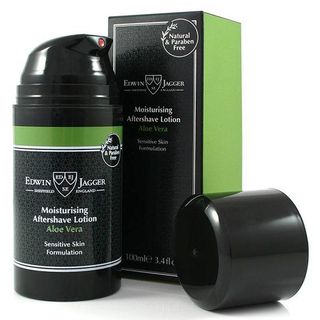
"Edwin Jagger - Aloe Vera Aftershave" is a well-rounded moisturizing product. This moisturizer uses a good combo of humectants and emollients. These both types of ingredients are essentials for improving the skin hydration and keeping the skin barrier healthy. Humectants in this product (panthenol, galactoarabinan, glycerin and aloe barbadensis extract) help to increase the water content in the upper layer of the skin. (These ingredients do so by "capturing" water molecules from the outside air or from within the deeper layers of the skin). Emollients in this formulation (glycine soja oil, cetearyl alcohol and glyceryl stearate citrate) help to reduce the moisture loss from the skin. They also soften the skin surface and relieve the feeling of dryness and tightness.
Ingredient callouts
- This formulation also uses an effective concentration of panthenol (pro-vitamin B5) - about 0.95% - 1.45%. Panthenol helps strengthen the skin barrier, improve hydration and reduce inflammation in skin.
Irritation risk
There are quite a few common irritants in this product, including ingredients without particular skin benefits. We would not recommend it for sensitive skin. We assess the overall irritancy of this moisturizer to be high. For a detailed overview of all potential irritants: click here
You can see the detailed formula review with the breakdown of all actives in the product and the full ingredient list with estimated concentrations in the tables below.
Price
The product retails for 23.00£ in the United Kingdom and for 34.00$ in the United States.
For a detailed price comparison: click here.
Sources cited in this review
Every concentration estimate and effectiveness label is anchored to one of these 14 studies and safety reviews.
- 1
- 2
- 3
- 4
- 5
- 6Skin moisturizing effects of panthenol-based formulationspdfs.semanticscholar.org

Affiliate links · As an Amazon Associate, WIMJ earns from qualifying purchases.