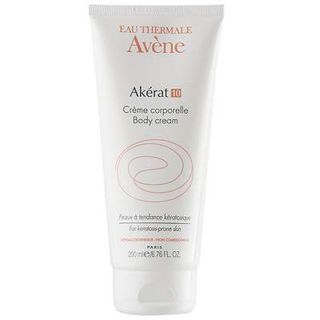
Eau Thermale Avene Body Akerat 10: Body Cream
Works for
1 of 3 advertised claims delivered
MoisturizingParaffinum liquidum, Urea + 3 moreStrong evidence
“Body Cream”
This product can help improve hydration of the skin with the two types of ingredients.
The first type is called “humectants”:
these ingredients help attract water.
When humectants are on the surface of the skin, they “pull in” the moisture from the outside environment, or from
within deeper layers of the skin. The following ingredients in this product do the job:
urea.
This product also contains ingredients called “occlusives”. They help reduce the speed with which our skin loses moisture to the outside environment. These ingredients also help soften the upper layer of the skin, so it feels less tight and nicer to the touch. The following ingredients in this product do the job: paraffinum liquidum, prunus amygdalus dulcis oil.
The following ingredients in this product are especially good for supporting the skin barrier and helping with the hydration level: paraffinum liquidum, urea
Anti-agingPrunus amygdalus dulcis oil, Lactic acidLimited evidence
“very sensitive skin, dehydrated, oily and blemish-prone, anti-ageing, sun-protection, dull skin, dry skin, redness-prone, and itchy skin.”
This product does not contain ingredients that are able to reduce fine lines and wrinkles or help with skin elasticity, but it can improve the look of the skin temporarily through moisturization. Well-moisturized skin might also be able to repair the sun damage better.
ExfoliationUrea, Lactic acid + 1 moreLimited evidence
“Urea, Salicylic Acid and Lastic Acid, this gentle body lotion nourishes, exfoliates, and retexturises skin.”
This product might help exfoliate the skin with urea, but This ingredient is not the most effective.
Can it cause trouble?
Irritancy8 flagged ingredientsLow risk
ComedogenicClean of flagged comedogenic ingredientsNone flagged


User reviews
Be the first — your take helps the next person decide.
Ingredients
Filter by role to see what each ingredient is doing.
Water~40–60%
Paraffinum liquidum~6.8–10.3%
- Irritation risk
- Low
Mineral oil. One of the most effective and well studied occlusive and emollient moisturizing ingredients. Helps reduce moisture loss in skin and repair skin barrier function
More about Paraffinum liquidumPropylene glycol~4.1–6.2%
- Irritation risk
- High
Helps oil and water mix together and can enhance the penetration of other ingredients into the skin. It can be irritating
More about Propylene glycolUrea~3–4.5%
- Irritation risk
- Low
Naturally present in skin (urea makes up about 7% of natural moisturizing factors in skin). Attracts water to the upper layer of the skin. Also has a positive effect on the skin barrier beyond the humectant action. Can enhance penetration of other ingredients. Is an exfoliating ingredient when used in high concentrations
More about UreaTriethanolamine~2.3–3.4%
- Irritation risk
- Medium
Used to adjust pH of the product and can help improve the product's smell
More about TriethanolamineMethyl glucose sesquistearate~1.9–2.9%
- Irritation risk
- Medium
Helps water and oil mix together
More about Methyl glucose sesquistearatePrunus amygdalus dulcis seed~1.4–2.1%
- Irritation risk
- Low
Helps soften the upper layer of the skin
More about Prunus amygdalus dulcis seedPrunus amygdalus dulcis oil~1.2–1.8%
- Irritation risk
- Low
An emollient that softens the skin
More about Prunus amygdalus dulcis oilPeg-20 methyl glucose sesquistearate~0.85–1.3%
- Irritation risk
- Medium
Helps oil and water mix together
More about Peg-20 methyl glucose sesquistearateSalicylic acid~0.45–1%
- Irritation risk
- High
Used for skin exfoliation. It has an anti-inflammatory and anti-bacterial effect, helps to unclog pores, prevent blemishes and speed up healing of the existing ones. Sometimes referred to as a BHA (beta-hydroxy acid)
More about Salicylic acidCarbomer~0.35–0.8%
- Irritation risk
- Low
Helps create a thicker or gel-like product texture. It is not a surfactant but can be used in gentle cleansing formulations
More about CarbomerLactic acid~0.2–0.7%
- Irritation risk
- Medium
An exfoliating and moisturizing alpha-hydroxy acid (AHA). Typically causes less irritation than other AHAs, for example, glycolic acid. At high concentrations (about 15%), lactic acid can help reduce lines and wrinkles. Recent studies show that lactic acid can support the "good" bacteria living on skin's surface (healthy skin microbiome)
More about Lactic acidPhenoxyethanol~0.1–0.5%
- Irritation risk
- Low
A preservative. It helps prevent bacterial growth in cosmetic products
More about PhenoxyethanolEthylene brassylate~0.05–0.3%
Tocopheryl acetate~0.05–0.3%
- Irritation risk
- Medium
A more stable but less bio-available form of vitamin E compared to Tocopherol. Might help moisturize and protect the skin from free radicals, but mostly used in low concentrations to stabilize other ingredients.
More about Tocopheryl acetateIngredient list view
Water, Paraffinum liquidum, Propylene glycol, Urea, Triethanolamine, Methyl glucose sesquistearate, Prunus amygdalus dulcis seed, Prunus amygdalus dulcis oil, Peg-20 methyl glucose sesquistearate, Salicylic acid, Carbomer, Lactic acid, Phenoxyethanol, Ethylene brassylate, Tocopheryl acetate
Compare prices
Retailers ranked by price — lowest first.
Worth comparing, line by line.
Match % combines shared ingredients, the first five ingredients, shared actives and hero ingredients, irritancy (lower counts in the alternative's favour), texture and body area. Only products in the same routine step are compared.
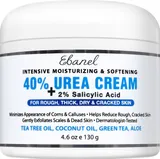
| Eau Thermale AveneBody Akerat 10: Body CreamYOUR PRODUCT | AvèneAkérat Body Cream | SVRXERIAL 30 Body Cream | Ebanel40% Urea Cream + 2% Salicylic Acid | |
|---|---|---|---|---|
| Match | — | 100% | 91% | 83% |
| Price | — | $14.71 | $23.39 | $15.95 |
| Shared key ingredients | — | 4 of 4 | 3 of 4 | 3 of 4 |
| Key difference | — | — | Caprylic/Capric Triglyceride | Cyclopentasiloxane |
| Irritancy | Low | Low | Low | Medium |
| Drying alcohol | — | — | — | — |
| View product | Shop | Shop | Shop |
Product summary
"Eau Thermale Avene - Body Akerat 10: Body Cream" has a good moisturizing formula. This moisturizer uses a good combo of humectants and emollients. These both types of ingredients are essentials for improving the skin hydration and keeping the skin barrier healthy. Humectants in this product (urea) help to increase the water content in the upper layer of the skin. (These ingredients do so by "capturing" water molecules from the outside air or from within the deeper layers of the skin). Paraffinum liquidum and prunus amygdalus dulcis oil in this product help decrease the water evoporation from the skin, so that it stays hydrated for longer. These ingredients also soften the skin and take away the feeling of tightness and dryness.
Irritation risk
This moisturizer contains some common irritants, including those without a benefit for the skin. We assess the overall irritancy of this moisturizer to be low. For a detailed overview of all potential irritants: click here
You can see the detailed formula review with the breakdown of all actives in the product and the full ingredient list with estimated concentrations in the tables below.
Sources cited in this review
Every concentration estimate and effectiveness label is anchored to one of these 13 studies and safety reviews.
- 1A review on the extensive skin benefits of mineral oilncbi.nlm.nih.gov
- 2Surfactants and experimental irritant contact dermatitisncbi.nlm.nih.gov
- 3Propylene Glycolpubmed.ncbi.nlm.nih.gov
- 4Skin-sensitizing and irritant properties of propylene glycolonlinelibrary.wiley.com
- 5Topical urea in skincare: A reviewpubmed.ncbi.nlm.nih.gov
- 6

Affiliate links · As an Amazon Associate, WIMJ earns from qualifying purchases.