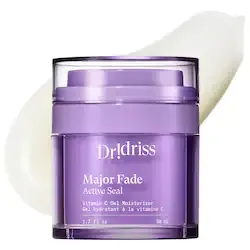
Dr. Idriss Major Fade Active Seal Dark Spot Vitamin C + Glutathione Gel-Cream Refillable Moisturizer
Works for
MoisturizingCeramide np, Hexapeptide-2 + 15 moreWorks well
“What it is: A moisturizer that brightens, fades the look of dark spots, seals in discoloration-defending actives, and supports the skin barrier.”
This product can help improve hydration of the skin with the two types of ingredients.
The first type is called “humectants”:
these ingredients help attract water.
When humectants are on the surface of the skin, they “pull in” the moisture from the outside environment, or from
within deeper layers of the skin. The following ingredients in this product do the job:
glycerin, bis-peg-18 methyl ether dimethyl silane.
This product also contains ingredients called “occlusives”. They help reduce the speed with which our skin loses moisture to the outside environment. These ingredients also help soften the upper layer of the skin, so it feels less tight and nicer to the touch. The following ingredients in this product do the job: caprylic/capric triglyceride, phenyl trimethicone.
The following ingredients in this product are especially good for supporting the skin barrier and helping with the hydration level: ceramide ap, ceramide eop, ceramide np, hexapeptide-2, phytosphingosine
Evens skin toneTetrahexyldecyl ascorbate ~2.4–3.5%, below the ~4% it needsUnder-dosed
“What it is: A moisturizer that brightens, fades the look of dark spots, seals in discoloration-defending actives, and supports the skin barrier.”
Effective ingredients missing or their concentration is too low
Anti-agingSide benefit · Hexapeptide-2, Tocopherol + 1 moreMay help
This product contains hexapeptide-2. There is some human evidence that this ingredient helps reduce and prevent fine lines and wrinkles and improve skin elasticity and firmness, though it is smaller or less consistent than the evidence for the best anti-aging ingredients.
Can it cause trouble?
Irritancy9 flagged ingredientsMedium risk
ComedogenicClean of flagged comedogenic ingredientsNone flagged


User reviews
Be the first — your take helps the next person decide.
Ingredients
Filter by role to see what each ingredient is doing.
4-butylresorcinol~23–34%
- Irritation risk
- Low
Hexapeptide-2~4.8–7.2%
- Irritation risk
- Low
A type of peptide. Peptides are excellent moisturizers and might be able support collagen production reducing fine lines and wrinkles
More about Hexapeptide-2Water~4.8–7.3%
Glycerin~3–4.5%
- Irritation risk
- Low
One of the best moisturizing ingredients. Naturally present in skin. It attracts water to the upper layer of the skin working as a humectant
More about GlycerinTetrahexyldecyl ascorbate~2.4–3.5%
- Irritation risk
- Medium
Being a lipid soluble form of vitamin C, it is more stable than ascorbic acid, but still degrades quickly and needs to be stabilized in a formulation with another ingredient. It is claimed to penetrate skin better than pure vitamin C and have the the similar benefits, but solid studies of its effectiveness are lacking. Is likely to require a higher concentration in a product than pure vitamin C to be effective. It might be able to help reduce pore clogging.
More about Tetrahexyldecyl ascorbateSqualane~2–3%
- Irritation risk
- Low
An oil naturally present in skin. Works as an emollient to soften the skin and form a protective layer on its surface without a greasy feeling.
More about SqualaneCaprylic/capric triglyceride~1.7–2.6%
- Irritation risk
- Medium
A good mix of fatty acids that forms a protective layer on the skin. Improves the shelf life of products. Derived from coconut and glycerin
More about Caprylic/capric triglycerideBis-peg-18 methyl ether dimethyl silane~1.4–2%
- Irritation risk
- Low
A type of silicone that helps soften the upper layer of the skin and create a nice product texture
More about Bis-peg-18 methyl ether dimethyl silaneHydroxyethyl acrylate/sodium acryloyldimethyl taurate copolymer~1.3–1.9%
- Irritation risk
- Medium
A gelling agent that thickens the product consistency and leaves the skin with a velvety finish
More about Hydroxyethyl acrylate/sodium acryloyldimethyl taurate copolymerTriheptanoin~1.1–1.6%
- Irritation risk
- Low
A synthetic triglyceride. Helps soften the upper layer of the skin
More about TriheptanoinPentylene glycol~1–1.5%
- Irritation risk
- Medium
Used to preserve products, dissolve other ingredients and create a nice product texture
More about Pentylene glycolPhenyl trimethicone~0.85–1.25%
- Irritation risk
- Low
A type of silicone that can decrease loss of moisture from the skin surface. It helps create a nice product texture
More about Phenyl trimethiconeOxidized glutathione~0.85–1.3%
- Irritation risk
- Low
4-butylresorcinol~0.55–1.3%
- Irritation risk
- Low
Hexapeptide-2~0.55–1.25%
- Irritation risk
- Low
A type of peptide. Peptides are excellent moisturizers and might be able support collagen production reducing fine lines and wrinkles
More about Hexapeptide-2Hydrolyzed brassica napus seedcake extract~0.55–1.25%
- Irritation risk
- Low
Ceramide np~0.55–1.3%
- Irritation risk
- Low
A type of lipid similar to ceramides naturally present in skin. Helps to soften the upper layer of the skin and supports the skin barrier function to keep it hydrated. Can help to prevent inflammation in skin
More about Ceramide npCeramide ap~0.55–1.25%
- Irritation risk
- Low
A type of lipid similar to ceramides naturally present in skin. Helps to soften the upper layer of the skin and supports the skin barrier function to keep it hydrated. Can help to prevent inflammation in skin
More about Ceramide apCeramide eop~0.5–1.15%
- Irritation risk
- Low
A type of lipid similar to ceramides naturally present in skin. Helps to soften the upper layer of the skin and supports the skin barrier function to keep it hydrated. Can help to prevent inflammation in skin
More about Ceramide eopTocopherol~0.45–1%
- Irritation risk
- Low
Pure form of vitamin E. Can help moisturise and protect the skin from free radicals. Often used to help stabilise other ingredients or the formula itself
More about TocopherolButylene glycol~0.4–0.95%
- Irritation risk
- Low
Used to create a nice product texture and help delivery of other ingredients. Might be somewhat helpful in attracting water to the upper layer of the skin
More about Butylene glycolCetearyl olivate~0.4–0.95%
Coco-caprylate/caprate~0.45–1%
- Irritation risk
- Low
Helps to soften the upper layer of the skin without creating a greasy texture
More about Coco-caprylate/caprateSorbitan olivate~0.4–0.95%
Ethylhexylglycerin~0.35–0.85%
Polysorbate 60~0.35–0.75%
Xanthan gum~0.3–0.75%
- Irritation risk
- Low
Used to create a thicker product consistency
More about Xanthan gumDilinoleic acid/butanediol copolymer~0.4–0.9%
- Irritation risk
- Low
Acrylates/c10-30 alkyl acrylate crosspolymer~0.4–0.9%
- Irritation risk
- Medium
Maintains the texture of skincare products. Allows the product to spread evenly. Helps oil and water mix together
More about Acrylates/c10-30 alkyl acrylate crosspolymerCholesterol~0.35–0.85%
- Irritation risk
- Low
An emollient that is naturally found in skin
More about CholesterolPhytosphingosine~0.35–0.85%
- Irritation risk
- Low
A type of lipid that is naturally present in skin. It might help in repairing skin barrier function and has anti-bacterial effect
More about PhytosphingosineDipotassium glycyrrhizate~0.2–0.75%
- Irritation risk
- Low
A salt derived from licorice. Works as an emollient to soften the upper layer of the skin and can help calm down inflammation. Might be helpful for skin lightening
More about Dipotassium glycyrrhizateSodium lauroyl lactylate~0.2–0.75%
- Irritation risk
- Medium
Helps water and oil mix together
More about Sodium lauroyl lactylateCarbomer~0.15–0.7%
- Irritation risk
- Low
Helps create a thicker or gel-like product texture. It is not a surfactant but can be used in gentle cleansing formulations
More about CarbomerSodium hydroxide~0.15–0.65%
Tetrasodium glutamate diacetate~0.15–0.6%
- Irritation risk
- Low
Helps stabilize the product formulation
More about Tetrasodium glutamate diacetateSorbitan isostearate~0.15–0.6%
- Irritation risk
- Low
Helps oil and water mix together
More about Sorbitan isostearateCastor oil/ipdi copolymer~0.15–0.7%
Sodium benzoate~0.1–0.45%
Potassium sorbate~0.15–0.5%
Phenoxyethanol~0.15–0.55%
- Irritation risk
- Low
A preservative. It helps prevent bacterial growth in cosmetic products
More about PhenoxyethanolIngredient list view
4-butylresorcinol, Hexapeptide-2, Water, Glycerin, Tetrahexyldecyl ascorbate, Squalane, Caprylic/capric triglyceride, Bis-peg-18 methyl ether dimethyl silane, Hydroxyethyl acrylate/sodium acryloyldimethyl taurate copolymer, Triheptanoin, Pentylene glycol, Phenyl trimethicone, Oxidized glutathione, 4-butylresorcinol, Hexapeptide-2, Hydrolyzed brassica napus seedcake extract, Ceramide np, Ceramide ap, Ceramide eop, Tocopherol, Butylene glycol, Cetearyl olivate, Coco-caprylate/caprate, Sorbitan olivate, Ethylhexylglycerin, Polysorbate 60, Xanthan gum, Dilinoleic acid/butanediol copolymer, Acrylates/c10-30 alkyl acrylate crosspolymer, Cholesterol, Phytosphingosine, Dipotassium glycyrrhizate, Sodium lauroyl lactylate, Carbomer, Sodium hydroxide, Tetrasodium glutamate diacetate, Sorbitan isostearate, Castor oil/ipdi copolymer, Sodium benzoate, Potassium sorbate, Phenoxyethanol
Compare prices
Retailers ranked by price — lowest first.

Worth comparing, line by line.
Match % combines shared ingredients, the first five ingredients, shared actives and hero ingredients, irritancy (lower counts in the alternative's favour), texture and body area. Only products in the same routine step are compared.
| Dr. IdrissMajor Fade Active Seal Dark Spot Vitamin C + Glutathione Gel-Cream Refillable MoisturizerYOUR PRODUCT | PillowtalkDermMajor Fade Active Seal Moisturizer | DermaticaSoothing Centella Gel Moisturiser | THE formularxBarrier Relief Lightweight Ceramide Moisturizer | |
|---|---|---|---|---|
| Match | — | 67% | 55% | 54% |
| Price | $58.00 | — | $17.00−$41.00 | $9.16−$48.84 |
| Shared key ingredients | — | 10 of 14 | 8 of 14 | 7 of 14 |
| Key difference | — | Linoleic Acid | Niacinamide | Colloidal Oatmeal |
| Irritancy | Medium | Low | Low | Low |
| Drying alcohol | — | — | — | — |
| View product | Shop | Shop | Shop |
More alternatives: COSRX Derma Water Barrier MoisturizerCeraVe Oil Control Moisturising Gel-Cream
Sources cited in this review
Every concentration estimate and effectiveness label is anchored to one of these 11 studies and safety reviews.
- 1
- 2
- 3
- 4
- 5
- 6

Affiliate links · As an Amazon Associate, WIMJ earns from qualifying purchases.