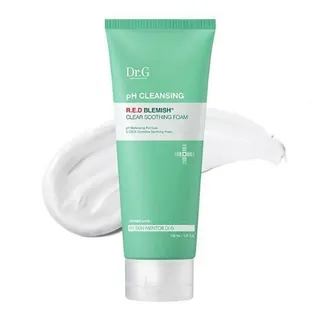
Dr.G pH Cleansing R.E.D Blemish Clear Soothing Foam
Works for
Anti-blemishSalicylic acid, Centella asiatica extractWorks well
“Dr.G pH Cleansing R.E.D Blemish Clear Soothing Foam helps clears blemishes and moisturizes skin.”
This product can help reduce breakouts and clogged pores because it contains the following ingredient: salicylic acid. This ingredient is used for treating acne and can have a noticeable effect.
CleansingSodium cocoyl isethionate, Coco-betaine + 6 moreCleanses gently
“pH Cleansing R.E.D Blemish Clear Soothing Foam”
This product works by removing dirt and oil from the surface of the skin. It uses a combination of mild cleansing agents (coco-betaine, coco-glucoside, glyceryl stearate, potassium cocoyl glycinate, quillaja saponaria bark extract, sodium cocoyl isethionate, sodium methyl cocoyl taurate, stearyl alcohol) and should be able to cleanse the skin gently. Still keep in mind that any cleansing can disrupt the skin barrier, and most people do not need to cleanse their skin more than once per day.
Even though this formulation is mild, the following cleansing agents could trigger an irritation or allergy for some people: coco-betaine, coco-glucoside, sodium methyl cocoyl taurate
ExfoliationSide benefit · Salicylic acidWorks well
This product can help exfoliate the skin. In other words, it helps break down the bonds between dead cells on the surface of the skin and speed up the skin turnover. Skin often appears softer and brighter after exfoliation, but overdoing it can result in disrupted skin barrier. The following ingredient is doing the exfoliating job in this product: salicylic acid.
Can it cause trouble?
Irritancy1 strong irritant: Gaultheria procumbens leaf extractMedium risk
ComedogenicClean of flagged comedogenic ingredientsNone flagged

User reviews
Be the first — your take helps the next person decide.
Ingredients
Filter by role to see what each ingredient is doing.
Water~45–55%
Sodium cocoyl isethionate~8.8–10.7%
- Irritation risk
- Medium
Helps water and oil mix together. Can be used as a cleansing agent
More about Sodium cocoyl isethionateGlycerin~4.2–5.1%
- Irritation risk
- Low
One of the best moisturizing ingredients. Naturally present in skin. It attracts water to the upper layer of the skin working as a humectant
More about GlycerinCoco-betaine~4.3–5.3%
- Irritation risk
- High
Helps oil and water mix together and works as a cleansing agent. Can be allergenic
More about Coco-betaineGlyceryl stearate~2.4–2.9%
- Irritation risk
- Low
An emollient that softens the skin and forms a protective layer on its surface. Helps water and oil mix together
More about Glyceryl stearateStearyl alcohol~2–2.4%
- Irritation risk
- Low
An emollient that helps soften the skin
More about Stearyl alcoholSodium methyl cocoyl taurate~2–2.4%
- Irritation risk
- High
Helps oil and water mix together. Can be used as cleansing agent
More about Sodium methyl cocoyl taurateSodium chloride~1.5–1.9%
- Irritation risk
- Low
Used to stabilize mixtures of oil and water, and create thicker, gel-like product textures
More about Sodium chlorideButylene glycol~1.2–1.5%
- Irritation risk
- Low
Used to create a nice product texture and help delivery of other ingredients. Might be somewhat helpful in attracting water to the upper layer of the skin
More about Butylene glycolQuillaja saponaria bark extract~1.1–1.3%
- Irritation risk
- Medium
Helps water and oil mix together
More about Quillaja saponaria bark extractGaultheria procumbens leaf extract~0.65–1%
- Irritation risk
- High
Centella asiatica extract~0.6–0.95%
- Irritation risk
- Medium
A plant extract that has been shown to be able to reduce inflammation in skin, support restoration of skin barrier function, as well as support collagen production. Contains active compounds called centelloids: asiaticoside, madecasosside, asiatic acid and madecassic acid. Might be helpful in preventing stretch marks. It can be itself be irritating though.
More about Centella asiatica extractBifida ferment lysate~0.55–0.85%
- Irritation risk
- Low
Consists of remains of dead yeast bacteria cells. Helps to hydrate the skin and reduce irritation. Might has some anti-oxidant effect
More about Bifida ferment lysateLeuconostoc/radish root ferment filtrate~0.55–0.8%
- Irritation risk
- Medium
A preservative that comes from radishes fermented by a bacteria. New research suggests that the preservation properties in the ingredient come from an ammonium salt that is not present naturally in radish root but used in its cultivation. Is problematic because the exact amount of the preservative agents is difficult to determine
More about Leuconostoc/radish root ferment filtrateSodium hyaluronate~0.5–0.75%
- Irritation risk
- Low
One of the best moisturizing ingredients. Attracts water into the upper layer of the skin
More about Sodium hyaluronateHydrolyzed hyaluronic acid~0.5–0.7%
- Irritation risk
- Low
One of the best moisturizing ingredients. Attracts water into the upper layer of the skin. A version of it is naturally present in skin
More about Hydrolyzed hyaluronic acidHyaluronic acid~0.5–0.7%
- Irritation risk
- Low
One of the best moisturizing ingredients. Attracts water into the upper layer of the skin. Naturally present in skin. Typically has large molecule size unless advertised otherwise on the product label. Helps support skin's barrier function and may help to reduce inflammation
More about Hyaluronic acidOxygen~0.45–0.65%
- Irritation risk
- Low
Oxygen molecules that are abundant in normal air. In cosmetic formulas typically comes as a perfluorohexane oxygen emulsion. There is no evidence for benefits of the oxygen emulsion in topical creams, lotions or serums. There is a study available confirming a positive impact of oxygen therapy for skin wound healing, but it used an emulsion stored under high pressure using special equipment
More about OxygenPotassium cocoyl glycinate~0.45–0.65%
Coco-glucoside~0.5–0.7%
- Irritation risk
- High
Used as a cleansing agent (surfactant) in cleansers. Helps water and oil mix together in lotions. Can be irritating
More about Coco-glucosideSalicylic acid~0.3–0.6%
- Irritation risk
- High
Used for skin exfoliation. It has an anti-inflammatory and anti-bacterial effect, helps to unclog pores, prevent blemishes and speed up healing of the existing ones. Sometimes referred to as a BHA (beta-hydroxy acid)
More about Salicylic acidCaprylyl glycol~0.35–0.65%
- Irritation risk
- Medium
Helps preserve products and creates a nice product texture
More about Caprylyl glycol1,2-hexanediol~0.3–0.55%
Butyl avocadate~0.3–0.55%
- Irritation risk
- Low
Lactobacillus~0.3–0.55%
- Irritation risk
- Low
A non-living ingredient made by fermentation with the bacteria Lactobacillus. It can help attract water to the upper layer of the skin and might help reduce inflammation
More about LactobacillusMadecassoside~0.3–0.55%
- Irritation risk
- Medium
An antioxidant that is typically derived from plant Centella Asiatica. It can help neutralize free radicals in skin and support skin barrier function. It could, however, itself be irritating. It is often unstable in formulations
More about MadecassosideGlycine~0.3–0.55%
- Irritation risk
- Low
Helps to attract water to the upper layer of the skin and can help restore the skin barrier function
More about GlycineSerine~0.3–0.55%
- Irritation risk
- Low
An amino-acid that helps to attract water to the upper layer of the skin. In combination with other amino-acids, might help to reduce fine lines and wrinkles
More about SerineGlutamic acid~0.3–0.55%
- Irritation risk
- Low
An amino-acid that helps attract water to the upper layer of the skin
More about Glutamic acidAspartic acid~0.3–0.55%
- Irritation risk
- Low
An amino-acid that helps increase skin hydration and might help to slightly improve skin firmness, potentially reducing lines and wrinkles
More about Aspartic acidLeucine~0.3–0.55%
- Irritation risk
- Low
Alanine~0.3–0.55%
- Irritation risk
- Low
An amino-acid that helps to attract water to the upper layer of the skin and might help to lighten the skin, but solid evidence is lacking
More about AlanineLysine~0.3–0.55%
- Irritation risk
- Low
An amino-acid that helps to attract water to the upper layer of the skin. In combination with other amino-acids, might help to reduce fine lines and wrinkles
More about LysineArginine~0.3–0.55%
- Irritation risk
- Low
An amino acid that is naturally present in skin and helps keep it hydrated. When used together with AHAs, it can reduce their irritating effect on the skin
More about ArginineTyrosine~0.3–0.55%
Phenylalanine~0.3–0.55%
- Irritation risk
- Low
Proline~0.3–0.6%
Threonine~0.3–0.55%
- Irritation risk
- Low
An amino-acid that helps to attract water to the upper layer of the skin. In combination with other amino-acids, might help to reduce fine lines and wrinkles
More about ThreonineValine~0.3–0.55%
- Irritation risk
- Low
Isoleucine~0.3–0.55%
- Irritation risk
- Low
An amino acid that can help attract water to the upper layer of the skin and support skin's barrier function
More about IsoleucineHistidine~0.3–0.55%
Cysteine~0.25–0.5%
- Irritation risk
- Low
Might help neutralize free radicals in skin and might be helpful against hyperpigmentation
More about CysteineMethionine~0.25–0.5%
- Irritation risk
- Low
Hydroxypropyltrimonium hyaluronate~0.3–0.5%
- Irritation risk
- Low
Ethylhexylglycerin~0.25–0.45%
Asiaticoside~0.2–0.35%
- Irritation risk
- Medium
An active compound of Centella Asiatica plant extract. In combination with other active compounds of Centella Asiatica extract (madecasosside, asiatic acid and madecassic acid), asiaticoside has been shown to be helpful in wound-healing, restoring skin barrier function and supporting collagen production in skin. It can, however, itself be irritating
More about AsiaticosideAsiatic acid~0.2–0.4%
- Irritation risk
- Medium
An active compound of Centella Asiatica plant extract. In combination with other active compounds of Centella Asiatica extract (asiaticoside, madecasosside and madecassic acid) asiatic acid has been shown to be helpful in wound-healing, restoring skin barrier function and supporting collagen production in skin. It can, however, itself be irritating
More about Asiatic acidMadecassic acid~0.2–0.35%
- Irritation risk
- Medium
An active compound of Centella Asiatica plant extract. In combination with other active compounds of Centella Asiatica extract (asiaticoside, madecasosside and asiatic acid), madecassic acid has been shown to be helpful in wound-healing, restoring skin barrier function and supporting collagen production in skin. It can, however, itself be irritating
More about Madecassic acidPropyl gallate~0.15–0.3%
- Irritation risk
- Medium
Helps preserve product formulations and can mask the smell of other ingredients in a product
More about Propyl gallateSodium acetylated hyaluronate~0.15–0.25%
- Irritation risk
- Low
A type of hyaluronic acid that works as an excellent moisturizer by attracting water into the upper layer of the skin. Is typically feels less sticky on the skin compared to the usual hyaluronic acid
More about Sodium acetylated hyaluronateHydrolyzed sodium hyaluronate~0.15–0.3%
- Irritation risk
- Low
Attracts water into the upper layer of the skin
More about Hydrolyzed sodium hyaluronateSodium hyaluronate crosspolymer~0.15–0.25%
- Irritation risk
- Medium
Attracts water into the upper layer of the skin
More about Sodium hyaluronate crosspolymerPotassium hyaluronate~0.1–0.2%
- Irritation risk
- Low
Disodium edta~0.05–0.1%
Ingredient list view
Water, Sodium cocoyl isethionate, Glycerin, Coco-betaine, Glyceryl stearate, Stearyl alcohol, Sodium methyl cocoyl taurate, Sodium chloride, Butylene glycol, Quillaja saponaria bark extract, Gaultheria procumbens leaf extract, Centella asiatica extract, Bifida ferment lysate, Leuconostoc/radish root ferment filtrate, Sodium hyaluronate, Hydrolyzed hyaluronic acid, Hyaluronic acid, Oxygen, Potassium cocoyl glycinate, Coco-glucoside, Salicylic acid, Caprylyl glycol, 1,2-hexanediol, Butyl avocadate, Lactobacillus, Madecassoside, Glycine, Serine, Glutamic acid, Aspartic acid, Leucine, Alanine, Lysine, Arginine, Tyrosine, Phenylalanine, Proline, Threonine, Valine, Isoleucine, Histidine, Cysteine, Methionine, Hydroxypropyltrimonium hyaluronate, Ethylhexylglycerin, Asiaticoside, Asiatic acid, Madecassic acid, Propyl gallate, Sodium acetylated hyaluronate, Hydrolyzed sodium hyaluronate, Sodium hyaluronate crosspolymer, Potassium hyaluronate, Disodium edta
Compare prices
Retailers ranked by price — lowest first.

Worth comparing, line by line.
Match % combines shared ingredients, the first five ingredients, shared actives and hero ingredients, irritancy (lower counts in the alternative's favour), texture and body area. Only products in the same routine step are compared.
| Dr.GpH Cleansing R.E.D Blemish Clear Soothing FoamYOUR PRODUCT | GenabellePink Cloud Cleansing Foam | xx | AbibAcne Foam Cleanser Heartleaf Foam | |
|---|---|---|---|---|
| Match | — | 71% | 70% | 70% |
| Price | — | $14.91 | $11.74 | $8.34 |
| Shared key ingredients | — | 4 of 35 | 15 of 35 | 7 of 35 |
| Key difference | — | Hexylene Glycol | Chondrus Crispus Extract | Panthenol |
| Irritancy | Medium | Low | Medium | Medium |
| Drying alcohol | — | — | — | — |
| View product | Shop | Shop | Shop |


More alternatives: L'Oréal Paris Daily Foaming Gel CleanserCeraVe Balancing Air Foam Facial Cleanser
Sources cited in this review
Every concentration estimate and effectiveness label is anchored to one of these 43 studies and safety reviews.
- 1Final Report on the Safety Assessment of Sodium Cocoyl Isethionatejournals.sagepub.com
- 2
- 3
- 4
- 5Centella asiatica in cosmetologyncbi.nlm.nih.gov
- 6

Affiliate links · As an Amazon Associate, WIMJ earns from qualifying purchases.