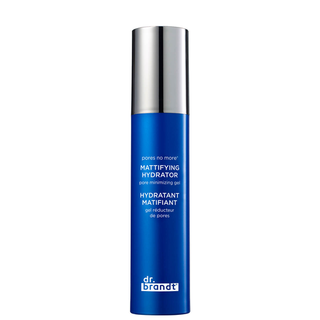
Dr. Brandt Mattifying Hydrator Pore Minimizing Gel
Works for
1 of 2 advertised claims delivered
Moisturizing13 ingredients credited for this claimGood support
“A lightweight gel that simultaneously mattifies and hydrates for up to eight hours while minimizing the appearance of pores.”
This product can help improve hydration of the skin with the two types of ingredients.
The first type is called “humectants”:
these ingredients help attract water.
When humectants are on the surface of the skin, they “pull in” the moisture from the outside environment, or from
within deeper layers of the skin. The following ingredients in this product do the job:
glycerin, polyglutamic acid.
This product also contains ingredients called “occlusives”. They help reduce the speed with which our skin loses moisture to the outside environment. These ingredients also help soften the upper layer of the skin, so it feels less tight and nicer to the touch. The following ingredients in this product do the job: dimethicone, caprylyl glycol.
Anti-blemish1 ingredient credited for this claimWeak support
“With regular use, pores are less clogged and skin is less shiny.”
Effective ingredients missing or their concentration is too low.
Can it cause trouble?
Irritancy2 strong irritants: Alcohol denat., Retinyl palmitateMedium risk
ComedogenicClean of flagged comedogenic ingredientsNone flagged
User reviews
Be the first — your take helps the next person decide.
Ingredients
Filter by role to see what each ingredient is doing.
Water~45–55%
Dimethicone~6.3–7.7%
- Irritation risk
- Low
A silicone that helps to reduce water loss from the surface of the skin. Can temporarily "fill in" lines and wrinkles, absorb oil, and create a nice product finish
More about DimethiconePolysilicone-11~4.3–5.2%
- Irritation risk
- Low
A silicone that forms a light film on the skin surface helping to bind water and temporarily absorb oils creating a matt and powdery feel
More about Polysilicone-11Dimethicone/divinyldimethicone/silsesquioxane crosspolymer~3.1–3.8%
- Irritation risk
- Low
Butylene glycol~2.3–2.8%
- Irritation risk
- Low
Used to create a nice product texture and help delivery of other ingredients. Might be somewhat helpful in attracting water to the upper layer of the skin
More about Butylene glycolPropanediol~1.9–2.3%
- Irritation risk
- Low
Acts as a solvent for other ingredients. Speeds up the absorption of other ingredients into the skin
More about PropanediolBarium sulfate~1.6–2%
- Irritation risk
- Low
Polysorbate 20~1.4–1.7%
Polymethylsilsesquioxane~1.2–1.5%
- Irritation risk
- Low
A silicone that improves product texture and helps dissolve other ingredients. Can form a non-greasy film on the skin to prevent moisture loss
More about PolymethylsilsesquioxaneSodium pca~0.9–1.1%
- Irritation risk
- Low
Naturally present in skin and helps to attract water to its upper layer
More about Sodium pcaGlycerin~0.7–1%
- Irritation risk
- Low
One of the best moisturizing ingredients. Naturally present in skin. It attracts water to the upper layer of the skin working as a humectant
More about GlycerinPhenoxyethanol~0.5–0.75%
- Irritation risk
- Low
A preservative. It helps prevent bacterial growth in cosmetic products
More about PhenoxyethanolIsohexadecane~0.55–0.85%
- Irritation risk
- Low
Improves the texture of the product and helps soften the skin. Helps oil and water mix together and can be used as a cleansing agent
More about IsohexadecaneAlcohol denat.~0.4–0.6%
- Irritation risk
- High
Produces temporary toning effect. Can help dissolve other ingredients or preserve products
More about Alcohol denat.Carbomer~0.35–0.6%
- Irritation risk
- Low
Helps create a thicker or gel-like product texture. It is not a surfactant but can be used in gentle cleansing formulations
More about CarbomerTocopheryl acetate~0.35–0.6%
- Irritation risk
- Medium
A more stable but less bio-available form of vitamin E compared to Tocopherol. Might help moisturize and protect the skin from free radicals, but mostly used in low concentrations to stabilize other ingredients.
More about Tocopheryl acetateAmmonium polyacryloyldimethyl taurate~0.3–0.6%
- Irritation risk
- Low
Used to create a thicker product consistency
More about Ammonium polyacryloyldimethyl taurateTromethamine~0.3–0.55%
Sodium acrylates copolymer~0.25–0.45%
- Irritation risk
- Medium
Used to create a thicker product consistency
More about Sodium acrylates copolymerSorbitol~0.25–0.45%
- Irritation risk
- Low
Helps attract water to the upper layer of the skin and improves the product texture
More about SorbitolXanthan gum~0.2–0.4%
- Irritation risk
- Low
Used to create a thicker product consistency
More about Xanthan gumTitanium dioxide~0.3–0.5%
- Irritation risk
- Low
Works as a UV filter when used in high concentrations. It is photostable and is effective mostly against the UVB light, with some protection in the UVA range. In small concentrations, used for its ability to improve the color of cosmetic products. Is usually well tolerated by the skin
More about Titanium dioxideLecithin~0.25–0.4%
- Irritation risk
- Low
Used mostly for creating emulsions - helping oil and water mix together. Helps soften the upper layer of the skin
More about LecithinPolysorbate 80~0.2–0.4%
Iris florentina root extract~0.2–0.35%
- Irritation risk
- Low
Mica~0.2–0.4%
- Irritation risk
- Low
Creates an illusion of smoother and more radiant skin tone. Adds shimmer to the skin by reflecting light
More about MicaEthylhexylglycerin~0.2–0.35%
Zinc sulfate~0.2–0.35%
Retinyl palmitate~0.15–0.3%
- Irritation risk
- High
Three steps removed from the active form of vitamin A - retinoic acid. To have an effect in the skin, it first needs to be converted twice to become the retinoic acid. This means it is less potent than retinol, but could also be less irritating. Once converted to the retinoic acid in the skin, it helps against all signs of aging, improves skin cell turnover and helps fight blemishes and clogged pores. However, in many cosmetic formulations, it is used in a concentration that is too low to have the full effect
More about Retinyl palmitateSaccharide isomerate~0.2–0.35%
- Irritation risk
- Low
Helps attract water to the upper layer of the skin
More about Saccharide isomeratePolyglutamic acid~0.2–0.35%
- Irritation risk
- Low
Helps attract water to the upper layer of the skin.
More about Polyglutamic acidDiatomaceous earth~0.3–0.55%
Methylsilanol mannuronate~0.15–0.3%
- Irritation risk
- Low
Caprylyl glycol~0.15–0.3%
- Irritation risk
- Medium
Helps preserve products and creates a nice product texture
More about Caprylyl glycolDisodium edta~0.1–0.2%
Glyceryl caprylate~0.15–0.25%
- Irritation risk
- Low
An emollient that can also help water and oil mix together, as well as prevent bacteria growth in products
More about Glyceryl caprylateTin oxide~0.15–0.3%
- Irritation risk
- Low
A colorant that can add a pearl-like appearance to the formulation
More about Tin oxideIngredient list view
Water, Dimethicone, Polysilicone-11, Dimethicone/divinyldimethicone/silsesquioxane crosspolymer, Butylene glycol, Propanediol, Barium sulfate, Polysorbate 20, Polymethylsilsesquioxane, Sodium pca, Glycerin, Phenoxyethanol, Isohexadecane, Alcohol denat., Carbomer, Tocopheryl acetate, Ammonium polyacryloyldimethyl taurate, Tromethamine, Sodium acrylates copolymer, Sorbitol, Xanthan gum, Titanium dioxide, Lecithin, Polysorbate 80, Iris florentina root extract, Mica, Ethylhexylglycerin, Zinc sulfate, Retinyl palmitate, Saccharide isomerate, Polyglutamic acid, Diatomaceous earth, Methylsilanol mannuronate, Caprylyl glycol, Disodium edta, Glyceryl caprylate, Tin oxide
Compare prices
Retailers ranked by price — lowest first.


Sources cited in this review
Every concentration estimate and effectiveness label is anchored to one of these 10 studies and safety reviews.
- 1
- 2Final Report on the Safety Assessment of Dimethicone Copolyoljournals.sagepub.com
- 3
- 4
- 5Safety Assessment of Tromethamine as Used in Cosmeticscir-safety.org
- 6

Affiliate links · As an Amazon Associate, WIMJ earns from qualifying purchases.