Works for
1 of 1 advertised claim delivered
Moisturizing15 ingredients credited for this claimStrong support
“It’s beneficial in helping redness appear less prominent while hydrating drier areas for a more natural finish.”
This product can help improve hydration of the skin with the two types of ingredients.
The first type is called “humectants”:
these ingredients help attract water.
When humectants are on the surface of the skin, they “pull in” the moisture from the outside environment, or from
within deeper layers of the skin. The following ingredients in this product do the job:
fructose, glycerin.
This product also contains ingredients called “occlusives”. They help reduce the speed with which our skin loses moisture to the outside environment. These ingredients also help soften the upper layer of the skin, so it feels less tight and nicer to the touch. The following ingredients in this product do the job: caprylic/capric triglyceride, cannabis sativa seed oil.
The following ingredients in this product are especially good for supporting the skin barrier and helping with the hydration level: ceramide np
Anti-oxidationNot advertised by the brand · 5 ingredients credited for this claimStrong support
This product contains antioxidants (vitis vinifera seed extract) that can help neutralize free radicals in skin. By doing so, they can lessen the damage the skin gets from the UV light (sun).
Anti-agingNot advertised by the brand · 4 ingredients credited for this claimModerate support
This product contains vitis vinifera seed extract. This ingredient might be able to help reduce and prevent fine lines and wrinkles, improve skin elasticity and firmness, but there is not enough evidence that it actually works.
Can it cause trouble?
Irritancy1 strong irritant: Ocimum sanctum leaf extractMedium risk
Comedogenic1 ingredient rated 2 or more on the 0–5 pore-clogging scale1 flagged
User reviews
Be the first — your take helps the next person decide.
Ingredients
Filter by role to see what each ingredient is doing.
Water~45–55%
Caprylic/capric triglyceride~6.7–8.2%
- Irritation risk
- Medium
A good mix of fatty acids that forms a protective layer on the skin. Improves the shelf life of products. Derived from coconut and glycerin
More about Caprylic/capric triglycerideHydroxystearic acid~4.4–5.4%
Cetyl alcohol~2.6–3.1%
- Irritation risk
- Low
A non-drying alcohol that works to soften the skin and stabilize product formulations helping oil and water mix together
More about Cetyl alcoholStearyl alcohol~2.4–2.9%
- Irritation risk
- Low
An emollient that helps soften the skin
More about Stearyl alcoholPolyglyceryl-6 stearate~2–2.4%
- Irritation risk
- Low
Helps soften the upper layer of the skin
More about Polyglyceryl-6 stearateCannabis sativa seed oil~1.7–2%
- Irritation risk
- Medium
A plant oil that due to its high linoleic acid content can help strengthen skin's barrier function and soften its upper layer
More about Cannabis sativa seed oilLactococcus ferment lysate~1.4–1.7%
- Irritation risk
- Low
Consists of remains of dead bacteria cells. Is likely helpful in attracting water to the upper layer of the skin. Might be helpful in reducing inflammation and neutralizing free radicals in skin
More about Lactococcus ferment lysateAvena sativa kernel flour~1.4–1.7%
- Irritation risk
- Low
A type of colloidal oatmeal. Can contain potent antioxidants and anti-inflammatory compounds. Is effective in supporting skin barrier
More about Avena sativa kernel flourOphiopogon japonicus root extract~0.8–1.2%
- Irritation risk
- Medium
Plant extract that might help neutralize free radicals and support skin barrier function, but research on its effectiveness in skin is lacking
More about Ophiopogon japonicus root extractYogurt~0.65–1%
- Irritation risk
- Low
Ceramide np~0.6–0.9%
- Irritation risk
- Low
A type of lipid similar to ceramides naturally present in skin. Helps to soften the upper layer of the skin and supports the skin barrier function to keep it hydrated. Can help to prevent inflammation in skin
More about Ceramide npEnteromorpha compressa extract~0.5–0.75%
- Irritation risk
- Low
- Comedogenicity
- 3/5
Polysorbate 60~0.5–0.7%
Sorbitan isostearate~0.45–0.65%
- Irritation risk
- Low
Helps oil and water mix together
More about Sorbitan isostearateSucrose~0.35–0.65%
- Irritation risk
- Low
Can help attract water to the upper layer of the skin. In crystal form, it can work as a gentle exfoliant, gentler than the salt scrub. Helps stabilize the emulsion
More about SucroseFructose~0.4–0.6%
- Irritation risk
- Low
Helps attract water to the upper layer of the skin
More about FructoseGlucose~0.3–0.6%
- Irritation risk
- Low
Helps attract water to the upper layer of the skin. Could be helpful in restoring the skin barrier function
More about GlucoseCamellia sinensis leaf extract~0.3–0.55%
- Irritation risk
- Low
Can contain potent anti-oxidant compounds (abbreviated ECG, GCG, EGC, and EGCG) that might help protect the skin from free radicals. Can help calm down inflammation and has some anti-bacterial properties. Unfortunately, these antioxidants are unstable and lose their effectiveness very quickly in products. The concentration of the antioxidant compounds in the extract also tends to be low to be effective in topical formulation
More about Camellia sinensis leaf extractOcimum sanctum leaf extract~0.25–0.5%
- Irritation risk
- High
A plant extract that is rich in a fragrance compound eugenol that is a frequent allergen and can be irritating. It might also contain anti-oxidants to help neutralize free radicals
More about Ocimum sanctum leaf extractSilybum marianum fruit extract~0.25–0.5%
- Irritation risk
- Low
Lactic acid~0.25–0.5%
- Irritation risk
- Medium
An exfoliating and moisturizing alpha-hydroxy acid (AHA). Typically causes less irritation than other AHAs, for example, glycolic acid. At high concentrations (about 15%), lactic acid can help reduce lines and wrinkles. Recent studies show that lactic acid can support the "good" bacteria living on skin's surface (healthy skin microbiome)
More about Lactic acidVitis vinifera seed extract~0.25–0.5%
- Irritation risk
- Low
A plant extract that contains resveratrol and other anti-oxidant compounds that can help neutralize free radicals, reduce inflammation in skin and even out its tone. Can be also used to stabilize the product formulation
More about Vitis vinifera seed extractInulin~0.25–0.45%
- Irritation risk
- Low
Helps attract water to the upper layer of the skin. Is claimed to support the growth of "good" bacteria in skin (as a "prebiotic"), but the research is lacking
More about InulinMaltodextrin~0.25–0.45%
- Irritation risk
- Low
Used to stabilize the product formulation and can help absorb oil
More about MaltodextrinGlycerin~0.25–0.5%
- Irritation risk
- Low
One of the best moisturizing ingredients. Naturally present in skin. It attracts water to the upper layer of the skin working as a humectant
More about GlycerinPolyglyceryl-6 behenate~0.25–0.45%
Ethylhexylglycerin~0.2–0.4%
Propanediol~0.25–0.4%
- Irritation risk
- Low
Acts as a solvent for other ingredients. Speeds up the absorption of other ingredients into the skin
More about PropanediolBenzyl alcohol~0.1–0.2%
- Irritation risk
- High
A preservative. Can be used to mask unpleasant smell. Can be irritating
More about Benzyl alcoholMethyl lactate~0.15–0.25%
- Irritation risk
- Low
Hydroxyethyl acrylate/sodium acryloyldimethyl taurate copolymer~0.15–0.25%
- Irritation risk
- Medium
A gelling agent that thickens the product consistency and leaves the skin with a velvety finish
More about Hydroxyethyl acrylate/sodium acryloyldimethyl taurate copolymerSodium chloride~0.15–0.25%
- Irritation risk
- Low
Used to stabilize mixtures of oil and water, and create thicker, gel-like product textures
More about Sodium chlorideSodium benzoate~0.1–0.2%
Citric acid~0.05–0.1%
- Irritation risk
- Medium
Can work as an exfoliant but is typically used to adjust the product pH
More about Citric acidIngredient list view
Water, Caprylic/capric triglyceride, Hydroxystearic acid, Cetyl alcohol, Stearyl alcohol, Polyglyceryl-6 stearate, Cannabis sativa seed oil, Lactococcus ferment lysate, Avena sativa kernel flour, Ophiopogon japonicus root extract, Yogurt, Ceramide np, Enteromorpha compressa extract, Polysorbate 60, Sorbitan isostearate, Sucrose, Fructose, Glucose, Camellia sinensis leaf extract, Ocimum sanctum leaf extract, Silybum marianum fruit extract, Lactic acid, Vitis vinifera seed extract, Inulin, Maltodextrin, Glycerin, Polyglyceryl-6 behenate, Ethylhexylglycerin, Propanediol, Benzyl alcohol, Methyl lactate, Hydroxyethyl acrylate/sodium acryloyldimethyl taurate copolymer, Sodium chloride, Sodium benzoate, Citric acid
Compare prices
Retailers ranked by price — lowest first.

Product summary
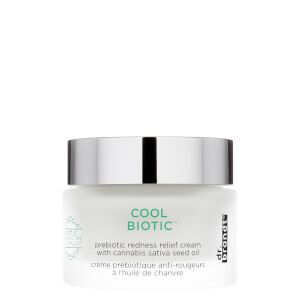
"Dr. Brandt - Cool Biotic Cream" is a well-rounded moisturizing product. As we expect from a proper moisturizer, the formula includes a combo of effective humectants and emollients. These are the two different types of ingredients that are essential for improving the skin hydration and supporting a healthy skin barrier. Fructose, glycerin, sucrose and glucose in this product (humectants) attract water molecules to the upper layer of the skin (the water comes from the outside air or from the deeper layers of the skin if the air is dry). Ceramide np, cannabis sativa seed oil, caprylic/capric triglyceride, cetyl alcohol and polyglyceryl-6 stearate in this product help decrease the water evoporation from the skin, so that it stays hydrated for longer. These ingredients also soften the skin and take away the feeling of tightness and dryness.
Ingredient callouts
- Another benefit is that this moisturizer contain ceramides (ceramide np 0.60% - 0.90%). Ceramides are an important part of our natural skin barrier. The ceramides used in skincare are synthetic or come from plants. They help soften the skin and can help "fill the gaps" in the skin barrier, keeping the skin hydrated and resilient for longer.
Irritation risk
There are some common irritants in this product, including ingredients that do not have benefits for the skin. We assess the overall irritancy of this moisturizer to be medium. For a detailed overview of all potential irritants: click here
You can see the detailed formula review with the breakdown of all actives in the product and the full ingredient list with estimated concentrations in the tables below.
Price
The product retails for 55.00$ in the United States, for 70.08CA$ in Canada and from 42.90£ up to 45.00£ in the United Kingdom.
For a detailed price comparison: click here.
Sources cited in this review
Every concentration estimate and effectiveness label is anchored to one of these 14 studies and safety reviews.
- 1
- 2Hemp (Cannabis sativa L.) as a Resource for Green Cosmeticstandfonline.com
- 3
- 4Cosmetic use of an ophiopogon japonicus active principlepatents.google.com
- 5
- 6

Affiliate links · As an Amazon Associate, WIMJ earns from qualifying purchases.