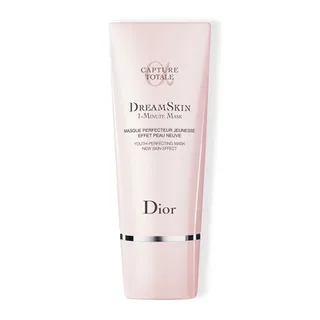
Dior Dreamskin 1 Minute Youth Perfecting Mask New Skin Effect
Works for
Anti-agingGlycolic acid, Tocopherol + 1 moreWorks well
“Skin is freed from signs of fatigue, the skin radiates, glowing with new perfection. .”
This product can help reduce and prevent fine lines and wrinkles, improve skin elasticity and firmness because it contains glycolic acid.
Keep in mind that it typically takes at least 6 weeks to notice any results because the changes that are needed to improve fine lines and elasticity happen in the deeper layers of the skin. No topical anti-aging product can “erase” wrinkles or fully reverse signs of aging.
ExfoliationGlycolic acidWorks well
“Key features and benefits. . Peeling action, gently exfoliates the skin, blurring the imperfections' appearance.”
This product can help exfoliate the skin. In other words, it helps break down the bonds between dead cells on the surface of the skin and speed up the skin turnover. Skin often appears softer and brighter after exfoliation, but overdoing it can result in disrupted skin barrier. The following ingredient is doing the exfoliating job in this product: glycolic acid.
Evens skin toneSide benefit · Glycolic acid, Dipotassium glycyrrhizate + 1 moreWorks well
This product can help reduce hypepigmentation and even out the skin tone because it contains the following effective ingredients: glycolic acid
Keep in mind that you would need to apply any topical skincare targetted at hypigmentation consistently for a couple of months to get a result. No topical skincare product can help get rid of hyperpigmentation (including post-acne marks and age spots) instantly.
MoisturizingSide benefit · Glycerin, Palmaria palmata extract + 5 moreWorks
This product contains good ingredients to attract water to the upper layer of the skin. These ingredients are called "humectants": glycerin, butylene glycol.
When humectants are on the surface of the skin, they “pull in” the moisture from the outside environment, or from within deeper layers of the skin. If the air is dry, humectants can speed up the moisture loss from the skin. This is why it is a good idea to use another product on top of this one to help "seal in" the moisture (look for ingredients like dimethicone, squalane, oils and butters).
Can it cause trouble?
Irritancy5 strong irritants: Alcohol, Parfum + 3 more — patch-test recommendedHigh risk
Comedogenic2 ingredients rated 2 or more on the 0–5 pore-clogging scale2 flagged

User reviews
Be the first — your take helps the next person decide.
Ingredients
Filter by role to see what each ingredient is doing.
Water~40–60%
Glycerin~4.1–6.2%
- Irritation risk
- Low
One of the best moisturizing ingredients. Naturally present in skin. It attracts water to the upper layer of the skin working as a humectant
More about GlycerinPolysorbate 20~3.2–4.9%
Glycolic acid~2.7–4%
- Irritation risk
- High
An alpha-hydroxy acid (AHA) that helps to remove the dead skin cells on the surface of the skin reveling a more even, smoother complexation. It is also able to stimulate collagen production with long-term use. Could help to reduce pore congestion. It can be irritating to the skin. Apply sunscreen daily if using products with glycolic acid
More about Glycolic acidButylene glycol~2–3%
- Irritation risk
- Low
Used to create a nice product texture and help delivery of other ingredients. Might be somewhat helpful in attracting water to the upper layer of the skin
More about Butylene glycolHydroxyethyl acrylate/sodium acryloyldimethyl taurate copolymer~1.6–2.4%
- Irritation risk
- Medium
A gelling agent that thickens the product consistency and leaves the skin with a velvety finish
More about Hydroxyethyl acrylate/sodium acryloyldimethyl taurate copolymerTitanium dioxide~1.8–2.7%
- Irritation risk
- Low
Works as a UV filter when used in high concentrations. It is photostable and is effective mostly against the UVB light, with some protection in the UVA range. In small concentrations, used for its ability to improve the color of cosmetic products. Is usually well tolerated by the skin
More about Titanium dioxideHydrogenated polyisobutene~1.3–2%
- Irritation risk
- Low
Used to improve the product consistency and soften the upper layer of the skin
More about Hydrogenated polyisobuteneAlcohol~1–1.5%
- Irritation risk
- High
Can be drying and contribute to skin irritation. Used in formulars to dissolve other ingredients, create a thinner product consistency or for its antibacterial properties
More about AlcoholCitric acid~0.8–1.2%
- Irritation risk
- Medium
Can work as an exfoliant but is typically used to adjust the product pH
More about Citric acidSodium hydroxide~0.5–1.1%
Simmondsia chinensis seed oil~0.45–1%
- Irritation risk
- Medium
Softens the upper layer of skin and helps restore the healthy skin barrier. Has shown to help calm down inflammation in skin. It is a stable oil, meaning that it retains its properties even when exposed to air.
More about Simmondsia chinensis seed oilParfum~0.3–0.75%
- Irritation risk
- High
An aromatic blend of unspecified and possibly irritating ingredients
More about ParfumXanthan gum~0.3–0.7%
- Irritation risk
- Low
Used to create a thicker product consistency
More about Xanthan gumSclerotium gum~0.2–0.7%
- Irritation risk
- Low
Used to create gel-like formulas and stabilize emulsions
More about Sclerotium gumDipotassium glycyrrhizate~0.2–0.7%
- Irritation risk
- Low
A salt derived from licorice. Works as an emollient to soften the upper layer of the skin and can help calm down inflammation. Might be helpful for skin lightening
More about Dipotassium glycyrrhizatePhenoxyethanol~0.2–0.75%
- Irritation risk
- Low
A preservative. It helps prevent bacterial growth in cosmetic products
More about PhenoxyethanolXylitol~0.15–0.6%
- Irritation risk
- Low
Helps attract water to the upper layer of the skin and repair the skin barrier function
More about XylitolPolysorbate 60~0.15–0.65%
Sorbitan isostearate~0.15–0.55%
- Irritation risk
- Low
Helps oil and water mix together
More about Sorbitan isostearateTetrasodium edta~0.1–0.45%
Ascorbyl glucoside~0.1–0.45%
- Irritation risk
- Medium
A vitamin C derivative that is more stable but less potent than pure form of vitamin C. Has a potential to boost collagen production, nutralise free radicals and reduce hyperpigmentation, but the required concentration is likely to be much higher than for the pure form of vitamin C, limiting the ingredient's effectiveness in products
More about Ascorbyl glucosideSynthetic fluorphlogopite~0.1–0.4%
- Irritation risk
- Low
A mineral that is used as an optical filter (makes the skin looks nicer through light reflection) and to improve the texture of cosmetic products
More about Synthetic fluorphlogopiteMalva sylvestris extract~0.1–0.4%
- Irritation risk
- High
Hibiscus sabdariffa flower extract~0.1–0.4%
- Irritation risk
- High
A plant extract that can be irritating. It might contain a compound anthocyanin that could be helpful in neutralizing free radicals
More about Hibiscus sabdariffa flower extractZea mays starch~0.1–0.4%
- Irritation risk
- Medium
- Comedogenicity
- 3/5
Used to thicken the product's consistency
More about Zea mays starchHydrogenated lecithin~0.1–0.4%
- Irritation risk
- Low
Helps to retain moisture by creating a protective barrier on the skin. Rich in fatty acids. Improves product texture and helps with the penetration of other ingredients.
More about Hydrogenated lecithinSaponins~0.15–0.55%
Limonene~0.1–0.3%
- Irritation risk
- High
A common frangrance that can easily irritate skin, especially if exposed to air, light or heat
More about LimonenePentaerythrityl tetra-di-t-butyl hydroxyhydrocinnamate~0.1–0.4%
- Irritation risk
- Low
Used to increase stability of product formulations
More about Pentaerythrityl tetra-di-t-butyl hydroxyhydrocinnamateAframomum angustifolium seed extract~0.1–0.35%
- Irritation risk
- Low
Palmaria palmata extract~0.1–0.35%
- Irritation risk
- Low
- Comedogenicity
- 3/5
Red algae extract that helps attract water to the upper layer of the skin
More about Palmaria palmata extractSodium benzoate~0.05–0.25%
Tin oxide~0.15–0.55%
- Irritation risk
- Low
A colorant that can add a pearl-like appearance to the formulation
More about Tin oxidePotassium sorbate~0.05–0.3%
Tocopherol~0.05–0.25%
- Irritation risk
- Low
Pure form of vitamin E. Can help moisturise and protect the skin from free radicals. Often used to help stabilise other ingredients or the formula itself
More about TocopherolJasminum officinale flower extract~0.05–0.15%
Ci 14700~0.05–0.1%
Ingredient list view
Water, Glycerin, Polysorbate 20, Glycolic acid, Butylene glycol, Hydroxyethyl acrylate/sodium acryloyldimethyl taurate copolymer, Titanium dioxide, Hydrogenated polyisobutene, Alcohol, Citric acid, Sodium hydroxide, Simmondsia chinensis seed oil, Parfum, Xanthan gum, Sclerotium gum, Dipotassium glycyrrhizate, Phenoxyethanol, Xylitol, Polysorbate 60, Sorbitan isostearate, Tetrasodium edta, Ascorbyl glucoside, Synthetic fluorphlogopite, Malva sylvestris extract, Hibiscus sabdariffa flower extract, Zea mays starch, Hydrogenated lecithin, Saponins, Limonene, Pentaerythrityl tetra-di-t-butyl hydroxyhydrocinnamate, Aframomum angustifolium seed extract, Palmaria palmata extract, Sodium benzoate, Tin oxide, Potassium sorbate, Tocopherol, Jasminum officinale flower extract, Ci 14700
Compare prices
Retailers ranked by price — lowest first.
Worth comparing, line by line.
Match % combines shared ingredients, the first five ingredients, shared actives and hero ingredients, irritancy (lower counts in the alternative's favour), texture and body area. Only products in the same routine step are compared.
| DiorDreamskin 1 Minute Youth Perfecting Mask New Skin EffectYOUR PRODUCT | Etude HouseBerry Blend Smoothing Facial Mask with 28% Acid Complex | 3LABAnti-Aging Mask | Elizabeth GrantWonder Effect Glycolic Mask | |
|---|---|---|---|---|
| Match | — | 60% | 59% | 59% |
| Price | — | — | $305.93 | $10.00 |
| Shared key ingredients | — | 2 of 6 | 3 of 6 | 2 of 6 |
| Key difference | — | Salicylic Acid | Niacinamide | Niacinamide |
| Irritancy | High | Medium | Medium | Medium |
| Drying alcohol | Contains drying alcohol | — | — | — |
| View product | Shop | Shop | Shop |


More alternatives: Drunk Elephant T.L.C. Sukari Babyfacial MidiHyper Skin Hyper Even Fade and Glow AHA Mask
Sources cited in this review
Every concentration estimate and effectiveness label is anchored to one of these 16 studies and safety reviews.
- 1
- 2
- 3Glycolic acid peel therapy – a current reviewncbi.nlm.nih.gov
- 4
- 5
- 6

Affiliate links · As an Amazon Associate, WIMJ earns from qualifying purchases.