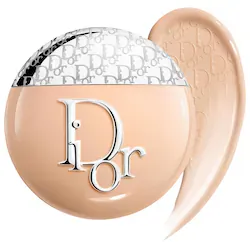
Dior Backstage Glow-Up Skin Tint Hydrating Tinted Moisturizer SPF 20
Works for
Sun protectionSPF 20 · 3 UV filters · Broad spectrumWeak protectionSPF under 30
This product offers broad spectrum sun protection, but it is weak. We recommend to use a broad spectrum sunscreen with at least SPF 30.
This product can be considered "reef safe" because it does not contain the UV filters (oxybenzone and octinoxate) that can be harmful to coral reefs when present in the water in high concentrations.
MoisturizingGlycerin, Undecane + 10 moreWorks
“Product name: Backstage Glow-Up Skin Tint Hydrating Tinted Moisturizer SPF 20”
This product contains good ingredients to attract water to the upper layer of the skin. These ingredients are called "humectants": glycerin.
When humectants are on the surface of the skin, they “pull in” the moisture from the outside environment, or from within deeper layers of the skin. If the air is dry, humectants can speed up the moisture loss from the skin. This is why it is a good idea to use another product on top of this one to help "seal in" the moisture (look for ingredients like dimethicone, squalane, oils and butters).
Can it cause trouble?
Irritancy2 strong irritants: Alcohol, ParfumMedium risk
Comedogenic1 ingredient rated 2 or more on the 0–5 pore-clogging scale1 flagged
User reviews
Be the first — your take helps the next person decide.
Ingredients
Filter by role to see what each ingredient is doing.
Ethylhexyl salicylate4.5%
- Irritation risk
- Low
Octisalate. A UV filter. It offers some protection against the sun rays that cause sunburn (UVB), but does not protect against the most aging sun rays (UVA). It loses its effectiveness quickly when exposed to sunlight. It is an organic, or so called "chemical" sunscreen
More about Ethylhexyl salicylateWater~45–55%
Dicaprylyl carbonate~6.3–7.7%
- Irritation risk
- Low
Helps products spread more easily and works as an emollient to soften skin
More about Dicaprylyl carbonateGlycerin~5.7–6.9%
- Irritation risk
- Low
One of the best moisturizing ingredients. Naturally present in skin. It attracts water to the upper layer of the skin working as a humectant
More about GlycerinUndecane~4.3–5.3%
- Irritation risk
- Medium
Helps create a non-greasy finish on the skin
More about UndecaneAlcohol~3–3.7%
- Irritation risk
- High
Can be drying and contribute to skin irritation. Used in formulars to dissolve other ingredients, create a thinner product consistency or for its antibacterial properties
More about AlcoholPolyglyceryl-2 dipolyhydroxystearate~2.3–2.8%
- Irritation risk
- Low
Helps to soften the upper layer of the skin
More about Polyglyceryl-2 dipolyhydroxystearatePropanediol~1.9–2.3%
- Irritation risk
- Low
Acts as a solvent for other ingredients. Speeds up the absorption of other ingredients into the skin
More about PropanediolCellulose~1.7–2.1%
- Irritation risk
- Low
Can be used to help absorb oil as well as add volume and imporve texture of products.
More about CelluloseC9-12 alkane~1.4–1.7%
Dipropylene glycol~1.1–1.3%
- Irritation risk
- Low
Helps to dissolve other ingredients in a formulation. Slows down the rate of product drying
More about Dipropylene glycolPolyglyceryl-3 diisostearate~0.9–1.1%
- Irritation risk
- Medium
- Comedogenicity
- 3/5
Helps oil and water mix together
More about Polyglyceryl-3 diisostearateTridecane~0.65–0.95%
Lecithin~0.65–1%
- Irritation risk
- Low
Used mostly for creating emulsions - helping oil and water mix together. Helps soften the upper layer of the skin
More about LecithinSilica~1–1.2%
Hydroxypropyl starch~0.55–0.8%
- Irritation risk
- Low
Parfum~0.5–0.75%
- Irritation risk
- High
An aromatic blend of unspecified and possibly irritating ingredients
More about ParfumStearalkonium hectorite~0.5–0.8%
Dextrin isostearate~0.5–0.7%
- Irritation risk
- Low
Coco-caprylate/caprate~0.5–0.75%
- Irritation risk
- Low
Helps to soften the upper layer of the skin without creating a greasy texture
More about Coco-caprylate/caprateAluminum hydroxide~0.5–0.75%
- Irritation risk
- Low
Is used to add opaque (non-transparent) appearance to formulations. Can be used to coat other ingredients for even dispersion. This is a different ingredient compared to the ones used in antipersperants (aluminium chloride and aluminium chlorohydrate)
More about Aluminum hydroxideSodium myristoyl glutamate~0.5–0.75%
Sodium benzoate~0.25–0.5%
Sodium citrate~0.35–0.6%
- Irritation risk
- Medium
Helps to control the skin's pH level. Maintains the skin's natural film of amino-lactic acids and oils. Helps to preserve products
More about Sodium citrateSorbitan sesquiisostearate~0.3–0.6%
Propylene carbonate~0.35–0.6%
- Irritation risk
- Low
Is used to dissolve other ingredients and create nice product texture
More about Propylene carbonateAlumina~0.5–0.75%
- Irritation risk
- Low
The same compound that is used safely in dental implants and bone cements. In cosmetics, it is used to improve the consistency of products
More about AluminaStearic acid~0.45–0.65%
- Irritation risk
- Low
Helps oil and water mix together and works as an emollient
More about Stearic acidOctyldodecanol~0.3–0.55%
- Irritation risk
- Low
An emollient that helps to soften the skin and create a pleasant product texture and stabilize the formulation
More about OctyldodecanolMica~0.3–0.55%
- Irritation risk
- Low
Creates an illusion of smoother and more radiant skin tone. Adds shimmer to the skin by reflecting light
More about MicaCitric acid~0.3–0.6%
- Irritation risk
- Medium
Can work as an exfoliant but is typically used to adjust the product pH
More about Citric acidTocopherol~0.3–0.6%
- Irritation risk
- Low
Pure form of vitamin E. Can help moisturise and protect the skin from free radicals. Often used to help stabilise other ingredients or the formula itself
More about TocopherolDimethicone/vinyl dimethicone crosspolymer~0.3–0.55%
- Irritation risk
- Low
Used to stabilize product formulations and create a nice product texture
More about Dimethicone/vinyl dimethicone crosspolymerPentylene glycol~0.35–0.65%
- Irritation risk
- Medium
Used to preserve products, dissolve other ingredients and create a nice product texture
More about Pentylene glycolCollagen amino acids~0.25–0.5%
- Irritation risk
- Low
Help attract water to the upper layer of the skin, soften it and support the skin barrier function
More about Collagen amino acidsTitanium dioxide4.23%
- Irritation risk
- Low
Works as a UV filter when used in high concentrations. It is photostable and is effective mostly against the UVB light, with some protection in the UVA range. In small concentrations, used for its ability to improve the color of cosmetic products. Is usually well tolerated by the skin
More about Titanium dioxideCi 77491~0.15–0.3%
- Irritation risk
- Low
A red colorant made of iron oxide. Typically is not irritating
More about Ci 77491Ci 77492~0.15–0.3%
Iron oxides~0.1–0.2%
- Irritation risk
- Low
An umbrella term for the following three colorants: CI 77491, CI 77492, CI 77499. They might be able to offer some protection against visible light, but the degree of the protection is not clear
More about Iron oxidesZinc oxide~0.15–0.3%
- Irritation risk
- Low
A broad spectrum sunblock (protects from both UVA and UVB rays). Is suitable for most sensitive skins. In small concentrations, can be used as a colorant
More about Zinc oxideCi 77163~0.1–0.15%
Ingredient list view
Ethylhexyl salicylate, Water, Dicaprylyl carbonate, Glycerin, Undecane, Alcohol, Polyglyceryl-2 dipolyhydroxystearate, Propanediol, Cellulose, C9-12 alkane, Dipropylene glycol, Polyglyceryl-3 diisostearate, Tridecane, Lecithin, Silica, Hydroxypropyl starch, Parfum, Stearalkonium hectorite, Dextrin isostearate, Coco-caprylate/caprate, Aluminum hydroxide, Sodium myristoyl glutamate, Sodium benzoate, Sodium citrate, Sorbitan sesquiisostearate, Propylene carbonate, Alumina, Stearic acid, Octyldodecanol, Mica, Citric acid, Tocopherol, Dimethicone/vinyl dimethicone crosspolymer, Pentylene glycol, Collagen amino acids, Titanium dioxide, Ci 77491, Ci 77492, Iron oxides, Zinc oxide, Ci 77163
Compare prices
Retailers ranked by price — lowest first.

Worth comparing, line by line.
Match % combines shared ingredients, the first five ingredients, shared actives and hero ingredients, irritancy (lower counts in the alternative's favour), texture and body area. Only products in the same routine step are compared.
| DiorBackstage Glow-Up Skin Tint Hydrating Tinted Moisturizer SPF 20YOUR PRODUCT | MustelaVery High Protection Sun Lotion SPF50+ | ObagiPhysical Defense Broad Spectrum SPF 40 | iS ClinicalExtreme Protect SPF 40 | |
|---|---|---|---|---|
| Match | — | 41% | 39% | 39% |
| Price | $55.00 | — | $69.00+$14.00 | $92.00+$37.00 |
| Shared key ingredients | — | 4 of 5 | 3 of 5 | 3 of 5 |
| Key difference | — | Tinosorb S | Caprylic/Capric Triglyceride | Madecassic Acid |
| Irritancy | Medium | Low | Low | Low |
| SPF | SPF 20 | SPF 50 | SPF 40 | SPF 40 |
| Drying alcohol | Contains drying alcohol | — | — | — |
| View product | Shop | Shop | Shop |


More alternatives: Ultra Violette Daydream Screen SPF 50 Tinted VeilLa Roche-Posay Tolériane High Coverage Corrective Fluid SPF25 - Colour: 10
Sources cited in this review
Every concentration estimate and effectiveness label is anchored to one of these 10 studies and safety reviews.
- 1
- 2Safety Assessment of Alkyl Esters as Used in Cosmeticscir-safety.org
- 3
- 4Vitamin E in dermatologyncbi.nlm.nih.gov
- 5Vitamin E and Skin Healthlpi.oregonstate.edu
- 6A review of inorganic UV filters zinc oxide and titanium dioxideonlinelibrary.wiley.com

Affiliate links · As an Amazon Associate, WIMJ earns from qualifying purchases.