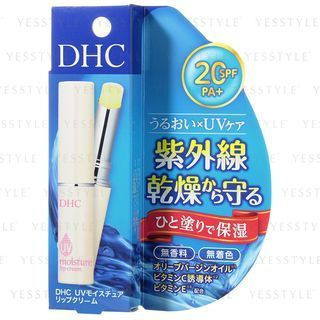
DHC UV Moisture Lip Cream SPF 20 PA+
Works for
1 of 3 advertised claims delivered
Sun protectionSPF 20 · 1 UV filter · Partial spectrumWeak protectionSPF under 30
This product does not offer good protection against UVA rays.
Moisturizing14 ingredients credited for this claimStrong support
“UV Moisture Lip Cream SPF 20 PA+”
This product can help soften the skin and reduce its moisture loss with emollients and occlusives: beeswax, squalane.
Keep in mind that this product does not contain effective ingredients to attract water to the upper layer of the skin. This is why an additional product with humectants like glycerin or hyaluronic acid can be helpful (apply it before this product for the best results).
The following ingredients in this product are especially good for supporting the skin barrier and helping with the hydration level: lanolin
Anti-aging2 ingredients credited for this claimLimited support
“Formulated with virgin olive oil, Vitamin C derivatives and Vitamin E, this lip cream moisturizes, nourishes and protects lips from harmful UV rays.”
This product does not contain ingredients that are able to reduce fine lines and wrinkles or help with skin elasticity, but it can improve the look of the skin temporarily through moisturization. Well-moisturized skin might also be able to repair the sun damage better.
The biggest anti-aging effect in this product comes from sun protection. Sun damage is the main factor causing early signs of skin aging. We, however, do not recommend using this product as a sunscreen because the protection it offers is not strong enough).
Can it cause trouble?
Irritancy1 strong irritant: Benzophenone-3Medium risk
ComedogenicClean of flagged comedogenic ingredientsNone flagged

User reviews
Be the first — your take helps the next person decide.
Ingredients
Filter by role to see what each ingredient is doing.
Lanolin~22–33%
- Irritation risk
- Low
Sebum of wool-bearing animals (most commonly sheep). Helps soften the upper layer of the skin and reduce the skin water loss. In rare cases could be an allergen. Not suitable for vegans
More about LanolinCandelilla cera~5.6–8.4%
- Irritation risk
- Low
Lanolin~3.6–5.4%
- Irritation risk
- Low
Sebum of wool-bearing animals (most commonly sheep). Helps soften the upper layer of the skin and reduce the skin water loss. In rare cases could be an allergen. Not suitable for vegans
More about LanolinOlea europaea fruit oil~3.6–5.5%
- Irritation risk
- Medium
An emollient that helps soften the skin but is not effective for restoring its barrier function. Might be helpful to calm down inflammation
More about Olea europaea fruit oilHydrogenated jojoba oil~2.9–4.3%
- Irritation risk
- Low
Helps soften the upper layer of the skin
More about Hydrogenated jojoba oilBenzophenone-3~2.4–3.7%
- Irritation risk
- High
Same as oxybenzone. Protects in the UVB and short UVA range. In small concentrations, used to stabilize product formulation. Can be irritating. Is shown to be harmful to coral reefs - consider avoiding bathing in coral reef areas when wearing a product with this ingredient. It can penetrate the skin and get absorbed into bloodstream faster than other popular filters available in the US. The study that produced this finding did not address any potential health effects of the absorption
More about Benzophenone-3Hydrogenated polyisobutene~1.7–2.6%
- Irritation risk
- Low
Used to improve the product consistency and soften the upper layer of the skin
More about Hydrogenated polyisobuteneBeeswax~1.5–2.3%
- Irritation risk
- Low
Forms a protective barrier that holds water and keeps dry skin hydrated. Keeps an emulsion from separating into its oil and liquid components, and increases the thickness of a product. Can be an allergen
More about BeeswaxCetyl lactate~1.2–1.8%
- Irritation risk
- Low
Squalane~1–1.45%
- Irritation risk
- Low
An oil naturally present in skin. Works as an emollient to soften the skin and form a protective layer on its surface without a greasy feeling.
More about SqualaneHydrogenated rapeseed alcohol~0.6–1.4%
Hydrogenated castor oil~0.5–1.2%
- Irritation risk
- Medium
A plant oil that can help soften the skin. It might be helpful in calming down inflammation, but solid research is lacking. Is often used in lip products to create the needed product consistency
More about Hydrogenated castor oilParaffin~0.4–0.9%
- Irritation risk
- Low
Prevents water loss from the skin surface and thickens the product consistency
More about ParaffinSimmondsia chinensis seed oil~0.45–1.05%
- Irritation risk
- Medium
Softens the upper layer of skin and helps restore the healthy skin barrier. Has shown to help calm down inflammation in skin. It is a stable oil, meaning that it retains its properties even when exposed to air.
More about Simmondsia chinensis seed oilGlyceryl distearate~0.4–0.95%
- Irritation risk
- Low
Ascorbyl tetraisopalmitate~0.4–0.95%
- Irritation risk
- Medium
A vitamin C derivative. Studies show that is might be effective in reducing hyperpigmentation, but there are no studies confirming that it is effectively converted into the bioavailable form of Vitamin C in skin. It is not clear how this derivative compares in effectiveness to the topical application of bioavailable form of vitamin C (L-ascorbic acid)
More about Ascorbyl tetraisopalmitateIsostearyl alcohol~0.4–0.9%
- Irritation risk
- Low
Helps soften the upper layer of the skin
More about Isostearyl alcoholTocopherol~0.2–0.75%
- Irritation risk
- Low
Pure form of vitamin E. Can help moisturise and protect the skin from free radicals. Often used to help stabilise other ingredients or the formula itself
More about TocopherolStearyl glycyrrhetinate~0.15–0.7%
- Irritation risk
- Medium
A fatty acid derived from licorice. Works as an emollient and can help calm down inflammation
More about Stearyl glycyrrhetinateIsostearoyl hydrolyzed collagen~0.3–0.75%
Aloe vera leaf extract~0.2–0.7%
- Irritation risk
- Low
Chamomilla recutita flower extract~0.15–0.55%
- Irritation risk
- High
Plant extract that can have healing and anti-inflammatory properties. It is a potential allergen and can be irritating
More about Chamomilla recutita flower extractLanolin wax~0.15–0.65%
- Irritation risk
- Low
Isostearic acid~0.15–0.6%
- Irritation risk
- Low
Used to create a nice product texture
More about Isostearic acidPhenoxyethanol~0.1–0.4%
- Irritation risk
- Low
A preservative. It helps prevent bacterial growth in cosmetic products
More about PhenoxyethanolStearic acid~0.15–0.7%
- Irritation risk
- Low
Helps oil and water mix together and works as an emollient
More about Stearic acidIngredient list view
Unknown, Lanolin, Unknown, Candelilla cera, Lanolin, Olea europaea fruit oil, Hydrogenated jojoba oil, Benzophenone-3, Hydrogenated polyisobutene, Beeswax, Cetyl lactate, Squalane, Hydrogenated rapeseed alcohol, Hydrogenated castor oil, Paraffin, Simmondsia chinensis seed oil, Glyceryl distearate, Ascorbyl tetraisopalmitate, Isostearyl alcohol, Tocopherol, Stearyl glycyrrhetinate, Isostearoyl hydrolyzed collagen, Aloe vera leaf extract, Chamomilla recutita flower extract, Lanolin wax, Isostearic acid, Phenoxyethanol, Stearic acid
Compare prices
Retailers ranked by price — lowest first.

Affiliate links · prices updated regularly
Worth comparing, line by line.
Match % combines shared ingredients, the first five ingredients, shared actives and hero ingredients, irritancy (lower counts in the alternative's favour), texture and body area. Only products in the same routine step are compared.
| DHCUV Moisture Lip Cream SPF 20 PA+YOUR PRODUCT | MUJILip Cream SPF 20 - 2 Types | |
|---|---|---|
| Match | — | 52% |
| Price | $11.75 | $7.40−$4.35 |
| Shared key ingredients | — | 2 of 8 |
| Key difference | — | Petrolatum |
| Irritancy | Medium | Low |
| SPF | SPF 20 | SPF 20 |
| Drying alcohol | — | — |
| View product | Shop |

Product summary
"DHC - UV Moisture Lip Cream SPF 20 PA+" does not provide enough UVA protection. UVA rays do not cause sunburn, but still damage the skin, leading to early signs of aging and pigmentation issues.
Sunscreen filters
This sunscreen uses so-called "chemical", or organic UV filters (organic simply means that their molecules contain atoms of carbon). These filters typically give good sun protection and rarely leave a white cast, but they can be irritating for sensitive skin. The UV filters in this sunscreen are: oxybenzone 2.40% - 3.70%.
Irritation risk
This lip sunscreen contains actives that can be irritating. We assess the overall irritancy of this lip sunscreen to be medium. For a detailed overview of all potential irritants: click here
You can see the detailed formula review with the breakdown of all actives in the product and the full ingredient list with estimated concentrations in the tables below.
Price
The product retails for 11.75$ in the United States.
For a detailed price comparison: click here.
Sources cited in this review
Every concentration estimate and effectiveness label is anchored to one of these 15 studies and safety reviews.
- 1
- 2Use of “natural” oils for moisturization: Review of olive, coconut, and sunflower seed oilonlinelibrary.wiley.com
- 3
- 4
- 5On Photostability of Oxybenzonecore.ac.uk
- 6

Affiliate links · As an Amazon Associate, WIMJ earns from qualifying purchases.