Works for
1 of 3 advertised claims delivered
MoisturizingGlycerin, Squalane + 22 moreGood evidence
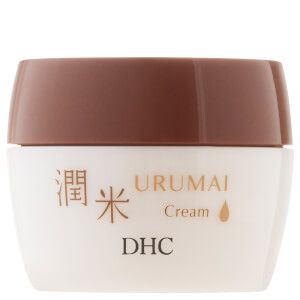
“Hydrate your complexion for a smoother, softer surface with the DHC Urumai Cream , a nourishing formula that takes its name from the Japanese words urumi, meaning moisture, and mai, which translates as rice.”
This product can help improve hydration of the skin with the two types of ingredients.
The first type is called “humectants”:
these ingredients help attract water.
When humectants are on the surface of the skin, they “pull in” the moisture from the outside environment, or from
within deeper layers of the skin. The following ingredients in this product do the job:
arginine, diglycerin.
This product also contains ingredients called “occlusives”. They help reduce the speed with which our skin loses moisture to the outside environment. These ingredients also help soften the upper layer of the skin, so it feels less tight and nicer to the touch. The following ingredients in this product do the job: arginine, caprylic/capric triglyceride.
Anti-agingTocopherolWeak evidence
“Enriched with Japanese rice peptides and antioxidants, this face moisturizer deeply hydrates while minimizing the signs of aging, hyperpigmentation and free radical damage so you can look your best.”
Effective ingredients missing or their concentration is too low.
Evens skin toneHYDROLYZED RICE BRAN EXTRACTWeak evidence
“Enriched with Japanese rice peptides and antioxidants, this face moisturizer deeply hydrates while minimizing the signs of aging, hyperpigmentation and free radical damage so you can look your best.”
Effective ingredients missing or their concentration is too low
Can it cause trouble?
Irritancy10 flagged ingredientsMedium risk
Comedogenic2 ingredients rated 2 or more on the 0–5 pore-clogging scale2 flagged
User reviews
Be the first — your take helps the next person decide.
Ingredients
Filter by role to see what each ingredient is doing.
Water~45–55%
Glycerin~4.4–5.4%
- Irritation risk
- Low
One of the best moisturizing ingredients. Naturally present in skin. It attracts water to the upper layer of the skin working as a humectant
More about GlycerinCaprylic/capric triglyceride~4.2–5.2%
- Irritation risk
- Medium
A good mix of fatty acids that forms a protective layer on the skin. Improves the shelf life of products. Derived from coconut and glycerin
More about Caprylic/capric triglycerideEthylhexyl palmitate~3.1–3.8%
- Irritation risk
- Low
- Comedogenicity
- 3/5
An emollient that helps soften the skin and create a nice product texture
More about Ethylhexyl palmitateDiglycerin~2.3–2.8%
- Irritation risk
- Low
Helps attract water to the upper layer of the skin
More about DiglycerinPropanediol~1.9–2.3%
- Irritation risk
- Low
Acts as a solvent for other ingredients. Speeds up the absorption of other ingredients into the skin
More about PropanediolPolyglyceryl-3 methylglucose distearate~1.6–2%
- Irritation risk
- Medium
Helps water and oil mix together
More about Polyglyceryl-3 methylglucose distearatePhytosteryl/isostearyl/cetyl/stearyl/behenyl dimer dilinoleate~1.5–1.8%
- Irritation risk
- Low
Helps soften the upper layer of the skin and create a nice product consistency
More about Phytosteryl/isostearyl/cetyl/stearyl/behenyl dimer dilinoleateC10-18 triglycerides~1.2–1.5%
- Irritation risk
- Low
Helps soften the skin and attract water to its upper layer. Helps create nice product texture
More about C10-18 triglyceridesGlyceryl stearate~1–1.2%
- Irritation risk
- Low
An emollient that softens the skin and forms a protective layer on its surface. Helps water and oil mix together
More about Glyceryl stearateVegetable oil~0.7–1.05%
- Irritation risk
- Low
An oil from a mixture of different vegetables. Helps soften the upper layer of the skin
More about Vegetable oilSqualane~0.6–0.95%
- Irritation risk
- Low
An oil naturally present in skin. Works as an emollient to soften the skin and form a protective layer on its surface without a greasy feeling.
More about SqualaneMacadamia ternifolia seed oil~0.55–0.8%
- Irritation risk
- Medium
Plant oil from nuts that helps soften the upper layer of the skin. Contains a high concentration of oleic acid that can weaken skin's barrier function and increase water-loss while enhancing penetration of other ingredients
More about Macadamia ternifolia seed oilOlea europaea fruit oil~0.45–0.7%
- Irritation risk
- Medium
An emollient that helps soften the skin but is not effective for restoring its barrier function. Might be helpful to calm down inflammation
More about Olea europaea fruit oilOryza sativa germ oil~0.45–0.7%
Simmondsia chinensis seed oil~0.45–0.7%
- Irritation risk
- Medium
Softens the upper layer of skin and helps restore the healthy skin barrier. Has shown to help calm down inflammation in skin. It is a stable oil, meaning that it retains its properties even when exposed to air.
More about Simmondsia chinensis seed oilPhytosteryl/behenyl/octyldodecyl lauroyl glutamate~0.4–0.6%
- Irritation risk
- Low
Cetearyl alcohol~0.4–0.65%
- Irritation risk
- Low
- Comedogenicity
- 2/5
A non-drying alcohol. Works as an emollient. Helps water and oil mix together and creates a nice product texture
More about Cetearyl alcoholGlyceryl caprylate~0.35–0.65%
- Irritation risk
- Low
An emollient that can also help water and oil mix together, as well as prevent bacteria growth in products
More about Glyceryl caprylateSclerotium gum~0.25–0.5%
- Irritation risk
- Low
Used to create gel-like formulas and stabilize emulsions
More about Sclerotium gumGlycogen~0.25–0.45%
- Irritation risk
- Low
Helps attract water to the upper layer of the skin
More about GlycogenButylene glycol~0.25–0.45%
- Irritation risk
- Low
Used to create a nice product texture and help delivery of other ingredients. Might be somewhat helpful in attracting water to the upper layer of the skin
More about Butylene glycolOryza sativa callus culture extract~0.25–0.4%
- Irritation risk
- Low
Cetearyl glucoside~0.25–0.45%
- Irritation risk
- Medium
Helps water and oil in the product mix well together and improves product texture
More about Cetearyl glucosidePhytosteryl rice branate~0.3–0.55%
- Irritation risk
- Low
Dehydroxanthan gum~0.25–0.5%
- Irritation risk
- Low
Helps create thicker product formulations and stabilize emulsions
More about Dehydroxanthan gumTocopherol~0.25–0.45%
- Irritation risk
- Low
Pure form of vitamin E. Can help moisturise and protect the skin from free radicals. Often used to help stabilise other ingredients or the formula itself
More about TocopherolHelianthus annuus seed oil unsaponifiables~0.25–0.5%
- Irritation risk
- Low
A great emollient due to its high linoleic acid content. One of the most effective plant oils in helping skin hydration and repairing skin barrier function
More about Helianthus annuus seed oil unsaponifiablesBrassica campestris/aleurites fordi oil copolymer~0.25–0.45%
- Irritation risk
- Low
Rosa canina fruit oil~0.25–0.5%
- Irritation risk
- Medium
A great emollient. Contains vitamin E (tocopherol) which may give it some anti-oxidant properties. Can contain volatile compounds and can be irritating
More about Rosa canina fruit oilSodium citrate~0.2–0.4%
- Irritation risk
- Medium
Helps to control the skin's pH level. Maintains the skin's natural film of amino-lactic acids and oils. Helps to preserve products
More about Sodium citrateBrassica campestris seed oil~0.2–0.4%
- Irritation risk
- Low
Helps soften the upper layer of the skin
More about Brassica campestris seed oilCitric acid~0.2–0.35%
- Irritation risk
- Medium
Can work as an exfoliant but is typically used to adjust the product pH
More about Citric acidHydrolyzed rice protein~0.15–0.3%
- Irritation risk
- Low
Helps attract water to the upper layer of the skin. Might have some anti-oxidant properties
More about Hydrolyzed rice proteinArginine~0.15–0.25%
- Irritation risk
- Low
An amino acid that is naturally present in skin and helps keep it hydrated. When used together with AHAs, it can reduce their irritating effect on the skin
More about ArgininePhytic acid~0.15–0.25%
- Irritation risk
- Medium
An alpha-hydroxy acid (AHA), but is mostly used to stabilize product formulations in cosmetics
More about Phytic acidSaccharomyces/rice bran ferment filtrate extract~0.1–0.2%
- Irritation risk
- Low
Oryza sativa extract~0.1–0.15%
- Irritation risk
- Low
A grain extract that helps to create a thicker product consistency. It might have some anti-oxidant properties and help attract water to the upper layer of the skin
More about Oryza sativa extractSilver oxide~0.05–0.15%
- Irritation risk
- Low
Ingredient list view
Water, Glycerin, Caprylic/capric triglyceride, Ethylhexyl palmitate, Diglycerin, Propanediol, Polyglyceryl-3 methylglucose distearate, Phytosteryl/isostearyl/cetyl/stearyl/behenyl dimer dilinoleate, C10-18 triglycerides, Glyceryl stearate, Vegetable oil, Squalane, Macadamia ternifolia seed oil, Olea europaea fruit oil, Oryza sativa germ oil, Simmondsia chinensis seed oil, Phytosteryl/behenyl/octyldodecyl lauroyl glutamate, Cetearyl alcohol, Glyceryl caprylate, Sclerotium gum, Glycogen, Butylene glycol, Oryza sativa callus culture extract, Cetearyl glucoside, Phytosteryl rice branate, Dehydroxanthan gum, Tocopherol, Helianthus annuus seed oil unsaponifiables, Brassica campestris/aleurites fordi oil copolymer, Rosa canina fruit oil, Sodium citrate, Brassica campestris seed oil, Citric acid, Hydrolyzed rice protein, Arginine, Phytic acid, Saccharomyces/rice bran ferment filtrate extract, Oryza sativa extract, Silver oxide
Compare prices
Retailers ranked by price — lowest first.
Affiliate links · prices updated regularly · As an Amazon Associate, WIMJ earns from qualifying purchases.
Sources cited in this review
Every concentration estimate and effectiveness label is anchored to one of these 11 studies and safety reviews.
- 1
- 2
- 3Use of “natural” oils for moisturization: Review of olive, coconut, and sunflower seed oilonlinelibrary.wiley.com
- 4Vitamin E in dermatologyncbi.nlm.nih.gov
- 5Vitamin E and Skin Healthlpi.oregonstate.edu
- 6

Affiliate links · As an Amazon Associate, WIMJ earns from qualifying purchases.