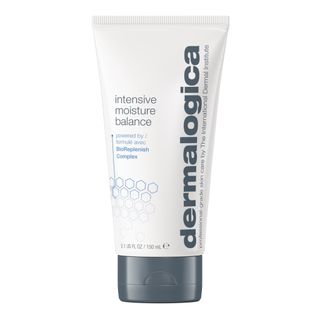
Dermalogica intensive moisture balance moisturizer jumbo
Works for
1 of 2 advertised claims delivered
Moisturizing22 ingredients credited for this claimStrong support
“intensive moisture balance moisturizer jumbo”
This product can help improve hydration of the skin with the two types of ingredients.
The first type is called “humectants”:
these ingredients help attract water.
When humectants are on the surface of the skin, they “pull in” the moisture from the outside environment, or from
within deeper layers of the skin. The following ingredients in this product do the job:
sodium hyaluronate, aloe barbadensis extract.
This product also contains ingredients called “occlusives”. They help reduce the speed with which our skin loses moisture to the outside environment. These ingredients also help soften the upper layer of the skin, so it feels less tight and nicer to the touch. The following ingredients in this product do the job: dimethicone, ethylhexyl hydroxystearate.
The following ingredients in this product are especially good for supporting the skin barrier and helping with the hydration level: ceramide np, linoleic acid
Anti-aging4 ingredients credited for this claimLimited support
“Hyaluronic Acid, combined with Echinacea, Centella Asiatica and Aloe Vera, locks in hydration to help enhance the skin's moisture content and reduce the appearance of fine lines.”
This product does not contain ingredients that are able to reduce fine lines and wrinkles or help with skin elasticity, but it can improve the look of the skin temporarily through moisturization. Well-moisturized skin might also be able to repair the sun damage better.
Can it cause trouble?
Irritancy1 strong irritant: Rosa centifolia flower extractMedium risk
Comedogenic3 ingredients rated 2 or more on the 0–5 pore-clogging scale3 flagged
User reviews
Be the first — your take helps the next person decide.
Ingredients
Filter by role to see what each ingredient is doing.
Water~45–55%
Ethylhexyl hydroxystearate~5.8–7.1%
- Irritation risk
- Low
Helps soften the upper layer of the skin and reduce water loss from it
More about Ethylhexyl hydroxystearateButylene glycol~4.1–5.1%
- Irritation risk
- Low
Used to create a nice product texture and help delivery of other ingredients. Might be somewhat helpful in attracting water to the upper layer of the skin
More about Butylene glycolCetearyl ethylhexanoate~3.3–4%
- Irritation risk
- Low
An emollient that helps soften the skin
More about Cetearyl ethylhexanoateCetyl caprylate~2.5–3.1%
- Irritation risk
- Low
Stearic acid~2.2–2.6%
- Irritation risk
- Low
Helps oil and water mix together and works as an emollient
More about Stearic acidPeg-8~1.8–2.2%
- Irritation risk
- Medium
Used to create a nice product consistency
More about Peg-8Octyldodecanol~1.5–1.8%
- Irritation risk
- Low
An emollient that helps to soften the skin and create a pleasant product texture and stabilize the formulation
More about OctyldodecanolDimethicone~1.3–1.6%
- Irritation risk
- Low
A silicone that helps to reduce water loss from the surface of the skin. Can temporarily "fill in" lines and wrinkles, absorb oil, and create a nice product finish
More about DimethiconeGlyceryl stearate se~1–1.2%
- Irritation risk
- Low
- Comedogenicity
- 2/5
Used to stabilize the product formulations and works as an emollient
More about Glyceryl stearate sePeg-100 stearate~0.9–1.1%
- Irritation risk
- Low
Helps oil and water mix togehter and creates a nice product texture
More about Peg-100 stearateSodium hyaluronate~0.6–0.9%
- Irritation risk
- Low
One of the best moisturizing ingredients. Attracts water into the upper layer of the skin
More about Sodium hyaluronateHydrolyzed sodium hyaluronate~0.55–0.8%
- Irritation risk
- Low
Attracts water into the upper layer of the skin
More about Hydrolyzed sodium hyaluronateSodium ascorbyl phosphate~0.5–0.8%
- Irritation risk
- Medium
A stable derivative of vitamin C. It is oil-soluble which means it is more likely to penetrate the skin compared to the pure form of vitamin C (which is water-soluble), but it is less bio-available and is way less effective in stimulating collagen and reducing wrinkles compared to the pure form of vitamin C (L-ascorbic acid) and its other derivatives (for example, magnesium ascorbyl phosphate). At the same time, this vitamin C derivative has been shown in studies to be effective in reducing acne, blemishes and clogged pores. It is less irritating then the pure form of vitamin C
More about Sodium ascorbyl phosphateChlorella vulgaris extract~0.45–0.7%
- Irritation risk
- Medium
- Comedogenicity
- 3/5
A plant extract that can help to attract water to the upper layer of the skin and might have some anti-oxidant and anti-inflammatory properties
More about Chlorella vulgaris extractCeramide np~0.5–0.75%
- Irritation risk
- Low
A type of lipid similar to ceramides naturally present in skin. Helps to soften the upper layer of the skin and supports the skin barrier function to keep it hydrated. Can help to prevent inflammation in skin
More about Ceramide npPhytosterols~0.5–0.75%
- Irritation risk
- Medium
Lipids that work as an emollient and can be helpful in repairing skin barrier function
More about PhytosterolsCentella asiatica extract~0.45–0.7%
- Irritation risk
- Medium
A plant extract that has been shown to be able to reduce inflammation in skin, support restoration of skin barrier function, as well as support collagen production. Contains active compounds called centelloids: asiaticoside, madecasosside, asiatic acid and madecassic acid. Might be helpful in preventing stretch marks. It can be itself be irritating though.
More about Centella asiatica extractLinoleic acid~0.5–0.75%
- Irritation risk
- Low
An excellent emollient. Helps soften the skin, restore its barrier function, and can help to calm down inflammation. It can be helpful to prevent blemishes and clogged pores
More about Linoleic acidEchinacea purpurea extract~0.3–0.55%
- Irritation risk
- High
Plant extract that might have some anti-oxidant properties. Can be irritating
More about Echinacea purpurea extractAloe barbadensis extract~0.3–0.55%
- Irritation risk
- Medium
Traditionally used to treat sunburns, dermatitis and inflammation, but evidence for its effectiveness is lacking. The extract can contain humectants that help attract water into the skin
More about Aloe barbadensis extractPalmitic acid~0.35–0.65%
- Irritation risk
- Low
An emollient that is naturally present in skin and helps soften it
More about Palmitic acidMyristic acid~0.3–0.55%
- Irritation risk
- Medium
- Comedogenicity
- 3/5
Helps oil and water mix together. Could be comedogenic
More about Myristic acidRosa centifolia flower extract~0.25–0.45%
- Irritation risk
- High
Contains essential oil. Can be irritating
More about Rosa centifolia flower extractLactic acid~0.25–0.5%
- Irritation risk
- Medium
An exfoliating and moisturizing alpha-hydroxy acid (AHA). Typically causes less irritation than other AHAs, for example, glycolic acid. At high concentrations (about 15%), lactic acid can help reduce lines and wrinkles. Recent studies show that lactic acid can support the "good" bacteria living on skin's surface (healthy skin microbiome)
More about Lactic acidLinolenic acid~0.3–0.6%
- Irritation risk
- Medium
An emollient that helps soften the skin and calm down inflammation
More about Linolenic acidPropanediol~0.3–0.5%
- Irritation risk
- Low
Acts as a solvent for other ingredients. Speeds up the absorption of other ingredients into the skin
More about PropanediolTocopherol~0.25–0.45%
- Irritation risk
- Low
Pure form of vitamin E. Can help moisturise and protect the skin from free radicals. Often used to help stabilise other ingredients or the formula itself
More about TocopherolPotassium cetyl phosphate~0.25–0.5%
- Irritation risk
- Medium
Helps oil and water mix together
More about Potassium cetyl phosphateHelianthus annuus seed oil~0.25–0.5%
- Irritation risk
- Low
A great emollient due to its high linoleic acid content. One of the most effective plant oils in helping skin hydration and repairing skin barrier function
More about Helianthus annuus seed oilTetrasodium glutamate diacetate~0.2–0.4%
- Irritation risk
- Low
Helps stabilize the product formulation
More about Tetrasodium glutamate diacetateEthylhexylglycerin~0.2–0.35%
Cetyl alcohol~0.25–0.45%
- Irritation risk
- Low
A non-drying alcohol that works to soften the skin and stabilize product formulations helping oil and water mix together
More about Cetyl alcoholCarbomer~0.15–0.3%
- Irritation risk
- Low
Helps create a thicker or gel-like product texture. It is not a surfactant but can be used in gentle cleansing formulations
More about CarbomerHydroxystearic acid~0.25–0.4%
Aminomethyl propanol~0.1–0.2%
Sodium hydroxide~0.1–0.2%
Phenoxyethanol~0.15–0.25%
- Irritation risk
- Low
A preservative. It helps prevent bacterial growth in cosmetic products
More about PhenoxyethanolIngredient list view
Water, Ethylhexyl hydroxystearate, Butylene glycol, Cetearyl ethylhexanoate, Cetyl caprylate, Stearic acid, Peg-8, Octyldodecanol, Dimethicone, Glyceryl stearate se, Peg-100 stearate, Sodium hyaluronate, Hydrolyzed sodium hyaluronate, Sodium ascorbyl phosphate, Chlorella vulgaris extract, Ceramide np, Phytosterols, Centella asiatica extract, Linoleic acid, Echinacea purpurea extract, Aloe barbadensis extract, Palmitic acid, Myristic acid, Rosa centifolia flower extract, Lactic acid, Linolenic acid, Propanediol, Tocopherol, Potassium cetyl phosphate, Helianthus annuus seed oil, Tetrasodium glutamate diacetate, Ethylhexylglycerin, Cetyl alcohol, Carbomer, Hydroxystearic acid, Aminomethyl propanol, Sodium hydroxide, Phenoxyethanol
Compare prices
Retailers ranked by price — lowest first.
Affiliate links · prices updated regularly · As an Amazon Associate, WIMJ earns from qualifying purchases.
Product summary
Judging from the ingredient list, "Dermalogica - intensive moisture balance moisturizer jumbo" works well for improving skin hydration The formulation is based on a combination of good humectants and emollients. Both are needed to increase the skin hydration level. Sodium hyaluronate, aloe barbadensis extract, butylene glycol and peg-8 in this product (humectants) attract water molecules to the upper layer of the skin (the water comes from the outside air or from the deeper layers of the skin if the air is dry). Emollients in this formulation (ceramide np, linoleic acid, linolenic acid, phytosterols and dimethicone) help to reduce the moisture loss from the skin. They also soften the skin surface and relieve the feeling of dryness and tightness.
Ingredient callouts
- Another benefit is that this moisturizer contain ceramides (ceramide np 0.50% - 0.75%). Ceramides are an important part of our natural skin barrier. The Ceramides used in skincare are synthetic or come from plants. They help soften the skin and can help "fill the gaps" in the skin barrier, keeping the skin hydrated and resilient for longer.
Irritation risk
This moisturizer contains some common irritants, including those without a benefit for the skin. We assess the overall irritancy of this moisturizer to be medium. For a detailed overview of all potential irritants: click here
You can see the detailed formula review with the breakdown of all actives in the product and the full ingredient list with estimated concentrations in the tables below.
About the brand
According to Cruelty-Free Kitty "Dermalogica" is cruelty free, but its parent company is not.
Price
The product retails for 98.00$ in the United States and for 129.00CA$ in Canada.
For a detailed price comparison: click here.
Sources cited in this review
Every concentration estimate and effectiveness label is anchored to one of these 34 studies and safety reviews.
- 1
- 2
- 3Final Report on the Safety Assessment of Dimethicone Copolyoljournals.sagepub.com
- 4Hyaluronic acid: A key molecule in skin agingncbi.nlm.nih.gov
- 5
- 6

Affiliate links · As an Amazon Associate, WIMJ earns from qualifying purchases.