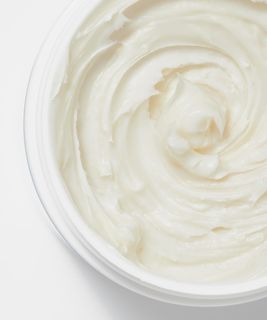
Dermadoctor Calm, Cool & Corrected 1% Colloidal Oatmeal Skin Replenishing Balm
Works for
1 of 2 advertised claims delivered
Moisturizing18 ingredients credited for this claimStrong support
“A rich moisturising cream.”
This product can help improve hydration of the skin with the two types of ingredients.
The first type is called “humectants”:
these ingredients help attract water.
When humectants are on the surface of the skin, they “pull in” the moisture from the outside environment, or from
within deeper layers of the skin. The following ingredients in this product do the job:
glycerin, sodium hyaluronate.
This product also contains ingredients called “occlusives”. They help reduce the speed with which our skin loses moisture to the outside environment. These ingredients also help soften the upper layer of the skin, so it feels less tight and nicer to the touch. The following ingredients in this product do the job: caprylic/capric triglyceride, squalene.
The following ingredients in this product are especially good for supporting the skin barrier and helping with the hydration level: panthenol, petrolatum
ExfoliationNo ingredient credited for this claimNo support
“DERMAdoctorKP Duty Dermatologist Formulated Body Scrub for Dry, Rough, Bumpy Skin with 10% AHAs + PHAs - 237ml31,15 $44,50 $”
This product does not contain effective exfoliating ingredients. It might be able to deliver physical exfoliation, that is scrub off some of the dead cells on the surface of the skin. We do not recommend physical exfoliation, because it is not uniform (some bits of skin can get exfoliated too much while others not at all). It can also traumatize the skin and aggrevate acne and other skin conditions.
Anti-oxidationNot advertised by the brand · 6 ingredients credited for this claimStrong support
This product contains antioxidants (superoxide dismutase) that can help neutralize free radicals in skin. By doing so, they can lessen the damage the skin gets from the UV light (sun).
The following ingredients - camellia sinensis leaf extract, squalene also can have an antioxidant effect, but there is less evidence to confirm their effectiveness in skin.
Anti-agingNot advertised by the brand · 3 ingredients credited for this claimModerate support
This product contains superoxide dismutase. This ingredient help neutralize free radicals in skin. By doing so, they might be able to prevent early signs of aging (like fine lines and wrinkles), at least to some extent. These ingredients will not be able to "reverse" signs of aging.
Can it cause trouble?
Irritancy10 flagged ingredientsLow risk
Comedogenic2 ingredients rated 2 or more on the 0–5 pore-clogging scale2 flagged
User reviews
Be the first — your take helps the next person decide.
Ingredients
Filter by role to see what each ingredient is doing.
Water~45–55%
Caprylic/capric triglyceride~6.6–8.1%
- Irritation risk
- Medium
A good mix of fatty acids that forms a protective layer on the skin. Improves the shelf life of products. Derived from coconut and glycerin
More about Caprylic/capric triglyceridePetrolatum~4.4–5.4%
- Irritation risk
- Low
One of the most effective and the most studied occlusive ingredients that creates a protective layer on top of the skin preventing moisture loss
More about PetrolatumSqualene~3.2–3.9%
- Irritation risk
- Low
- Comedogenicity
- 2/5
An oil that is naturally part of skin sebum that helps to soften its upper layer, reduce water loss and neutralize free radicals. It might be comedogenic. Avoid applying large concentrations (or pure oil) before sun exposure as oxidized squalene can clog pores and lead to skin irritation. Today squalene is mostly derived from vegetable oils or synthetized by yeast
More about SqualenePeg-100 stearate~2.4–2.9%
- Irritation risk
- Low
Helps oil and water mix togehter and creates a nice product texture
More about Peg-100 stearateGlyceryl stearate~1.9–2.3%
- Irritation risk
- Low
An emollient that softens the skin and forms a protective layer on its surface. Helps water and oil mix together
More about Glyceryl stearateCyclopentasiloxane~1.6–1.9%
- Irritation risk
- Low
A silicone that helps improve the product texture and spreadability. Can absorb oil creating a short-term mattifying effect on the skin
More about CyclopentasiloxanePentaerythrityl tetraisostearate~1.4–1.7%
- Irritation risk
- Medium
Used to create a thicker product consistency
More about Pentaerythrityl tetraisostearateGlycerin~1.1–1.4%
- Irritation risk
- Low
One of the best moisturizing ingredients. Naturally present in skin. It attracts water to the upper layer of the skin working as a humectant
More about GlycerinCetyl alcohol~1–1.2%
- Irritation risk
- Low
A non-drying alcohol that works to soften the skin and stabilize product formulations helping oil and water mix together
More about Cetyl alcoholCyclohexasiloxane~0.65–1%
- Irritation risk
- Low
A silicone that serves as an emollient. Helps create a nice non-greasy feels
More about CyclohexasiloxaneSodium hydroxide~0.5–0.8%
Superoxide dismutase~0.45–0.7%
- Irritation risk
- Low
An antioxidant enzyme that is naturally present in skin. It can help support skin barrier function and reduce inflammation in skin. It is used in topical medications for inflammatory skin conditions including atopic dermatitis (eczema) and psoriasis. There are three types of natural Superoxide Dismutase in human skin. The compound used in topical treatments and cosmetics are mimics of typically one of these natural variants
More about Superoxide dismutaseSodium hyaluronate~0.4–0.65%
- Irritation risk
- Low
One of the best moisturizing ingredients. Attracts water into the upper layer of the skin
More about Sodium hyaluronateNordihydroguaiaretic acid~0.35–0.65%
- Irritation risk
- Medium
Used to stabilize the formula of product formulation. Might be helpful in neutralizing free radicals in skin
More about Nordihydroguaiaretic acidOleanolic acid~0.35–0.6%
- Irritation risk
- Low
Might be helpful against blemishes, work as an anti-oxidant, reduce inflammation and improve skin's ability to hold on to moisture, but more research is needed to confirm its effectiveness when applied topically to human skin
More about Oleanolic acidCamellia sinensis leaf extract~0.35–0.65%
- Irritation risk
- Low
Can contain potent anti-oxidant compounds (abbreviated ECG, GCG, EGC, and EGCG) that might help protect the skin from free radicals. Can help calm down inflammation and has some anti-bacterial properties. Unfortunately, these antioxidants are unstable and lose their effectiveness very quickly in products. The concentration of the antioxidant compounds in the extract also tends to be low to be effective in topical formulation
More about Camellia sinensis leaf extractTocopheryl acetate~0.3–0.55%
- Irritation risk
- Medium
A more stable but less bio-available form of vitamin E compared to Tocopherol. Might help moisturize and protect the skin from free radicals, but mostly used in low concentrations to stabilize other ingredients.
More about Tocopheryl acetateButyrospermum parkii butter~0.3–0.6%
- Irritation risk
- Low
- Comedogenicity
- 3/5
A great moisturising ingredient that softens the skin and reduces water loss from its upper layer. It also can be helpful in protecting skin from free radicals
More about Butyrospermum parkii butterChamomilla recutita flower extract~0.25–0.45%
- Irritation risk
- High
Plant extract that can have healing and anti-inflammatory properties. It is a potential allergen and can be irritating
More about Chamomilla recutita flower extractAloe barbadensis leaf juice powder~0.25–0.45%
- Irritation risk
- Medium
Traditionally used to treat sunburns, dermatitis and inflammation, but evidence for its effectiveness is lacking. The extract can contain humectants that help attract water into the skin
More about Aloe barbadensis leaf juice powderPanthenol~0.25–0.4%
- Irritation risk
- Low
Helps attract water to the upper layer of the skin and can help improve skin barrier function
More about PanthenolCitric acid~0.2–0.35%
- Irritation risk
- Medium
Can work as an exfoliant but is typically used to adjust the product pH
More about Citric acidPalmitic acid~0.25–0.45%
- Irritation risk
- Low
An emollient that is naturally present in skin and helps soften it
More about Palmitic acidCarbomer~0.2–0.35%
- Irritation risk
- Low
Helps create a thicker or gel-like product texture. It is not a surfactant but can be used in gentle cleansing formulations
More about CarbomerEthylhexylglycerin~0.2–0.35%
Peg-60 almond glycerides~0.15–0.3%
Caprylyl glycol~0.15–0.25%
- Irritation risk
- Medium
Helps preserve products and creates a nice product texture
More about Caprylyl glycolHexylene glycol~0.1–0.15%
- Irritation risk
- Medium
Helps create a more spreadable product texture
More about Hexylene glycolButylene glycol~0.05–0.1%
- Irritation risk
- Low
Used to create a nice product texture and help delivery of other ingredients. Might be somewhat helpful in attracting water to the upper layer of the skin
More about Butylene glycolStearyl alcohol~0.1–0.2%
- Irritation risk
- Low
An emollient that helps soften the skin
More about Stearyl alcoholPhenoxyethanol~0.05–0.1%
- Irritation risk
- Low
A preservative. It helps prevent bacterial growth in cosmetic products
More about PhenoxyethanolIngredient list view
Water, Caprylic/capric triglyceride, Petrolatum, Squalene, Peg-100 stearate, Glyceryl stearate, Cyclopentasiloxane, Pentaerythrityl tetraisostearate, Glycerin, Cetyl alcohol, Cyclohexasiloxane, Sodium hydroxide, Superoxide dismutase, Sodium hyaluronate, Nordihydroguaiaretic acid, Oleanolic acid, Camellia sinensis leaf extract, Tocopheryl acetate, Butyrospermum parkii butter, Chamomilla recutita flower extract, Aloe barbadensis leaf juice powder, Panthenol, Citric acid, Palmitic acid, Carbomer, Ethylhexylglycerin, Peg-60 almond glycerides, Caprylyl glycol, Hexylene glycol, Butylene glycol, Stearyl alcohol, Phenoxyethanol
Compare prices
Retailers ranked by price — lowest first.
Product summary
"Dermadoctor - Calm, Cool & Corrected 1% Colloidal Oatmeal Skin Replenishing Balm" is effective for: Moisturizing
This moisturizer could be helpful for: Anti-aging, but its actives are not the most effective or are not well-studied.
About the brand
According to Cruelty-Free Kitty "Dermadoctor" is cruelty free and so is its parent company.
Sources cited in this review
Every concentration estimate and effectiveness label is anchored to one of these 22 studies and safety reviews.
- 1Squalene and its potential clinical useseuropepmc.org
- 2
- 3Enhanced comedo formation in rabbit ear skin by squalene and oleic acid peroxidesonlinelibrary.wiley.com
- 4
- 5
- 6

Affiliate links · As an Amazon Associate, WIMJ earns from qualifying purchases.