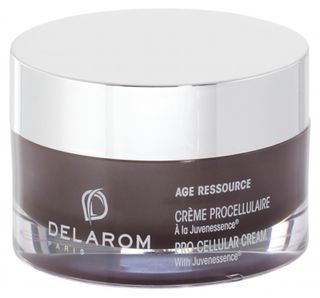
Works for
1 of 2 advertised claims delivered
MoisturizingTheobroma cacao seed butter, Glycine soja oil + 11 moreGood evidence
“More homogeneous, the skin is firmer, wrinkles and fine lines disappear.The skin is moisturized, radiant, tonic and replumped.”
This product can help improve hydration of the skin with the two types of ingredients.
The first type is called “humectants”:
these ingredients help attract water.
When humectants are on the surface of the skin, they “pull in” the moisture from the outside environment, or from
within deeper layers of the skin. The following ingredients in this product do the job:
algae extract, rosa damascena flower water.
This product also contains ingredients called “occlusives”. They help reduce the speed with which our skin loses moisture to the outside environment. These ingredients also help soften the upper layer of the skin, so it feels less tight and nicer to the touch. The following ingredients in this product do the job: caprylic/capric triglyceride, algae extract.
Anti-agingDipalmitoyl hydroxyproline, Algae extract + 1 moreLimited evidence
“More homogeneous, the skin is firmer, wrinkles and fine lines disappear.The skin is moisturized, radiant, tonic and replumped.”
This product does not contain ingredients that are able to reduce fine lines and wrinkles or help with skin elasticity, but it can improve the look of the skin temporarily through moisturization. Well-moisturized skin might also be able to repair the sun damage better.This ingredient - dipalmitoyl hydroxyproline - could be helpful for preventing or repairing signs of aging in theory, but there is no evidence that it actually works.
Can it cause trouble?
Irritancy3 strong irritants: Rosa damascena flower water, Parfum + 1 more — patch-test recommendedHigh risk
Comedogenic5 ingredients rated 2 or more on the 0–5 pore-clogging scale5 flagged
User reviews
Be the first — your take helps the next person decide.
Ingredients
Filter by role to see what each ingredient is doing.
Water~45–55%
Rosa damascena flower water~8–9.8%
- Irritation risk
- High
Used to add a nice rose smell to the product. Might help attract water to the upper layer of the skin and have some anti-oxidant effect. Can be irritating
More about Rosa damascena flower waterCentaurea cyanus flower water~4.8–5.9%
- Irritation risk
- High
Cornflower water. Might have an anti-oxidant effect and can help reduce inflammation in skin. However, it can be irritating on its own
More about Centaurea cyanus flower waterIsostearyl isostearate~3.3–4.1%
- Irritation risk
- Medium
- Comedogenicity
- 3/5
Helps soften the upper layer of the skin and improve the product texture. It can be comedogenic
More about Isostearyl isostearateVegetable oil~2.5–3.1%
- Irritation risk
- Low
An oil from a mixture of different vegetables. Helps soften the upper layer of the skin
More about Vegetable oilTheobroma cacao seed butter~2–2.5%
- Irritation risk
- Low
- Comedogenicity
- 3/5
Helps soften the upper layer of the skin and can be helpful in restoring the skin barrier function. Might have some anti-oxidant effect
More about Theobroma cacao seed butterGlyceryl stearate~1.7–2.1%
- Irritation risk
- Low
An emollient that softens the skin and forms a protective layer on its surface. Helps water and oil mix together
More about Glyceryl stearateOryza sativa starch~1.5–1.9%
- Irritation risk
- Low
Caprylic/capric triglyceride~1.3–1.6%
- Irritation risk
- Medium
A good mix of fatty acids that forms a protective layer on the skin. Improves the shelf life of products. Derived from coconut and glycerin
More about Caprylic/capric triglycerideOlea europaea fruit oil~0.95–1.2%
- Irritation risk
- Medium
An emollient that helps soften the skin but is not effective for restoring its barrier function. Might be helpful to calm down inflammation
More about Olea europaea fruit oilArgania spinosa kernel oil~0.7–1.05%
- Irritation risk
- Medium
An emollient that helps soften the upper layer of the skin. Might have some weak anti-oxidant properties
More about Argania spinosa kernel oilBenzyl alcohol~0.5–0.75%
- Irritation risk
- High
A preservative. Can be used to mask unpleasant smell. Can be irritating
More about Benzyl alcoholCetearyl glucoside~0.5–0.8%
- Irritation risk
- Medium
Helps water and oil in the product mix well together and improves product texture
More about Cetearyl glucosideParfum~0.45–0.7%
- Irritation risk
- High
An aromatic blend of unspecified and possibly irritating ingredients
More about ParfumDipalmitoyl hydroxyproline~0.45–0.65%
- Irritation risk
- Low
Is claimed to stimulate collagen and elastin production, as well as work as an anti-oxidant. There is however not enough evidence for its effectiveness
More about Dipalmitoyl hydroxyprolineHydrogenated vegetable oil~0.45–0.7%
- Irritation risk
- Low
- Comedogenicity
- 2/5
An oil from a mixture of different vegetables. Helps soften the upper layer of the skin
More about Hydrogenated vegetable oilTocopherol~0.45–0.65%
- Irritation risk
- Low
Pure form of vitamin E. Can help moisturise and protect the skin from free radicals. Often used to help stabilise other ingredients or the formula itself
More about TocopherolGlycine soja oil~0.4–0.6%
- Irritation risk
- Medium
- Comedogenicity
- 2/5
A good emollient that helps soften the skin and helps repair its barrier function. It can clog pores if used in high concentrations.
More about Glycine soja oilPalmitic acid~0.45–0.65%
- Irritation risk
- Low
An emollient that is naturally present in skin and helps soften it
More about Palmitic acidEuphorbia cerifera wax~0.4–0.6%
- Irritation risk
- Low
Carbomer~0.25–0.5%
- Irritation risk
- Low
Helps create a thicker or gel-like product texture. It is not a surfactant but can be used in gentle cleansing formulations
More about CarbomerDehydroacetic acid~0.25–0.45%
Sodium hydroxide~0.25–0.45%
Citric acid~0.2–0.4%
- Irritation risk
- Medium
Can work as an exfoliant but is typically used to adjust the product pH
More about Citric acidMimosa tenuiflora bark extract~0.2–0.35%
- Irritation risk
- Low
Algae extract~0.25–0.45%
- Irritation risk
- Low
- Comedogenicity
- 3/5
Plant extract that helps the skin to attract water and make it more smooth for touch. Also shows promise of anti-aging properties, but research is not extensive yet
More about Algae extractAnthemis nobilis flower oil~0.1–0.25%
- Irritation risk
- High
An essential oil that is used as a fragrance and can be irritating. It might have some anti-oxidant effect in skin
More about Anthemis nobilis flower oilHydrolyzed beta-glucan~0.15–0.25%
- Irritation risk
- Low
Sodium benzoate~0.1–0.2%
Potassium sorbate~0.1–0.2%
Benzyl alcohol~0.05–0.1%
- Irritation risk
- High
A preservative. Can be used to mask unpleasant smell. Can be irritating
More about Benzyl alcoholLimonene~0.05%
- Irritation risk
- High
A common frangrance that can easily irritate skin, especially if exposed to air, light or heat
More about LimoneneIngredient list view
Water, Rosa damascena flower water, Centaurea cyanus flower water, Isostearyl isostearate, Vegetable oil, Theobroma cacao seed butter, Glyceryl stearate, Oryza sativa starch, Caprylic/capric triglyceride, Olea europaea fruit oil, Argania spinosa kernel oil, Benzyl alcohol, Cetearyl glucoside, Parfum, Dipalmitoyl hydroxyproline, Hydrogenated vegetable oil, Tocopherol, Glycine soja oil, Palmitic acid, Euphorbia cerifera wax, Carbomer, Dehydroacetic acid, Sodium hydroxide, Citric acid, Mimosa tenuiflora bark extract, Algae extract, Anthemis nobilis flower oil, Hydrolyzed beta-glucan, Sodium benzoate, Potassium sorbate, Benzyl alcohol, Limonene
Compare prices
Retailers ranked by price — lowest first.
Sources cited in this review
Every concentration estimate and effectiveness label is anchored to one of these 9 studies and safety reviews.
- 1
- 2
- 3
- 4Use of “natural” oils for moisturization: Review of olive, coconut, and sunflower seed oilonlinelibrary.wiley.com
- 5
- 6Vitamin E in dermatologyncbi.nlm.nih.gov

Affiliate links · As an Amazon Associate, WIMJ earns from qualifying purchases.