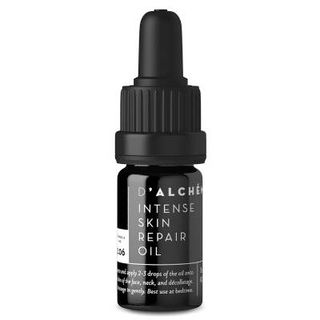
DALCHMY D'ALCHÉMY INTENSE SKIN REPAIR OIL
Works for
1 of 3 advertised claims delivered
Moisturizing18 ingredients credited for this claimGood support
“Supports defence mechanisms and stimulates skin regeneration.”
This product can help soften the skin and reduce its moisture loss with emollients and occlusives: caprylic/capric triglyceride, cocos nucifera oil.
Keep in mind that this product does not contain effective ingredients to attract water to the upper layer of the skin. This is why an additional product with humectants like glycerin or hyaluronic acid can be helpful (apply it before this product for the best results).
Anti-aging1 ingredient credited for this claimLimited support
“Argan and linseed oils – effectively moisturise and soften the epidermis, reduce the volume and appearance of wrinkles, and help restore the skin's hydro-lipid barrier by stimulating its regeneration.”
This product does not contain ingredients that are able to reduce fine lines and wrinkles or help with skin elasticity, but it can improve the look of the skin temporarily through moisturization. Well-moisturized skin might also be able to repair the sun damage better.
This ingredient squalene might be able to help neutralize free radicals in skin and help it fight off some of the sun damage.
Evens skin toneNo ingredient credited for this claimNo support
“Camu camu fruit extract – rejuvenates the skin, eliminates lines and wrinkles, and lightens hyperpigmentation.”
Effective ingredients missing or their concentration is too low
Anti-oxidationNot advertised by the brand · 8 ingredients credited for this claimModerate support
This product contains antioxidants (squalene) that might be able to help neutralize free radicals in skin to lessen the damage it gets from the UV light (sun). There is not enough evidence to confirm their effectiveness in skin though.
Can it cause trouble?
Irritancy13 strong irritants: Rosa damascena extract, Rosa damascena flower oil + 11 more — patch-test recommendedHigh risk
Comedogenic3 ingredients rated 2 or more on the 0–5 pore-clogging scale3 flagged
User reviews
Be the first — your take helps the next person decide.
Ingredients
Filter by role to see what each ingredient is doing.
Caprylic/capric triglyceride~23–34%
- Irritation risk
- Medium
A good mix of fatty acids that forms a protective layer on the skin. Improves the shelf life of products. Derived from coconut and glycerin
More about Caprylic/capric triglyceridePrunus amygdalus dulcis seed~5.1–7.6%
- Irritation risk
- Low
Helps soften the upper layer of the skin
More about Prunus amygdalus dulcis seedSimmondsia chinensis seed oil~5–7.5%
- Irritation risk
- Medium
Softens the upper layer of skin and helps restore the healthy skin barrier. Has shown to help calm down inflammation in skin. It is a stable oil, meaning that it retains its properties even when exposed to air.
More about Simmondsia chinensis seed oilSqualane~4–6%
- Irritation risk
- Low
An oil naturally present in skin. Works as an emollient to soften the skin and form a protective layer on its surface without a greasy feeling.
More about SqualaneVitis vinifera seed oil~2.9–4.3%
- Irritation risk
- Medium
A great emollient that can also have anti-oxidant properties
More about Vitis vinifera seed oilIsopropyl isostearate~2.1–3.2%
- Irritation risk
- Low
- Comedogenicity
- 3/5
An emollient that helps soften the skin
More about Isopropyl isostearateArgania spinosa kernel oil~1.6–2.5%
- Irritation risk
- Medium
An emollient that helps soften the upper layer of the skin. Might have some weak anti-oxidant properties
More about Argania spinosa kernel oilHelianthus annuus seed oil~1.5–2.3%
- Irritation risk
- Low
A great emollient due to its high linoleic acid content. One of the most effective plant oils in helping skin hydration and repairing skin barrier function
More about Helianthus annuus seed oilMalpighia emarginata fruit extract~1.1–1.6%
- Irritation risk
- Low
Paullinia cupana fruit extract~0.85–1.3%
- Irritation risk
- High
Vaccinium macrocarpon fruit extract~0.5–1.2%
- Irritation risk
- High
A berry extract. Might have some anti-oxidant properties
More about Vaccinium macrocarpon fruit extractHippophae rhamnoides fruit extract~0.45–1.05%
- Irritation risk
- Medium
A plant extract that might help neutralize free radicals in skin, but research on its effectiveness is lacking
More about Hippophae rhamnoides fruit extractMyrciaria dubia fruit extract~0.4–0.95%
- Irritation risk
- Medium
A plant extract that might help neutralize free radicals in skin, but research on its effectiveness is lacking
More about Myrciaria dubia fruit extractCocos nucifera oil~0.4–0.95%
- Irritation risk
- Low
- Comedogenicity
- 3/5
An emollient. Found to be as effective as a moisturizer for dry skin as mineral oil. Could be comedogenic
More about Cocos nucifera oilLinum usitatissimum seed oil~0.35–0.8%
Persea gratissima oil~0.45–1%
- Irritation risk
- Medium
An emollient that helps soften the skin and could be helpful in repairing its barrier function
More about Persea gratissima oilMacadamia ternifolia seed oil~0.4–0.95%
- Irritation risk
- Medium
Plant oil from nuts that helps soften the upper layer of the skin. Contains a high concentration of oleic acid that can weaken skin's barrier function and increase water-loss while enhancing penetration of other ingredients
More about Macadamia ternifolia seed oilOlea europaea fruit oil~0.35–0.85%
- Irritation risk
- Medium
An emollient that helps soften the skin but is not effective for restoring its barrier function. Might be helpful to calm down inflammation
More about Olea europaea fruit oilRosa damascena extract~0.3–0.7%
- Irritation risk
- High
Oil of a very fragrant pink rose used as fragrance in cosmetics. Extensive research has shown it has mixed benefits. In the pro column, inhaling this flower’s scent seems to have relaxing properties and the plant’s petals contain skin-soothing and antioxidant compounds that can benefit skin. On the flipside, the numerous chemicals that create this rose’s distinctive fragrance pose a risk of causing skin aggravation.
More about Rosa damascena extractRosa damascena flower oil~0.2–0.75%
- Irritation risk
- High
Used as a fragrance. Can be irritating
More about Rosa damascena flower oilPistacia lentiscus gum~0.35–0.85%
- Irritation risk
- High
A tree rasin that could temporarily tighten the skin and might help regulate sebum production, but the research on its effectiveness in skin is lacking
More about Pistacia lentiscus gumSantalum album wood oil~0.15–0.7%
- Irritation risk
- High
Mauritia flexuosa fruit oil~0.2–0.7%
- Irritation risk
- Medium
Helps soften the upper layer of the skin
More about Mauritia flexuosa fruit oilEugenia caryophyllus bud oil~0.15–0.65%
Rosmarinus officinalis oil~0.15–0.65%
- Irritation risk
- Low
Beta-sitosterol~0.3–0.75%
- Irritation risk
- Low
A phytosterol that can support skin's barrier function and help the skin stay hydrated
More about Beta-sitosterolTocopherol~0.15–0.7%
- Irritation risk
- Low
Pure form of vitamin E. Can help moisturise and protect the skin from free radicals. Often used to help stabilise other ingredients or the formula itself
More about TocopherolSqualene~0.35–0.8%
- Irritation risk
- Low
- Comedogenicity
- 2/5
An oil that is naturally part of skin sebum that helps to soften its upper layer, reduce water loss and neutralize free radicals. It might be comedogenic. Avoid applying large concentrations (or pure oil) before sun exposure as oxidized squalene can clog pores and lead to skin irritation. Today squalene is mostly derived from vegetable oils or synthetized by yeast
More about SqualeneParfum~0.15–0.55%
- Irritation risk
- High
An aromatic blend of unspecified and possibly irritating ingredients
More about ParfumRosmarinus officinalis leaf extract~0.15–0.5%
- Irritation risk
- High
Can be helpful in reducing inflammation in skin, including inflamed acne. It can be irritating
More about Rosmarinus officinalis leaf extractCitral~0.1–0.45%
Citronellol~0.1–0.4%
Eugenol~0.1–0.35%
Farnesol~0.1–0.35%
Geraniol~0.05–0.25%
Linalool~0.05–0.25%
Limonene~0.05–0.2%
- Irritation risk
- High
A common frangrance that can easily irritate skin, especially if exposed to air, light or heat
More about LimoneneIngredient list view
Caprylic/capric triglyceride, Prunus amygdalus dulcis seed, Simmondsia chinensis seed oil, Squalane, Vitis vinifera seed oil, Isopropyl isostearate, Argania spinosa kernel oil, Helianthus annuus seed oil, Malpighia emarginata fruit extract, Paullinia cupana fruit extract, Vaccinium macrocarpon fruit extract, Hippophae rhamnoides fruit extract, Myrciaria dubia fruit extract, Cocos nucifera oil, Linum usitatissimum seed oil, Persea gratissima oil, Macadamia ternifolia seed oil, Olea europaea fruit oil, Rosa damascena extract, Rosa damascena flower oil, Pistacia lentiscus gum, Santalum album wood oil, Mauritia flexuosa fruit oil, Eugenia caryophyllus bud oil, Rosmarinus officinalis oil, Beta-sitosterol, Tocopherol, Squalene, Parfum, Rosmarinus officinalis leaf extract, Citral, Citronellol, Eugenol, Farnesol, Geraniol, Linalool, Limonene
Compare prices
Retailers ranked by price — lowest first.
Sources cited in this review
Every concentration estimate and effectiveness label is anchored to one of these 21 studies and safety reviews.
- 1
- 2
- 3
- 4Effect of topically applied lipids on surfactant-irritated skinonlinelibrary.wiley.com
- 5
- 6Abundance of active ingredients in sea-buckthorn oilncbi.nlm.nih.gov

Affiliate links · As an Amazon Associate, WIMJ earns from qualifying purchases.