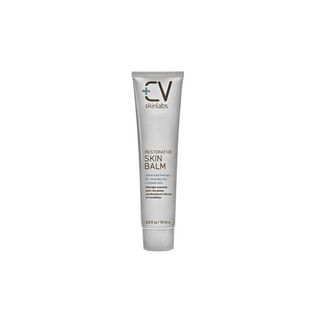
CV Skinlabs Restorative Skin Balm
Works for
1 of 1 advertised claim delivered
Moisturizing19 ingredients credited for this claimStrong support
“Restorative Skin Balm”
This product can help improve hydration of the skin with the two types of ingredients.
The first type is called “humectants”:
these ingredients help attract water.
When humectants are on the surface of the skin, they “pull in” the moisture from the outside environment, or from
within deeper layers of the skin. The following ingredients in this product do the job:
glycerin.
This product also contains ingredients called “occlusives”. They help reduce the speed with which our skin loses moisture to the outside environment. These ingredients also help soften the upper layer of the skin, so it feels less tight and nicer to the touch. The following ingredients in this product do the job: beeswax, caprylic/capric triglyceride.
The following ingredients in this product are especially good for supporting the skin barrier and helping with the hydration level: lanolin
Can it cause trouble?
Irritancy3 strong irritants: Calendula officinalis flower extract, Arnica montana flower extract + 1 more — patch-test recommendedHigh risk
Comedogenic2 ingredients rated 2 or more on the 0–5 pore-clogging scale2 flagged


User reviews
Be the first — your take helps the next person decide.
Ingredients
Filter by role to see what each ingredient is doing.
Ricinus communis seed oil~25–37%
- Irritation risk
- Medium
A plant oil that can help soften the skin. It might be helpful in calming down inflammation, but solid research is lacking. Is often used in lip products to create the needed product consistency
More about Ricinus communis seed oilLanolin~5–7.5%
- Irritation risk
- Low
Sebum of wool-bearing animals (most commonly sheep). Helps soften the upper layer of the skin and reduce the skin water loss. In rare cases could be an allergen. Not suitable for vegans
More about LanolinRicinus communis seed oil~4.8–7.1%
- Irritation risk
- Medium
A plant oil that can help soften the skin. It might be helpful in calming down inflammation, but solid research is lacking. Is often used in lip products to create the needed product consistency
More about Ricinus communis seed oilCopernicia cerifera wax~3.8–5.7%
- Irritation risk
- Low
Helps to soften the upper layer of the skin and create a nice product consistency
More about Copernicia cerifera waxBeeswax~2.8–4.3%
- Irritation risk
- Low
Forms a protective barrier that holds water and keeps dry skin hydrated. Keeps an emulsion from separating into its oil and liquid components, and increases the thickness of a product. Can be an allergen
More about BeeswaxCera alba~2.6–3.9%
- Irritation risk
- Medium
Forms a protective barrier that holds water and keeps dry skin hydrated. Keeps an emulsion from separating into its oil and liquid components, and increases the thickness of a product. Can be an allergen
More about Cera albaCaprylic/capric triglyceride~1.8–2.6%
- Irritation risk
- Medium
A good mix of fatty acids that forms a protective layer on the skin. Improves the shelf life of products. Derived from coconut and glycerin
More about Caprylic/capric triglycerideGlycerin~1.4–2.1%
- Irritation risk
- Low
One of the best moisturizing ingredients. Naturally present in skin. It attracts water to the upper layer of the skin working as a humectant
More about GlycerinC10-18 triglycerides~1.2–1.8%
- Irritation risk
- Low
Helps soften the skin and attract water to its upper layer. Helps create nice product texture
More about C10-18 triglyceridesEuphorbia cerifera wax~1.1–1.7%
- Irritation risk
- Low
Carthamus tinctorius seed oil~0.6–1.35%
- Irritation risk
- Low
An emollient that helps soften the skin and might help calm down inflammation
More about Carthamus tinctorius seed oilAcacia decurrens/jojoba/sunflower seed wax polyglyceryl-3 esters~0.5–1.15%
- Irritation risk
- Medium
Helps soften the upper layer of the skin and create a nice product texture
More about Acacia decurrens/jojoba/sunflower seed wax polyglyceryl-3 estersButyrospermum parkii butter~0.45–1.05%
- Irritation risk
- Low
- Comedogenicity
- 3/5
A great moisturising ingredient that softens the skin and reduces water loss from its upper layer. It also can be helpful in protecting skin from free radicals
More about Butyrospermum parkii butterGlycine soja oil~0.4–0.9%
- Irritation risk
- Medium
- Comedogenicity
- 2/5
A good emollient that helps soften the skin and helps repair its barrier function. It can clog pores if used in high concentrations.
More about Glycine soja oilSimmondsia chinensis seed oil~0.4–0.9%
- Irritation risk
- Medium
Softens the upper layer of skin and helps restore the healthy skin barrier. Has shown to help calm down inflammation in skin. It is a stable oil, meaning that it retains its properties even when exposed to air.
More about Simmondsia chinensis seed oilTocopherol~0.3–0.7%
- Irritation risk
- Low
Pure form of vitamin E. Can help moisturise and protect the skin from free radicals. Often used to help stabilise other ingredients or the formula itself
More about TocopherolPrunus amygdalus dulcis seed~0.2–0.75%
- Irritation risk
- Low
Helps soften the upper layer of the skin
More about Prunus amygdalus dulcis seedSqualane~0.35–0.75%
- Irritation risk
- Low
An oil naturally present in skin. Works as an emollient to soften the skin and form a protective layer on its surface without a greasy feeling.
More about SqualaneGanoderma lucidum extract~0.15–0.55%
- Irritation risk
- Medium
Helps attract water to the upper layer of the skin
More about Ganoderma lucidum extractCalendula officinalis flower extract~0.1–0.5%
- Irritation risk
- High
A plant extract that has some anti-oxidant and anti-bacterial properties. Can be irritating
More about Calendula officinalis flower extractCurcuma longa root extract~0.1–0.45%
- Irritation risk
- High
A plant extract that can contain an active compound curcumin, that may have some anti-inflammatory properties when applied to the skin, but solid research is lacking and the typical concentration used in skincare products is too low. Can be an irritant
More about Curcuma longa root extractArnica montana flower extract~0.1–0.45%
- Irritation risk
- High
A plant extract that can be irritating. It can have some anti-bacterial properties, but there are no evidence of a beneficial effect for skin
More about Arnica montana flower extractBisabolol~0.1–0.4%
- Irritation risk
- Low
An active component of chamomile plant that historically has been used to calm down irritated skin. A recent study shows that bisabolol indeed can have some anti-inflammatory effect on skin, even though conclusive data is lacking. Bisabolol has a sweet floral scent and can be added to products for its aromatic properties
More about BisabololZingiber officinale root extract~0.1–0.35%
- Irritation risk
- High
A plant extract that can contain an irritating essential oil. Might have some anti-oxidant effect, but evidence is lacking
More about Zingiber officinale root extractHippophae rhamnoides oil~0.15–0.55%
- Irritation risk
- High
A good emollient. Contains various ingredients including vitamins and fatty acids that could work in the skin to neutralize free radicals and minimize moisture loss - if enough of these compounds is able to penetrate the skin in an active form.
More about Hippophae rhamnoides oilHippophae rhamnoides kernel extract~0.1–0.3%
- Irritation risk
- Low
Rosa canina fruit oil~0.1–0.45%
- Irritation risk
- Medium
A great emollient. Contains vitamin E (tocopherol) which may give it some anti-oxidant properties. Can contain volatile compounds and can be irritating
More about Rosa canina fruit oilChamomilla recutita flower extract~0.05–0.2%
- Irritation risk
- High
Plant extract that can have healing and anti-inflammatory properties. It is a potential allergen and can be irritating
More about Chamomilla recutita flower extractIngredient list view
Ricinus communis seed oil, Lanolin, Ricinus communis seed oil, Copernicia cerifera wax, Beeswax, Cera alba, Caprylic/capric triglyceride, Glycerin, C10-18 triglycerides, Euphorbia cerifera wax, Carthamus tinctorius seed oil, Acacia decurrens/jojoba/sunflower seed wax polyglyceryl-3 esters, Butyrospermum parkii butter, Glycine soja oil, Simmondsia chinensis seed oil, Tocopherol, Prunus amygdalus dulcis seed, Squalane, Ganoderma lucidum extract, Calendula officinalis flower extract, Curcuma longa root extract, Arnica montana flower extract, Bisabolol, Zingiber officinale root extract, Hippophae rhamnoides oil, Hippophae rhamnoides kernel extract, Rosa canina fruit oil, Chamomilla recutita flower extract
Compare prices
Retailers ranked by price — lowest first.
Worth comparing, line by line.
Match % combines shared ingredients, the first five ingredients, shared actives and hero ingredients, irritancy (lower counts in the alternative's favour), texture and body area. Only products in the same routine step are compared.
| CV SkinlabsRestorative Skin BalmYOUR PRODUCT | LanoThe Original LanoStick | Lanolips101 Dry Skin Super Cream | |
|---|---|---|---|
| Match | — | 56% | 50% |
| Price | $26.00 | $16.95−$9.05 | $14.53−$11.47 |
| Shared key ingredients | — | 7 of 16 | 9 of 16 |
| Key difference | — | Euphorbia Cerifera Cera | Vitis Vinifera Seed Oil |
| Irritancy | High | Medium | High |
| Drying alcohol | — | — | — |
| View product | Shop | Shop |

Product summary
"CV Skinlabs - Restorative Skin Balm" has a good moisturizing formula. To work well, any moisturizer needs to include a combination of water-binding and emollient ingredients. CV Skinlabs - Restorative Skin Balm ticks this box. Humectants in this product (glycerin) help to increase the water content in the upper layer of the skin. (These ingredients do so by "capturing" water molecules from the outside air or from within the deeper layers of the skin). Lanolin, carthamus tinctorius seed oil, glycine soja oil, hippophae rhamnoides oil and beeswax in this product help decrease the water evoporation from the skin, so that it stays hydrated for longer. These ingredients also soften the skin and take away the feeling of tightness and dryness.
This product contains ingredients that could be beneficial, but their concentrations are too low in this formulation: rosehip oil, vitamin e and jojoba oilIrritation risk
This moisturizer contains some common irritants, including those without a benefit for the skin. We assess the overall irritancy of this moisturizer to be high. For a detailed overview of all potential irritants: click here
You can see the detailed formula review with the breakdown of all actives in the product and the full ingredient list with estimated concentrations in the tables below.
Sources cited in this review
Every concentration estimate and effectiveness label is anchored to one of these 19 studies and safety reviews.
- 1
- 2
- 3
- 4
- 5
- 6

Affiliate links · As an Amazon Associate, WIMJ earns from qualifying purchases.