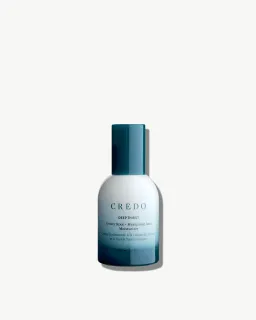
Credo Skincare Deep Thirst Vetiver Root + Hyaluronic Acid Moisturizer for Dry Skin
Works for
1 of 1 advertised claim delivered
MoisturizingAlpha-glucan oligosaccharide, Caprylic/capric triglyceride + 19 moreGood evidence
“Deep Thirst Vetiver Root + Hyaluronic Acid Moisturizer for Dry Skin”
This product can help improve hydration of the skin with the two types of ingredients.
The first type is called “humectants”:
these ingredients help attract water.
When humectants are on the surface of the skin, they “pull in” the moisture from the outside environment, or from
within deeper layers of the skin. The following ingredients in this product do the job:
glycerin, hydrolyzed hyaluronic acid.
This product also contains ingredients called “occlusives”. They help reduce the speed with which our skin loses moisture to the outside environment. These ingredients also help soften the upper layer of the skin, so it feels less tight and nicer to the touch. The following ingredients in this product do the job: caprylic/capric triglyceride, squalane.
Can it cause trouble?
Irritancy6 strong irritants: Parfum, Citrus aurantium dulcis peel oil + 4 more — patch-test recommendedHigh risk
Comedogenic2 ingredients rated 2 or more on the 0–5 pore-clogging scale2 flagged


User reviews
Be the first — your take helps the next person decide.
Ingredients
Filter by role to see what each ingredient is doing.
Water~45–55%
Glycerin~4.4–5.4%
- Irritation risk
- Low
One of the best moisturizing ingredients. Naturally present in skin. It attracts water to the upper layer of the skin working as a humectant
More about GlycerinCoconut alkanes~4.1–5%
- Irritation risk
- Medium
- Comedogenicity
- 2/5
An emollient that helps soften the skin
More about Coconut alkanesCoco-caprylate/caprate~3.1–3.8%
- Irritation risk
- Low
Helps to soften the upper layer of the skin without creating a greasy texture
More about Coco-caprylate/caprateHydrogenated olive oil unsaponifiables~2.3–2.8%
- Irritation risk
- Low
Help soften the upper layer of the skin
More about Hydrogenated olive oil unsaponifiablesCaprylic/capric triglyceride~2–2.4%
- Irritation risk
- Medium
A good mix of fatty acids that forms a protective layer on the skin. Improves the shelf life of products. Derived from coconut and glycerin
More about Caprylic/capric triglycerideStearic acid~1.7–2.1%
- Irritation risk
- Low
Helps oil and water mix together and works as an emollient
More about Stearic acidGlyceryl stearate~1.5–1.8%
- Irritation risk
- Low
An emollient that softens the skin and forms a protective layer on its surface. Helps water and oil mix together
More about Glyceryl stearateMarrubium vulgare extract~1–1.2%
- Irritation risk
- Low
Jojoba oil/macadamia seed oil esters~0.9–1.1%
- Irritation risk
- Low
Vetiveria zizanoides root extract~0.6–0.9%
- Irritation risk
- Low
Squalane~0.6–0.9%
- Irritation risk
- Low
An oil naturally present in skin. Works as an emollient to soften the skin and form a protective layer on its surface without a greasy feeling.
More about SqualanePhytosteryl macadamiate~0.5–0.8%
- Irritation risk
- Low
Helps soften the upper layer of the skin
More about Phytosteryl macadamiatePhytosterols~0.5–0.75%
- Irritation risk
- Medium
Lipids that work as an emollient and can be helpful in repairing skin barrier function
More about PhytosterolsTocopherol~0.4–0.6%
- Irritation risk
- Low
Pure form of vitamin E. Can help moisturise and protect the skin from free radicals. Often used to help stabilise other ingredients or the formula itself
More about TocopherolCetearyl alcohol~0.45–0.7%
- Irritation risk
- Low
- Comedogenicity
- 2/5
A non-drying alcohol. Works as an emollient. Helps water and oil mix together and creates a nice product texture
More about Cetearyl alcoholPunica granatum sterols~0.4–0.6%
- Irritation risk
- Low
Maltodextrin~0.35–0.65%
- Irritation risk
- Low
Used to stabilize the product formulation and can help absorb oil
More about MaltodextrinSodium pca~0.3–0.6%
- Irritation risk
- Low
Naturally present in skin and helps to attract water to its upper layer
More about Sodium pcaInulin~0.3–0.55%
- Irritation risk
- Low
Helps attract water to the upper layer of the skin. Is claimed to support the growth of "good" bacteria in skin (as a "prebiotic"), but the research is lacking
More about InulinAlpha-glucan oligosaccharide~0.35–0.6%
- Irritation risk
- Low
Helps attract water to the upper layer of the skin
More about Alpha-glucan oligosaccharideHydrolyzed hyaluronic acid~0.25–0.5%
- Irritation risk
- Low
One of the best moisturizing ingredients. Attracts water into the upper layer of the skin. A version of it is naturally present in skin
More about Hydrolyzed hyaluronic acidOpuntia ficus-indica seed oil~0.3–0.55%
- Irritation risk
- Medium
A plant oil that helps soften the upper layer of the skin and can support skin's barrier function due to its high content of linoleic acid. It also has anti-microbial properties
More about Opuntia ficus-indica seed oilPotassium cetyl phosphate~0.3–0.55%
- Irritation risk
- Medium
Helps oil and water mix together
More about Potassium cetyl phosphateCaprylyl glycol~0.3–0.5%
- Irritation risk
- Medium
Helps preserve products and creates a nice product texture
More about Caprylyl glycolGlyceryl caprylate~0.3–0.55%
- Irritation risk
- Low
An emollient that can also help water and oil mix together, as well as prevent bacteria growth in products
More about Glyceryl caprylatePhenylpropanol~0.25–0.45%
- Irritation risk
- High
Helps mask the smell of other ingredients and helps preserve the product formulation
More about PhenylpropanolLactobacillus ferment~0.25–0.45%
- Irritation risk
- Low
A fermentation product created by bacteria Lactobacillus. The fermented product has anti-bacterial properties and might be helpful in calming down inflammation, but studies are lacking. Helps attract water to the upper layer of the skin. Can be used as a preservative
More about Lactobacillus fermentCarbomer~0.25–0.5%
- Irritation risk
- Low
Helps create a thicker or gel-like product texture. It is not a surfactant but can be used in gentle cleansing formulations
More about CarbomerPotassium sorbate~0.25–0.5%
Sodium phytate~0.25–0.45%
Sodium lactate~0.25–0.45%
- Irritation risk
- Medium
Helps attract water to the upper layer of the skin. Is often used to adjust the pH level of the product
More about Sodium lactateParfum~0.25–0.45%
- Irritation risk
- High
An aromatic blend of unspecified and possibly irritating ingredients
More about ParfumCaprylic/capric triglyceride~0.3–0.6%
- Irritation risk
- Medium
A good mix of fatty acids that forms a protective layer on the skin. Improves the shelf life of products. Derived from coconut and glycerin
More about Caprylic/capric triglycerideMethyldihydrojasmonate~0.25–0.5%
Tetramethyl acetyloctahydronaphthalenes~0.2–0.4%
- Irritation risk
- Low
Dimethylcyclohexylethoxy isobutylpropanoate~0.25–0.5%
- Irritation risk
- Low
Juniperus virginiana oil~0.25–0.45%
- Irritation risk
- Medium
Cedarwood oil. Used as a fragrance. Can be irritating
More about Juniperus virginiana oilDipropylene glycol~0.25–0.45%
- Irritation risk
- Low
Helps to dissolve other ingredients in a formulation. Slows down the rate of product drying
More about Dipropylene glycolCitrus aurantium dulcis peel oil~0.25–0.45%
- Irritation risk
- High
An essentil oil from orange peel. Potential allergen and can be irritating
More about Citrus aurantium dulcis peel oilTrimethylcyclopentenyl dimethylisopentenol~0.25–0.45%
- Irritation risk
- Low
Citrus limon peel oil~0.25–0.45%
Methoxytrimethylheptanol~0.25–0.45%
- Irritation risk
- Low
Coumarin~0.25–0.45%
Linalool~0.25–0.45%
Fusanus spicatus wood oil~0.25–0.5%
- Irritation risk
- Low
Methylcyclopentadecenone~0.25–0.5%
- Irritation risk
- Low
Allyl alpha-ionone~0.25–0.45%
- Irritation risk
- Low
Gamma-nonalactone~0.2–0.4%
- Irritation risk
- Low
Phenylisohexanol~0.25–0.5%
- Irritation risk
- Low
Vetiveria zizanoides root oil~0.2–0.4%
- Irritation risk
- Low
P-menthan-7-ol~0.25–0.4%
- Irritation risk
- High
Dimethyl-3-cyclohexene-1-carbaldehyde~0.25–0.4%
- Irritation risk
- Low
Ethyl methylbutyl ketoxime~0.2–0.4%
- Irritation risk
- Low
Hexenyl acetate~0.2–0.4%
- Irritation risk
- Low
Gamma-octalactone~0.2–0.4%
- Irritation risk
- Low
Geranyl acetate~0.2–0.35%
- Irritation risk
- Low
3-hexenol~0.2–0.35%
- Irritation risk
- Low
Cistus ladaniferus oil~0.25–0.45%
- Irritation risk
- Low
Beta-ionone~0.15–0.25%
- Irritation risk
- Low
Dihydro pentamethylindanone~0.1–0.25%
- Irritation risk
- Low
Dodecahydro-tetramethylnaphthofuran~0.15–0.25%
- Irritation risk
- Low
Juniperus communis fruit oil~0.15–0.25%
- Irritation risk
- Low
Linalyl acetate~0.1–0.15%
- Irritation risk
- Low
Phenethyl alcohol~0.1–0.2%
Ingredient list view
Water, Glycerin, Coconut alkanes, Coco-caprylate/caprate, Hydrogenated olive oil unsaponifiables, Caprylic/capric triglyceride, Stearic acid, Glyceryl stearate, Marrubium vulgare extract, Jojoba oil/macadamia seed oil esters, Vetiveria zizanoides root extract, Squalane, Phytosteryl macadamiate, Phytosterols, Tocopherol, Cetearyl alcohol, Punica granatum sterols, Maltodextrin, Sodium pca, Inulin, Alpha-glucan oligosaccharide, Hydrolyzed hyaluronic acid, Opuntia ficus-indica seed oil, Potassium cetyl phosphate, Caprylyl glycol, Glyceryl caprylate, Phenylpropanol, Lactobacillus ferment, Carbomer, Potassium sorbate, Sodium phytate, Sodium lactate, Parfum, Caprylic/capric triglyceride, Methyldihydrojasmonate, Tetramethyl acetyloctahydronaphthalenes, Dimethylcyclohexylethoxy isobutylpropanoate, Juniperus virginiana oil, Dipropylene glycol, Citrus aurantium dulcis peel oil, Trimethylcyclopentenyl dimethylisopentenol, Citrus limon peel oil, Methoxytrimethylheptanol, Coumarin, Linalool, Fusanus spicatus wood oil, Methylcyclopentadecenone, Allyl alpha-ionone, Gamma-nonalactone, Phenylisohexanol, Vetiveria zizanoides root oil, P-menthan-7-ol, Dimethyl-3-cyclohexene-1-carbaldehyde, Ethyl methylbutyl ketoxime, Hexenyl acetate, Gamma-octalactone, Geranyl acetate, 3-hexenol, Unknown, Cistus ladaniferus oil, Beta-ionone, Dihydro pentamethylindanone, Dodecahydro-tetramethylnaphthofuran, Juniperus communis fruit oil, Linalyl acetate, Phenethyl alcohol
Compare prices
Retailers ranked by price — lowest first.

Affiliate links · prices updated regularly
Worth comparing, line by line.
Match % combines shared ingredients, the first five ingredients, shared actives and hero ingredients, irritancy (lower counts in the alternative's favour), texture and body area. Only products in the same routine step are compared.
| Credo SkincareDeep Thirst Vetiver Root + Hyaluronic Acid Moisturizer for Dry SkinYOUR PRODUCT | BielendaBeauty Molecules, B5, Molecular synbiotic ultra-moisturizing cream | OLIVARRIERComfort Barrier Cream Jumbo | Andalou NaturalsQuenching Coconut Water Visibly Firm Day Cream | |
|---|---|---|---|---|
| Match | — | 56% | 55% | 55% |
| Price | $51.20 | — | $34.52−$16.68 | — |
| Shared key ingredients | — | 5 of 13 | 5 of 13 | 4 of 13 |
| Key difference | — | Ceramide Eop | Phytosphingosine | Panthenol |
| Irritancy | High | Medium | Medium | Medium |
| Drying alcohol | — | — | — | — |
| View product | Shop | Shop | Shop |

Sources cited in this review
Every concentration estimate and effectiveness label is anchored to one of these 14 studies and safety reviews.
- 1
- 2Safety Assessment of Alkyl Esters as Used in Cosmeticscir-safety.org
- 3Safety Assessment of Phytosterols as Used in Cosmeticscir-safety.org
- 4Vitamin E in dermatologyncbi.nlm.nih.gov
- 5Vitamin E and Skin Healthlpi.oregonstate.edu
- 6

Affiliate links · As an Amazon Associate, WIMJ earns from qualifying purchases.