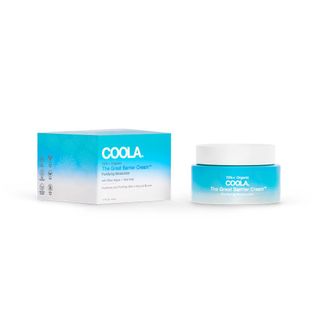
Coola The Great Barrier Cream™ Fortifying Moisturizer
Works for
1 of 1 advertised claim delivered
Moisturizing9 ingredients credited for this claimGood support
“The Great Barrier Cream™ Fortifying Moisturizer”
This product contains good ingredients to attract water to the upper layer of the skin. These ingredients are called "humectants": glycerin, hyaluronic acid.
When humectants are on the surface of the skin, they “pull in” the moisture from the outside environment, or from within deeper layers of the skin. If the air is dry, humectants can speed up the moisture loss from the skin. This is why it is a good idea to use another product on top of this one to help "seal in" the moisture (look for ingredients like dimethicone, squalane, oils and butters).
Anti-oxidationNot advertised by the brand · 2 ingredients credited for this claimModerate support
This product contains antioxidants (camellia sinensis leaf extract) that might be able to help neutralize free radicals in skin to lessen the damage it gets from the UV light (sun). There is not enough evidence to confirm their effectiveness in skin though.
Can it cause trouble?
Irritancy3 strong irritants: Jasminum sambac leaf cell extract, Parfum + 1 more — patch-test recommendedHigh risk
Comedogenic2 ingredients rated 2 or more on the 0–5 pore-clogging scale2 flagged
User reviews
Be the first — your take helps the next person decide.
Ingredients
Filter by role to see what each ingredient is doing.
Aloe barbadensis leaf juice~23–34%
- Irritation risk
- Medium
Traditionally used to treat sunburns, dermatitis and inflammation, but evidence for its effectiveness is lacking. The extract can contain humectants that help attract water into the skin
More about Aloe barbadensis leaf juiceWater~11–17%
Coco-caprylate/caprate~5.2–7.9%
- Irritation risk
- Low
Helps to soften the upper layer of the skin without creating a greasy texture
More about Coco-caprylate/caprateGlycerin~3.3–5%
- Irritation risk
- Low
One of the best moisturizing ingredients. Naturally present in skin. It attracts water to the upper layer of the skin working as a humectant
More about GlycerinDicaprylyl carbonate~2.7–4.1%
- Irritation risk
- Low
Helps products spread more easily and works as an emollient to soften skin
More about Dicaprylyl carbonatePolyglyceryl-4 isostearate~1.8–2.8%
- Irritation risk
- Medium
Helps water and oil mix together
More about Polyglyceryl-4 isostearatePropanediol~1.4–2.1%
- Irritation risk
- Low
Acts as a solvent for other ingredients. Speeds up the absorption of other ingredients into the skin
More about PropanediolMacrocystis pyrifera extract~1.2–1.8%
- Irritation risk
- Low
- Comedogenicity
- 3/5
Sea water~1.1–1.7%
- Irritation risk
- Low
Dissolves other ingredients. It does not have additional skin benefits compared to plain water
More about Sea waterMaris aqua~0.95–1.4%
Sea water~0.6–1.35%
- Irritation risk
- Low
Dissolves other ingredients. It does not have additional skin benefits compared to plain water
More about Sea waterCamellia sinensis leaf extract~0.55–1.25%
- Irritation risk
- Low
Can contain potent anti-oxidant compounds (abbreviated ECG, GCG, EGC, and EGCG) that might help protect the skin from free radicals. Can help calm down inflammation and has some anti-bacterial properties. Unfortunately, these antioxidants are unstable and lose their effectiveness very quickly in products. The concentration of the antioxidant compounds in the extract also tends to be low to be effective in topical formulation
More about Camellia sinensis leaf extractTheobroma cacao seed extract~0.45–1.1%
- Irritation risk
- Low
- Comedogenicity
- 3/5
Jasminum sambac leaf cell extract~0.4–1%
Ophiopogon japonicus root extract~0.4–0.95%
- Irritation risk
- Medium
Plant extract that might help neutralize free radicals and support skin barrier function, but research on its effectiveness in skin is lacking
More about Ophiopogon japonicus root extractBrassica oleracea acephala leaf extract~0.4–0.95%
- Irritation risk
- Medium
Might be helpful in neutralizing free radicals in skin but solid research is lacking. Helps attract water to the upper layer of the skin
More about Brassica oleracea acephala leaf extractSchinus molle extract~0.4–0.95%
- Irritation risk
- Low
Hyaluronic acid~0.35–0.85%
- Irritation risk
- Low
One of the best moisturizing ingredients. Attracts water into the upper layer of the skin. Naturally present in skin. Typically has large molecule size unless advertised otherwise on the product label. Helps support skin's barrier function and may help to reduce inflammation
More about Hyaluronic acidPhormidium persicinum extract~0.35–0.85%
- Irritation risk
- Low
1,2-hexanediol~0.35–0.75%
Sodium chloride~0.35–0.8%
- Irritation risk
- Low
Used to stabilize mixtures of oil and water, and create thicker, gel-like product textures
More about Sodium chlorideDisteardimonium hectorite~0.3–0.75%
- Irritation risk
- Low
A type of clay that is used to thicken the product consistency
More about Disteardimonium hectoritePolyglyceryl-3 polyricinoleate~0.3–0.75%
- Irritation risk
- Medium
Helps oil and water mix together
More about Polyglyceryl-3 polyricinoleateCaprylhydroxamic acid~0.2–0.75%
Sorbitan isostearate~0.2–0.75%
- Irritation risk
- Low
Helps oil and water mix together
More about Sorbitan isostearateButylene glycol~0.2–0.75%
- Irritation risk
- Low
Used to create a nice product texture and help delivery of other ingredients. Might be somewhat helpful in attracting water to the upper layer of the skin
More about Butylene glycolSodium benzoate~0.25–0.5%
Potassium sorbate~0.3–0.6%
Citric acid~0.15–0.7%
- Irritation risk
- Medium
Can work as an exfoliant but is typically used to adjust the product pH
More about Citric acidParfum~0.15–0.65%
- Irritation risk
- High
An aromatic blend of unspecified and possibly irritating ingredients
More about ParfumCitronellyl acetate~0.2–0.7%
- Irritation risk
- Low
Ethyl acetoacetate~0.15–0.6%
- Irritation risk
- Low
Ethyl 2-methylbutyrate~0.15–0.6%
- Irritation risk
- Low
Linalyl acetate~0.15–0.65%
- Irritation risk
- Low
Dimethyl heptenal~0.15–0.65%
- Irritation risk
- Low
Methyl anthranilate~0.1–0.45%
- Irritation risk
- Medium
Used as a fragrance. It can be used a booster for UV filters in non-European sunscreen formulations. A draft regulation in the EU proposes to restrict the usage of this ingredient to a low concentration in sunscreens because of concerns of photo-toxicity
More about Methyl anthranilateMimosa tenuiflora bark extract~0.1–0.35%
- Irritation risk
- Low
Alcohol~0.05–0.3%
- Irritation risk
- High
Can be drying and contribute to skin irritation. Used in formulars to dissolve other ingredients, create a thinner product consistency or for its antibacterial properties
More about AlcoholMethylbenzyl acetate~0.05–0.25%
- Irritation risk
- Low
Triethyl citrate~0.05–0.25%
Ingredient list view
Aloe barbadensis leaf juice, Water, Coco-caprylate/caprate, Glycerin, Dicaprylyl carbonate, Polyglyceryl-4 isostearate, Propanediol, Macrocystis pyrifera extract, Sea water, Maris aqua, Sea water, Camellia sinensis leaf extract, Theobroma cacao seed extract, Jasminum sambac leaf cell extract, Ophiopogon japonicus root extract, Brassica oleracea acephala leaf extract, Schinus molle extract, Hyaluronic acid, Phormidium persicinum extract, 1,2-hexanediol, Sodium chloride, Disteardimonium hectorite, Polyglyceryl-3 polyricinoleate, Caprylhydroxamic acid, Sorbitan isostearate, Butylene glycol, Sodium benzoate, Potassium sorbate, Citric acid, Parfum, Citronellyl acetate, Ethyl acetoacetate, Ethyl 2-methylbutyrate, Linalyl acetate, Dimethyl heptenal, Methyl anthranilate, Mimosa tenuiflora bark extract, Alcohol, Methylbenzyl acetate, Triethyl citrate
Compare prices
Retailers ranked by price — lowest first.

Sources cited in this review
Every concentration estimate and effectiveness label is anchored to one of these 9 studies and safety reviews.
- 1Safety Assessment of Alkyl Esters as Used in Cosmeticscir-safety.org
- 2
- 3
- 4Cosmetic use of an ophiopogon japonicus active principlepatents.google.com
- 5Efficacy of a New Topical Nano-hyaluronic Acid in Humansncbi.nlm.nih.gov
- 6Physiochemical properties and application of hyaluronic acid: a systematic reviewonlinelibrary.wiley.com

Affiliate links · As an Amazon Associate, WIMJ earns from qualifying purchases.