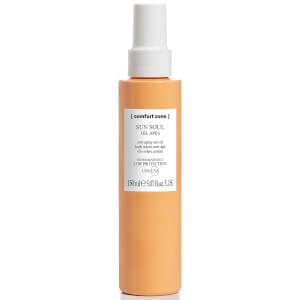
Comfort Zone Sun Soul Oil SPF6
Works for
1 of 4 advertised claims delivered
Sun protectionSPF 6 · 3 UV filters · Broad spectrumNo real protectionSPF too low
This product does not offer sun protection, or it is very low.
Moisturizing9 ingredients credited for this claimGood support
“Sweet Almond Oil powers alongside Peach Kernel Oil and Golden Seaweed for skin that appears youthful and thoroughly hydrated.”
This product can help soften the skin and reduce its moisture loss with emollients and occlusives: helianthus annuus seed oil, ethylhexyl palmitate.
Keep in mind that this product does not contain effective ingredients to attract water to the upper layer of the skin. This is why an additional product with humectants like glycerin or hyaluronic acid can be helpful (apply it before this product for the best results).
Evens skin tone1 ingredient credited for this claimWeak support
“This SPF-infused face and body oil is enriched with a variety of anti-ageing actives, helping to defend against the appearance of dark spots as well as environmental aggressors.”
Effective ingredients missing or their concentration is too low
Anti-aging3 ingredients credited for this claimWeak support
“This SPF-infused face and body oil is enriched with a variety of anti-ageing actives, helping to defend against the appearance of dark spots as well as environmental aggressors.”
Effective ingredients missing or their concentration is too low.
Can it cause trouble?
Irritancy2 strong irritants: Parfum, Retinyl palmitateMedium risk
Comedogenic3 ingredients rated 2 or more on the 0–5 pore-clogging scale3 flagged
User reviews
Be the first — your take helps the next person decide.
Ingredients
Filter by role to see what each ingredient is doing.
Ethylhexyl palmitate~22–33%
- Irritation risk
- Low
- Comedogenicity
- 3/5
An emollient that helps soften the skin and create a nice product texture
More about Ethylhexyl palmitateDicaprylyl carbonate~4.9–7.4%
- Irritation risk
- Low
Helps products spread more easily and works as an emollient to soften skin
More about Dicaprylyl carbonateOctyldodecanol~4.4–6.6%
- Irritation risk
- Low
An emollient that helps to soften the skin and create a pleasant product texture and stabilize the formulation
More about OctyldodecanolIsostearyl isostearate~3.8–5.6%
- Irritation risk
- Medium
- Comedogenicity
- 3/5
Helps soften the upper layer of the skin and improve the product texture. It can be comedogenic
More about Isostearyl isostearatePrunus amygdalus dulcis oil~2.7–4.1%
- Irritation risk
- Low
An emollient that softens the skin
More about Prunus amygdalus dulcis oilPrunus amygdalus dulcis seed~1.9–2.8%
- Irritation risk
- Low
Helps soften the upper layer of the skin
More about Prunus amygdalus dulcis seedEthylhexyl methoxycinnamate~1.9–2.8%
- Irritation risk
- High
Octinoxate. When used in higher concentrations, works as a sunscreen protecting the skin from UVB rays. When used in lower concentration, helps to preserve the product formulation. Is shown to be harmful to coral reefs - consider avoiding bathing in coral reef areas when wearing a product with this ingredient. It can be irritating
More about Ethylhexyl methoxycinnamateHelianthus annuus seed oil~1.5–2.2%
- Irritation risk
- Low
A great emollient due to its high linoleic acid content. One of the most effective plant oils in helping skin hydration and repairing skin barrier function
More about Helianthus annuus seed oilButyl methoxydibenzoylmethane~1.4–2.1%
- Irritation risk
- Medium
Avobenzone. An organic, or so-called "chemical" UV filter. Protects against both UVA and UVB rays. Needs to be combined with other filters in a formulation to be stable.
More about Butyl methoxydibenzoylmethanePrunus persica kernel oil~0.95–1.4%
- Irritation risk
- Low
Bis-ethylhexyloxyphenol methoxyphenyl triazine~0.9–1.35%
- Irritation risk
- Medium
Tinosorb S. One of the most effective broad spectrum sunscreen ingredients. Protects from both UVA and UVB rays. It is photostable. Unfortunately, not approved by FDA (US) yet.
More about Bis-ethylhexyloxyphenol methoxyphenyl triazineCaprylic/capric triglyceride~0.5–1.2%
- Irritation risk
- Medium
A good mix of fatty acids that forms a protective layer on the skin. Improves the shelf life of products. Derived from coconut and glycerin
More about Caprylic/capric triglycerideParfum~0.3–0.75%
- Irritation risk
- High
An aromatic blend of unspecified and possibly irritating ingredients
More about ParfumPolyamide-8~0.4–0.9%
- Irritation risk
- Low
Tocopheryl acetate~0.15–0.6%
- Irritation risk
- Medium
A more stable but less bio-available form of vitamin E compared to Tocopherol. Might help moisturize and protect the skin from free radicals, but mostly used in low concentrations to stabilize other ingredients.
More about Tocopheryl acetateRetinyl palmitate~0.1–0.4%
- Irritation risk
- High
Three steps removed from the active form of vitamin A - retinoic acid. To have an effect in the skin, it first needs to be converted twice to become the retinoic acid. This means it is less potent than retinol, but could also be less irritating. Once converted to the retinoic acid in the skin, it helps against all signs of aging, improves skin cell turnover and helps fight blemishes and clogged pores. However, in many cosmetic formulations, it is used in a concentration that is too low to have the full effect
More about Retinyl palmitateLaminaria ochroleuca extract~0.1–0.35%
- Irritation risk
- Low
- Comedogenicity
- 3/5
Helps attract water to the upper layer of the skin
More about Laminaria ochroleuca extractTocopherol~0.05–0.3%
- Irritation risk
- Low
Pure form of vitamin E. Can help moisturise and protect the skin from free radicals. Often used to help stabilise other ingredients or the formula itself
More about TocopherolPentaerythrityl tetra-di-t-butyl hydroxyhydrocinnamate~0.05–0.3%
- Irritation risk
- Low
Used to increase stability of product formulations
More about Pentaerythrityl tetra-di-t-butyl hydroxyhydrocinnamateIngredient list view
Ethylhexyl palmitate, Dicaprylyl carbonate, Octyldodecanol, Isostearyl isostearate, Prunus amygdalus dulcis oil, Prunus amygdalus dulcis seed, Ethylhexyl methoxycinnamate, Helianthus annuus seed oil, Butyl methoxydibenzoylmethane, Prunus persica kernel oil, Bis-ethylhexyloxyphenol methoxyphenyl triazine, Caprylic/capric triglyceride, Parfum, Polyamide-8, Tocopheryl acetate, Retinyl palmitate, Laminaria ochroleuca extract, Tocopherol, Pentaerythrityl tetra-di-t-butyl hydroxyhydrocinnamate
Compare prices
Retailers ranked by price — lowest first.

.png)
Product summary
"Comfort Zone - Sun Soul Oil SPF6" offers broad spectrum protection. It means that it protects from both UVA and UVB rays (you can remember UVB as "burning" sunlight - they cause sunburn. You can remember UVA rays as "aging" - they do not lead to sunburn, but they cause photodamage and contribute to early signs of skin aging and hyperpigmentation). On the negative side, the SPF of this product is not high enough. We recommend to use a sunscreen with at least SPF 30 daily.
It contains good moisturizing ingredients and can double as a hydrating day cream.
Sunscreen filters
This is a so-called "chemical" sunscreen. It means that it uses organic UV filters. They typically offer good sun protection and rarely leave a white cast, but they can be irritating for some people with sensitive skin. The UV filters in this sunscreen are: tinosorb s 0.90% - 1.35%, avobenzone 1.40% - 2.10% and octinoxate 1.90% - 2.80%.
Irritation risk
There are some common irritants in this product, including ingredients that do not have benefits for the skin. We assess the overall irritancy of this sunscreen to be medium. For a detailed overview of all potential irritants: click here
You can see the detailed formula review with the breakdown of all actives in the product and the full ingredient list with estimated concentrations in the tables below.
Price
The product retails from 22.00£ up to 49.71£ in the United Kingdom and for 22.00$ in the United States.
For a detailed price comparison: click here.
Sources cited in this review
Every concentration estimate and effectiveness label is anchored to one of these 8 studies and safety reviews.
- 1
- 2
- 3
- 4Effect of topically applied lipids on surfactant-irritated skinonlinelibrary.wiley.com
- 5
- 6Vitamin E in dermatologyncbi.nlm.nih.gov

Affiliate links · As an Amazon Associate, WIMJ earns from qualifying purchases.