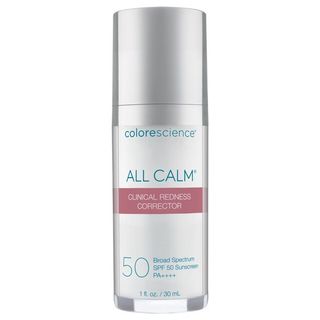
Colorescience All Calm Clinical Redness Corrector SPF 50 - Not Boxed
Works for
2 of 2 advertised claims delivered
Sun protectionSPF 50 · 2 UV filtersBroad spectrum
This product offers a good level of protection against both UVB and UVA rays.
It is a mineral sunscreen. In other words, it contains non-organic UV filters. It will probably not sting your eyes but might leave a white cast.
This product can be considered "reef safe" because it does not contain the UV filters (oxybenzone and octinoxate) that can be harmful to coral reefs when present in the water in high concentrations.
MoisturizingNiacinamide, Jojoba esters + 7 moreStrong evidence
“PA++++ UVB protection rating.”
This product can help soften the skin and reduce its moisture loss with emollients and occlusives: dimethiconol, jojoba esters.
Keep in mind that this product does not contain effective ingredients to attract water to the upper layer of the skin. This is why an additional product with humectants like glycerin or hyaluronic acid can be helpful (apply it before this product for the best results).
The following ingredients in this product are especially good for supporting the skin barrier and helping with the hydration level: niacinamide
Anti-agingNot advertised by the brand · Niacinamide, Glycolic acid + 1 moreStrong evidence
This product can help reduce and prevent fine lines and wrinkles, improve skin elasticity and firmness because it contains glycolic acid, niacinamide.
Keep in mind that it typically takes at least 6 weeks to notice any results because the changes that are needed to improve fine lines and elasticity happen in the deeper layers of the skin. No topical anti-aging product can “erase” wrinkles or fully reverse signs of aging.
This product can also help prevent early signs of skin aging because it offers a good level of broad spectrum sun protection. Sun damage is the main cause of premature skin aging, and protecting your skin from the sun is the best anti-aging strategy.
Evens skin toneNot advertised by the brand · Niacinamide, Glycolic acidStrong evidence
This product offers broad spectrum sun protection. It means that it can prevent hyperpigmentation and help keep the skin tone even (sun damage is the main factor causing age spots, darkening of post-acne marks and other discolorations).
ExfoliationNot advertised by the brand · Glycolic acidStrong evidence
This product can help exfoliate the skin. In other words, it helps break down the bonds between dead cells on the surface of the skin and speed up the skin turnover. Skin often appears softer and brighter after exfoliation, but overdoing it can result in disrupted skin barrier. The following ingredient is doing the exfoliating job in this product: glycolic acid.
Anti-blemishNot advertised by the brand · Niacinamide, Glycolic acidGood evidence
This product might be able to help reduce blemishes and clogged pores because it contains niacinamide.
The following ingredient (ingredients) in this product might be helpful, but there is no evidence to confirm that it actually works: glycolic acid
Can it cause trouble?
Irritancy1 strong irritant: Zingiber officinale root extractMedium risk
Comedogenic1 ingredient rated 2 or more on the 0–5 pore-clogging scale1 flagged

User reviews
Be the first — your take helps the next person decide.
Ingredients
Filter by role to see what each ingredient is doing.
Titanium dioxide11.6%
- Irritation risk
- Low
Works as a UV filter when used in high concentrations. It is photostable and is effective mostly against the UVB light, with some protection in the UVA range. In small concentrations, used for its ability to improve the color of cosmetic products. Is usually well tolerated by the skin
More about Titanium dioxideZinc oxide8.6%
- Irritation risk
- Low
A broad spectrum sunblock (protects from both UVA and UVB rays). Is suitable for most sensitive skins. In small concentrations, can be used as a colorant
More about Zinc oxideCyclopentasiloxane~23–35%
- Irritation risk
- Low
A silicone that helps improve the product texture and spreadability. Can absorb oil creating a short-term mattifying effect on the skin
More about CyclopentasiloxaneWater~12–18%
Dimethicone crosspolymer~5.5–8.3%
- Irritation risk
- Low
Used to create a thicker product texture. Helps soften the upper layer of the skin and might be able to prevent moisture loss from its surface
More about Dimethicone crosspolymerNiacinamide~3.5–5.2%
- Irritation risk
- Low
Is proven to be effective in reducing blemishes, evening out skin tone and helping to improve lines and wrinkles. It helps the skin to repair sun damage, calm down inflammation and keep maintain good levels of moisture. The concentration of about 2% is effective for supporting the skin barrier and evening out the skin tone. Concentration of 4-6% is better for helping with acne and balancing the sebum production
More about NiacinamideDisteardimonium hectorite~2.4–3.6%
- Irritation risk
- Low
A type of clay that is used to thicken the product consistency
More about Disteardimonium hectoriteDimethicone/vinyl dimethicone crosspolymer~2.1–3.2%
- Irritation risk
- Low
Used to stabilize product formulations and create a nice product texture
More about Dimethicone/vinyl dimethicone crosspolymerPropylene carbonate~1.8–2.7%
- Irritation risk
- Low
Is used to dissolve other ingredients and create nice product texture
More about Propylene carbonateDisodium lauriminodipropionate tocopheryl phosphates~1.5–2.2%
- Irritation risk
- Low
A form of Vitamin E. In concentrations 1-3%, it can help neutralize free radicals in skin and support photodamage repair
More about Disodium lauriminodipropionate tocopheryl phosphatesCrithmum maritimum extract~1.1–1.6%
- Irritation risk
- Low
- Comedogenicity
- 3/5
An algae extract that might have anti-oxidant properties
More about Crithmum maritimum extractMagnolia officinalis bark extract~0.55–1.3%
- Irritation risk
- Low
Zingiber officinale root extract~0.5–1.2%
- Irritation risk
- High
A plant extract that can contain an irritating essential oil. Might have some anti-oxidant effect, but evidence is lacking
More about Zingiber officinale root extractMagnesium carboxymethyl beta-glucan~0.4–0.95%
- Irritation risk
- Low
Helps attract water to the upper layer of the skin
More about Magnesium carboxymethyl beta-glucanJojoba esters~0.45–1%
- Irritation risk
- Medium
An emollient made of jojoba oil. Helps soften the skin and support its barrier function
More about Jojoba estersBisabolol~0.3–0.75%
- Irritation risk
- Low
An active component of chamomile plant that historically has been used to calm down irritated skin. A recent study shows that bisabolol indeed can have some anti-inflammatory effect on skin, even though conclusive data is lacking. Bisabolol has a sweet floral scent and can be added to products for its aromatic properties
More about BisabololSilica~0.5–1.2%
Polyhydroxystearic acid~0.4–0.9%
- Irritation risk
- Medium
Used to create a thicker product consistency and stabilize the formulation
More about Polyhydroxystearic acidDimethiconol~0.4–0.9%
- Irritation risk
- Low
A silicone that makes products more spreadable and keeps skin smooth. Helps to add gloss to skin and may visually fill in fine lines/wrinkles for short time
More about DimethiconolAlumina~0.4–0.95%
- Irritation risk
- Low
The same compound that is used safely in dental implants and bone cements. In cosmetics, it is used to improve the consistency of products
More about AluminaGlyceryl behenate/eicosadioate~0.35–0.75%
Phenoxyethanol~0.2–0.8%
- Irritation risk
- Low
A preservative. It helps prevent bacterial growth in cosmetic products
More about PhenoxyethanolTriethoxycaprylylsilane~0.15–0.65%
- Irritation risk
- Low
A type of silicone that helps oil and water mix well together. Helps to disperse other ingredients, e.g. pigments, evenly in a formulation
More about TriethoxycaprylylsilaneEthylhexylglycerin~0.15–0.6%
Tocopherol~0.15–0.65%
- Irritation risk
- Low
Pure form of vitamin E. Can help moisturise and protect the skin from free radicals. Often used to help stabilise other ingredients or the formula itself
More about TocopherolDehydroacetic acid~0.1–0.4%
Benzoic acid~0.1–0.35%
Glycolic acid~0.1–0.35%
- Irritation risk
- High
An alpha-hydroxy acid (AHA) that helps to remove the dead skin cells on the surface of the skin reveling a more even, smoother complexation. It is also able to stimulate collagen production with long-term use. Could help to reduce pore congestion. It can be irritating to the skin. Apply sunscreen daily if using products with glycolic acid
More about Glycolic acidChloroacetic acid~0.1–0.35%
- Irritation risk
- Low
Chromium oxide greens~0.05–0.25%
- Irritation risk
- Low
Ci 77288~0.05–0.25%
- Irritation risk
- Low
Iron oxides~0.05–0.25%
- Irritation risk
- Low
An umbrella term for the following three colorants: CI 77491, CI 77492, CI 77499. They might be able to offer some protection against visible light, but the degree of the protection is not clear
More about Iron oxidesIngredient list view
Titanium dioxide, Zinc oxide, Cyclopentasiloxane, Unknown, Water, Dimethicone crosspolymer, Niacinamide, Disteardimonium hectorite, Dimethicone/vinyl dimethicone crosspolymer, Propylene carbonate, Disodium lauriminodipropionate tocopheryl phosphates, Crithmum maritimum extract, Magnolia officinalis bark extract, Zingiber officinale root extract, Magnesium carboxymethyl beta-glucan, Jojoba esters, Bisabolol, Silica, Polyhydroxystearic acid, Dimethiconol, Alumina, Glyceryl behenate/eicosadioate, Phenoxyethanol, Triethoxycaprylylsilane, Ethylhexylglycerin, Tocopherol, Dehydroacetic acid, Benzoic acid, Glycolic acid, Chloroacetic acid, Chromium oxide greens, Ci 77288, Iron oxides
Compare prices
Retailers ranked by price — lowest first.

Affiliate links · prices updated regularly
Worth comparing, line by line.
Match % combines shared ingredients, the first five ingredients, shared actives and hero ingredients, irritancy (lower counts in the alternative's favour), texture and body area. Only products in the same routine step are compared.
| ColorescienceAll Calm Clinical Redness Corrector SPF 50 - Not BoxedYOUR PRODUCT | ColorescienceAll Calm Clinical Redness Corrector SPF 50 | CeraVeInvisible Mineral Sunscreen SPF 50 | MALIN + GOETZSPF30 Sunscreen High Protection | |
|---|---|---|---|---|
| Match | — | 96% | 75% | 74% |
| Price | $128.55 | $119.65−$8.90 | $13.97−$114.58 | $44.12−$84.43 |
| Shared key ingredients | — | 10 of 10 | 3 of 10 | 3 of 10 |
| Key difference | — | Caprylic/Capric Triglyceride | Panthenol | Caprylic/Capric Triglyceride |
| Irritancy | Medium | Medium | Low | Low |
| SPF | SPF 50 | SPF 50 | SPF 50 | SPF 30 |
| Drying alcohol | — | — | — | — |
| View product | Shop | Shop | Shop |


Product summary
We assess that "Colorescience - All Calm Clinical Redness Corrector SPF 50 - Not Boxed" can provide reliable sun protection based on the ingredient list. We love that it can protect from both UVA and UVB rays (not all sunscreens with SPF ratings give UVA protection. UVA rays do not cause sunburn, but still damage our skin and lead to early aging).
It contains good moisturizing ingredients and can double as a hydrating day cream. Like all broad-spectrum sunscreens, this product has an anti-aging benefit.
Sunscreen filters
This product is a mineral sunscreen. It uses titanium dioxide and zinc oxide for sun protection. Both titanium dioxide and zinc oxide almost never irritate even the most sensitive skin and eyes, but can leave a white cast.
Irritation risk
There are some common irritants in this product, including ingredients that do not have benefits for the skin. We assess the overall irritancy of this product to be medium. For a detailed overview of all potential irritants: click here
You can see the detailed formula review with the breakdown of all actives in the product and the full ingredient list with estimated concentrations in the tables below.
Price
The product retails for 128.55$ in the United States.
For a detailed price comparison: click here.
Sources cited in this review
Every concentration estimate and effectiveness label is anchored to one of these 16 studies and safety reviews.
- 1A review of inorganic UV filters zinc oxide and titanium dioxideonlinelibrary.wiley.com
- 2
- 3
- 4
- 5
- 6

Affiliate links · As an Amazon Associate, WIMJ earns from qualifying purchases.