Works for:
based on ingredients and %- Moisturizing
Can it cause trouble?
- Irritation risk: low
- Comedogenic risk ingredients: 0
Key actives

Product Summary
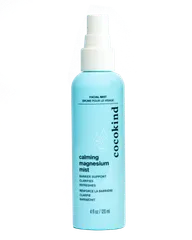
"cocokind - calming magnesium mist" could be helpful for: Moisturizing, but its actives are not the most effective or are not well-studied.
Ingredient callouts
- Humectants (manganese pca 1.20% - 1.70%, sodium pca 1.40% - 2.00%, zinc pca 1.80% - 2.80%, magnesium pca 2.10% - 3.10% and glycerin 2.70% - 4.00%). These ingredients help attract water to the upper layer of the skin and improve the skin hydration.
About the brand
According to Cruelty-Free Kitty "cocokind" is cruelty free and so is its parent company.
Price
The product retails for 18.00$ in the United States.
For a detailed price comparison: click here.
Works for
Moisturizing
What does the product description say?
Our calming magnesium-infused facial mist helps reduce visible redness, clarifies breakout-prone skin and supports the moisture barrier to keep your complexion clear and comfortable all day.
Source: Cocokind
This product contains good ingredients to attract water to the upper layer of the skin. These ingredients are called "humectants": glycerin, magnesium pca.
When humectants are on the surface of the skin, they “pull in” the moisture from the outside environment, or from within deeper layers of the skin. If the air is dry, humectants can speed up the moisture loss from the skin. This is why it is a good idea to use another product on top of this one to help "seal in" the moisture (look for ingredients like dimethicone, squalane, oils and butters).
One of the best moisturizing ingredients. Naturally present in skin. It attracts water to the upper layer of the skin working as a humectant
Helps attract water to the upper layer of the skin
Helps attract water to the upper layer of the skin. Often used as a part of an ingredient complex Physiogenyl together with Sodium PCA, Magnesium PCA and Zinc PCA. The manufacturer claims that it does more than attracting water, but there is no evidence or studies supporting this claim
Naturally present in skin and helps to attract water to its upper layer
A compound that combines zinc with a hydrating ingredient PCA. Might to be helpful against acne and clogged pores. Can help calm down inflammation in skin. Could be helpful in reducing the formation of free radicals in skin. Might help to reduce fine lines in wrinkles, but solid evidence is missing
How honest is this product?
| Promise | Can it deliver? |
|---|---|
| Moisturizing |
Total Promises Fulfilled score: 75/100.
We receive a small commission for purchases made through these links at no cost for you. Thank you for your support! Learn more
Potential irritants
Comedogenic ingredients
No comedogenic ingredients detected
User reviews (0)
Averages from community submissions.
No reviews yet for this product.
Be the first to share your experience!
Tried this product?
Help capture what the ingredient list can't—texture, finish, pilling, scent, and more. Answer what you can, skip the rest.
Takes ~30 seconds.
Reviews are shown in aggregate. No personal details.
Key Actives
A compound that combines zinc with a hydrating ingredient PCA. Might to be helpful against acne and clogged pores. Can help calm down inflammation in skin. Could be helpful in reducing the formation of free radicals in skin. Might help to reduce fine lines in wrinkles, but solid evidence is missing
One of the best moisturizing ingredients. Naturally present in skin. It attracts water to the upper layer of the skin working as a humectant
Helps attract water to the upper layer of the skin
Naturally present in skin and helps to attract water to its upper layer
Helps attract water to the upper layer of the skin. Often used as a part of an ingredient complex Physiogenyl together with Sodium PCA, Magnesium PCA and Zinc PCA. The manufacturer claims that it does more than attracting water, but there is no evidence or studies supporting this claim
Potential irritants
A preservative that comes from radishes fermented by a bacteria. New research suggests that the preservation properties in the ingredient come from an ammonium salt that is not present naturally in radish root but used in its cultivation. Is problematic because the exact amount of the preservative agents is difficult to determine
Can work as an exfoliant but is typically used to adjust the product pH
Comedogenic ingredients
We couldn't find any comedogenic ingredients in this product
All ingredients
A preservative that comes from radishes fermented by a bacteria. New research suggests that the preservation properties in the ingredient come from an ammonium salt that is not present naturally in radish root but used in its cultivation. Is problematic because the exact amount of the preservative agents is difficult to determine
One of the best moisturizing ingredients. Naturally present in skin. It attracts water to the upper layer of the skin working as a humectant
A compound that combines zinc with a hydrating ingredient PCA. Might to be helpful against acne and clogged pores. Can help calm down inflammation in skin. Could be helpful in reducing the formation of free radicals in skin. Might help to reduce fine lines in wrinkles, but solid evidence is missing
Naturally present in skin and helps to attract water to its upper layer
Helps attract water to the upper layer of the skin. Often used as a part of an ingredient complex Physiogenyl together with Sodium PCA, Magnesium PCA and Zinc PCA. The manufacturer claims that it does more than attracting water, but there is no evidence or studies supporting this claim
Used to stabilize the product formulation and can help absorb oil
Can work as an exfoliant but is typically used to adjust the product pH
Ingredient list view
Water, Sea silt extract, Leuconostoc/radish root ferment filtrate, Glycerin, Magnesium pca, Zinc pca, Sodium pca, Manganese pca, Polylysine, Nelumbo nucifera flower water, Nymphaea caerulea flower water, Biosaccharide gum-2, Maltodextrin, Ethylhexylglycerin, Citric acid, Potassium sorbate, Sodium gluconate, Sodium benzoate, 1,2-hexanediol, Sodium hydroxide