Works for
1 of 1 advertised claim delivered
Moisturizing13 ingredients credited for this claimStrong support
“Working to hydrate and nourish, the lip balm with rich emollients delivers an intense veil of moisture onto wanting lips, repairing dryness whilst replenishing moisture to leave lips feeling soft and comforted. . K. N.”
This product can help soften the skin and reduce its moisture loss with emollients and occlusives: bis-diglyceryl polyacyladipate-2, cera microcristallina.
Keep in mind that this product does not contain effective ingredients to attract water to the upper layer of the skin. This is why an additional product with humectants like glycerin or hyaluronic acid can be helpful (apply it before this product for the best results).
The following ingredients in this product are especially good for supporting the skin barrier and helping with the hydration level: petrolatum
Can it cause trouble?
Irritancy3 strong irritants: Retinyl palmitate, Salvia sclarea extract + 1 more — patch-test recommendedHigh risk
Comedogenic2 ingredients rated 2 or more on the 0–5 pore-clogging scale2 flagged
User reviews
Be the first — your take helps the next person decide.
Ingredients
Filter by role to see what each ingredient is doing.
Petrolatum~22–34%
- Irritation risk
- Low
One of the most effective and the most studied occlusive ingredients that creates a protective layer on top of the skin preventing moisture loss
More about PetrolatumPolybutene~4.9–7.4%
Polydecene~4.5–6.7%
- Irritation risk
- Low
Bis-diglyceryl polyacyladipate-2~3.9–5.8%
- Irritation risk
- Low
Helps soften the upper layer of the skin and reduce water loss from its surface
More about Bis-diglyceryl polyacyladipate-2Octyldodecanol~2.7–4%
- Irritation risk
- Low
An emollient that helps to soften the skin and create a pleasant product texture and stabilize the formulation
More about OctyldodecanolMicrocrystalline wax~1.9–2.9%
Cera microcristallina~1.7–2.5%
- Irritation risk
- Low
Helps to soften the upper layer of the skin, reduce water loss from its surface and create a thicker product consistency
More about Cera microcristallinaTocopheryl acetate~1.1–1.7%
- Irritation risk
- Medium
A more stable but less bio-available form of vitamin E compared to Tocopherol. Might help moisturize and protect the skin from free radicals, but mostly used in low concentrations to stabilize other ingredients.
More about Tocopheryl acetatePolyglyceryl-2 triisostearate~1–1.5%
- Irritation risk
- Low
Helps to soften the upper layer of the skin and create a nice product texture
More about Polyglyceryl-2 triisostearateAloe barbadensis leaf extract~0.95–1.4%
- Irritation risk
- Medium
Traditionally used to treat sunburns, dermatitis and inflammation, but evidence for its effectiveness is lacking. The extract can contain humectants that help attract water into the skin
More about Aloe barbadensis leaf extractCholesterol~0.55–1.3%
- Irritation risk
- Low
An emollient that is naturally found in skin
More about CholesterolHordeum vulgare extract~0.45–1.1%
- Irritation risk
- Medium
A plant extract that might have some anti-oxidant properties. Avoid if you are sensitive to gluten
More about Hordeum vulgare extractTriticum vulgare germ extract~0.45–1%
- Irritation risk
- Medium
- Comedogenicity
- 3/5
Plant extract that might have moisturizing properties. Avoid if you suffer from wheat or gluten intolerance
More about Triticum vulgare germ extractSqualane~0.4–0.95%
- Irritation risk
- Low
An oil naturally present in skin. Works as an emollient to soften the skin and form a protective layer on its surface without a greasy feeling.
More about SqualaneLinoleic acid~0.45–1%
- Irritation risk
- Low
An excellent emollient. Helps soften the skin, restore its barrier function, and can help to calm down inflammation. It can be helpful to prevent blemishes and clogged pores
More about Linoleic acidRetinyl palmitate~0.2–0.8%
- Irritation risk
- High
Three steps removed from the active form of vitamin A - retinoic acid. To have an effect in the skin, it first needs to be converted twice to become the retinoic acid. This means it is less potent than retinol, but could also be less irritating. Once converted to the retinoic acid in the skin, it helps against all signs of aging, improves skin cell turnover and helps fight blemishes and clogged pores. However, in many cosmetic formulations, it is used in a concentration that is too low to have the full effect
More about Retinyl palmitateSalvia sclarea extract~0.2–0.75%
- Irritation risk
- High
Used as a fragrance. Can be irritating
More about Salvia sclarea extractGlycine soja oil~0.2–0.8%
- Irritation risk
- Medium
- Comedogenicity
- 2/5
A good emollient that helps soften the skin and helps repair its barrier function. It can clog pores if used in high concentrations.
More about Glycine soja oilTetrahexyldecyl ascorbate~0.15–0.55%
- Irritation risk
- Medium
Being a lipid soluble form of vitamin C, it is more stable than ascorbic acid, but still degrades quickly and needs to be stabilized in a formulation with another ingredient. It is claimed to penetrate skin better than pure vitamin C and have the the similar benefits, but solid studies of its effectiveness are lacking. Is likely to require a higher concentration in a product than pure vitamin C to be effective. It might be able to help reduce pore clogging.
More about Tetrahexyldecyl ascorbateStearyl glycyrrhetinate~0.1–0.5%
- Irritation risk
- Medium
A fatty acid derived from licorice. Works as an emollient and can help calm down inflammation
More about Stearyl glycyrrhetinateBetula alba juice~0.1–0.4%
- Irritation risk
- Low
Rosa damascena extract~0.1–0.35%
- Irritation risk
- High
Oil of a very fragrant pink rose used as fragrance in cosmetics. Extensive research has shown it has mixed benefits. In the pro column, inhaling this flower’s scent seems to have relaxing properties and the plant’s petals contain skin-soothing and antioxidant compounds that can benefit skin. On the flipside, the numerous chemicals that create this rose’s distinctive fragrance pose a risk of causing skin aggravation.
More about Rosa damascena extractHexylene glycol~0.05–0.25%
- Irritation risk
- Medium
Helps create a more spreadable product texture
More about Hexylene glycolPotassium sulfate~0.05–0.25%
Caprylyl glycol~0.1–0.35%
- Irritation risk
- Medium
Helps preserve products and creates a nice product texture
More about Caprylyl glycolPhenoxyethanol~0.05–0.15%
- Irritation risk
- Low
A preservative. It helps prevent bacterial growth in cosmetic products
More about PhenoxyethanolCi 15850~0.01–0.05%
Ci 19140~0.01–0.05%
Ingredient list view
Petrolatum, Polybutene, Polydecene, Bis-diglyceryl polyacyladipate-2, Octyldodecanol, Microcrystalline wax, Cera microcristallina, Tocopheryl acetate, Polyglyceryl-2 triisostearate, Aloe barbadensis leaf extract, Cholesterol, Hordeum vulgare extract, Triticum vulgare germ extract, Squalane, Linoleic acid, Retinyl palmitate, Salvia sclarea extract, Glycine soja oil, Tetrahexyldecyl ascorbate, Stearyl glycyrrhetinate, Betula alba juice, Rosa damascena extract, Hexylene glycol, Potassium sulfate, Caprylyl glycol, Phenoxyethanol, Ci 15850, Ci 19140
Compare prices
Retailers ranked by price — lowest first.


Product summary
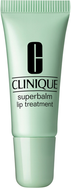
Based on the ingredients included, "Clinique - Superbalm Lip Treatment" works well for moisturizing the skin. The formulation is based on a combination of good humectants and emollients. Both are needed to increase the skin hydration level. Humectants in this product (caprylyl glycol) help to increase the water content in the upper layer of the skin. (These ingredients do so by "capturing" water molecules from the outside air or from within the deeper layers of the skin). Petrolatum, cholesterol, glycine soja oil, bis-diglyceryl polyacyladipate-2 and cera microcristallina in this product help decrease the water evoporation from the skin, so that it stays hydrated for longer. These ingredients also soften the skin and take away the feeling of tightness and dryness.
Ingredient callouts
- this lip product includes a form of retinoids (vitamin A) - retinyl palmitate 0.20% - 0.80%, but this type of vitamin A is not very effective. It could in theory help with fine lines and wrinkles, but the effect is most likely minimal.
- Another helpful ingredient in it is Linoleic Acid. It is one of the fatty acids naturally present in skin. It is part of the skin barrier. Preliminary research shows that it might be able to reduce clogged pores.
Irritation risk
We assess the overall irritancy of it to be high. For a detailed overview of all potential irritants: click here
You can see the detailed formula review with the breakdown of all actives in the product and the full ingredient list with estimated concentrations in the tables below.
Price
The product retails for 28.06CA$ in Canada, for 32.00A$ in Australia, from 14.00$ up to 18.50$ in the United States and from 13.00£ up to 15.20£ in the United Kingdom.
For a detailed price comparison: click here.
Sources cited in this review
Every concentration estimate and effectiveness label is anchored to one of these 11 studies and safety reviews.
- 1
- 2
- 3
- 4Celiac Disease & Skin Care Productsbadgut.org
- 5
- 6Wheat in skin caremdedge.com

Affiliate links · As an Amazon Associate, WIMJ earns from qualifying purchases.