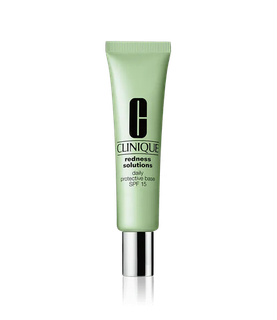
Clinique Redness Solutions Daily Protective Base Broad Spectrum SPF 15
Works for
0 of 1 advertised claim delivered
Sun protectionSPF 15 · 2 UV filters · Broad spectrumWeak protectionSPF under 30
This product offers broad spectrum sun protection, but it is weak. We recommend to use a broad spectrum sunscreen with at least SPF 30.
This product can be considered "reef safe" because it does not contain the UV filters (oxybenzone and octinoxate) that can be harmful to coral reefs when present in the water in high concentrations.
MoisturizingNot advertised by the brand · 19 ingredients credited for this claimStrong support
This product can help improve hydration of the skin with the two types of ingredients.
The first type is called “humectants”:
these ingredients help attract water.
When humectants are on the surface of the skin, they “pull in” the moisture from the outside environment, or from
within deeper layers of the skin. The following ingredients in this product do the job:
sucrose, butylene glycol.
This product also contains ingredients called “occlusives”. They help reduce the speed with which our skin loses moisture to the outside environment. These ingredients also help soften the upper layer of the skin, so it feels less tight and nicer to the touch. The following ingredients in this product do the job: dimethicone, octyldodecyl neopentanoate.
The following ingredients in this product are especially good for supporting the skin barrier and helping with the hydration level: phytosphingosine
Can it cause trouble?
Irritancy14 flagged ingredientsMedium risk
Comedogenic1 ingredient rated 2 or more on the 0–5 pore-clogging scale1 flagged

User reviews
Be the first — your take helps the next person decide.
Ingredients
Filter by role to see what each ingredient is doing.
Titanium dioxide6.4%
- Irritation risk
- Low
Works as a UV filter when used in high concentrations. It is photostable and is effective mostly against the UVB light, with some protection in the UVA range. In small concentrations, used for its ability to improve the color of cosmetic products. Is usually well tolerated by the skin
More about Titanium dioxideZinc oxide2%
- Irritation risk
- Low
A broad spectrum sunblock (protects from both UVA and UVB rays). Is suitable for most sensitive skins. In small concentrations, can be used as a colorant
More about Zinc oxideWater~45–55%
Trioctyldodecyl citrate~6.8–8.4%
- Irritation risk
- Low
Cyclopentasiloxane~6.7–8.2%
- Irritation risk
- Low
A silicone that helps improve the product texture and spreadability. Can absorb oil creating a short-term mattifying effect on the skin
More about CyclopentasiloxaneButylene glycol~4.5–5.5%
- Irritation risk
- Low
Used to create a nice product texture and help delivery of other ingredients. Might be somewhat helpful in attracting water to the upper layer of the skin
More about Butylene glycolC12-15 alkyl benzoate~4–4.9%
- Irritation risk
- Low
Enhances the product texture and makes it more spreadable. Helps reduce water loss from the outer layer of skin. Extands the shelf life by preventing bacteria growth
More about C12-15 alkyl benzoateSteareth-2~3.3–4.1%
Stearyl dimethicone~2.9–3.6%
- Irritation risk
- Low
Helps soften the upper layer of the skin
More about Stearyl dimethiconeTricaprylyl citrate~2.4–2.9%
- Irritation risk
- Low
Silica~2–2.5%
Barium sulfate~1.5–1.8%
- Irritation risk
- Low
Sorbitan tristearate~1.2–1.4%
- Irritation risk
- Medium
Helps oil and water mix together
More about Sorbitan tristearateAluminum stearate~1.1–1.3%
- Irritation risk
- Medium
Used to help evenly disperse other ingredients (for example, pigment) in a formulation
More about Aluminum stearateAscophyllum nodosum extract~1–1.2%
- Irritation risk
- Low
Brown seaweed extract. Can help attract water to the upper layer of the skin and might have some antioxidant effect
More about Ascophyllum nodosum extractAsparagopsis armata extract~1–1.2%
- Irritation risk
- Low
Red seaweed extract. Can help attract water to the upper layer of the skin and might have some antioxidant effect
More about Asparagopsis armata extractLecithin~1–1.2%
- Irritation risk
- Low
Used mostly for creating emulsions - helping oil and water mix together. Helps soften the upper layer of the skin
More about LecithinSea whip extract~0.95–1.15%
- Irritation risk
- Low
Might help neutrlize free radicals, calm down inflammation, and attract water to the upper layer of the skin
More about Sea whip extractGlyceryl stearate~1–1.2%
- Irritation risk
- Low
An emollient that softens the skin and forms a protective layer on its surface. Helps water and oil mix together
More about Glyceryl stearateTocopheryl acetate~0.8–1.2%
- Irritation risk
- Medium
A more stable but less bio-available form of vitamin E compared to Tocopherol. Might help moisturize and protect the skin from free radicals, but mostly used in low concentrations to stabilize other ingredients.
More about Tocopheryl acetatePeg-100 stearate~0.9–1.1%
- Irritation risk
- Low
Helps oil and water mix togehter and creates a nice product texture
More about Peg-100 stearateSucrose~0.7–1.05%
- Irritation risk
- Low
Can help attract water to the upper layer of the skin. In crystal form, it can work as a gentle exfoliant, gentler than the salt scrub. Helps stabilize the emulsion
More about SucrosePantethine~0.8–1.2%
- Irritation risk
- Low
Helps to hydrate the skin by improving its barrier funciton
More about PantethineCaffeine~0.7–1.05%
- Irritation risk
- Medium
Might be helpful in neutralizing free radicals. Can have a dehydration effect that might somewhat decrease the look of puffy eyes
More about CaffeineOctyldodecyl neopentanoate~0.75–1.15%
- Irritation risk
- Low
An emollient that helps soften the skin. Often used to stabilize other ingredients, for example, sunscreen
More about Octyldodecyl neopentanoateCeteth-2~0.7–1.05%
Peg-40 stearate~0.7–1.05%
Dimethicone~0.75–1.1%
- Irritation risk
- Low
A silicone that helps to reduce water loss from the surface of the skin. Can temporarily "fill in" lines and wrinkles, absorb oil, and create a nice product finish
More about DimethiconeCetearyl alcohol~0.75–1.1%
- Irritation risk
- Low
- Comedogenicity
- 2/5
A non-drying alcohol. Works as an emollient. Helps water and oil mix together and creates a nice product texture
More about Cetearyl alcoholPeg/ppg-18/18 dimethicone~0.7–1.05%
- Irritation risk
- Low
A silicone that mixes with water creating nice light-weight product texture
More about Peg/ppg-18/18 dimethiconeSteareth-20~0.75–1.1%
Bisabolol~0.5–0.75%
- Irritation risk
- Low
An active component of chamomile plant that historically has been used to calm down irritated skin. A recent study shows that bisabolol indeed can have some anti-inflammatory effect on skin, even though conclusive data is lacking. Bisabolol has a sweet floral scent and can be added to products for its aromatic properties
More about BisabololMagnesium ascorbyl phosphate~0.55–0.8%
- Irritation risk
- Medium
A derivative of vitamin C that is more stable, but less bioavailable than the pure form of vitamin C. It does not penetrate the skin well, but has been shown to convert to pure vitamin C once in skin. It can be helpful in stimulating collagen production and lightening the skin tone, but the required concentration is likely to be very high
More about Magnesium ascorbyl phosphatePolyglyceryl-6 polyricinoleate~0.6–0.9%
- Irritation risk
- Medium
Helps oil and water mix together
More about Polyglyceryl-6 polyricinoleateSorbitol~0.55–0.85%
- Irritation risk
- Low
Helps attract water to the upper layer of the skin and improves the product texture
More about SorbitolPhytosphingosine~0.65–0.95%
- Irritation risk
- Low
A type of lipid that is naturally present in skin. It might help in repairing skin barrier function and has anti-bacterial effect
More about PhytosphingosineSodium stearate~1–1.2%
Magnesium aluminum silicate~0.5–0.75%
- Irritation risk
- Low
Might be helpful in restoring skin barrier function and, when combined with zinc carbonate and malonic acid, reducing fine lines and wrinkles by stimulating elastin production. Also helps stabilize the product formulation
More about Magnesium aluminum silicateCaprylyl glycol~0.5–0.75%
- Irritation risk
- Medium
Helps preserve products and creates a nice product texture
More about Caprylyl glycolIsopropyl titanium triisostearate~0.55–0.8%
- Irritation risk
- Medium
Helps water and oil mix together
More about Isopropyl titanium triisostearateStearic acid~0.6–0.85%
- Irritation risk
- Low
Helps oil and water mix together and works as an emollient
More about Stearic acidHexylene glycol~0.25–0.45%
- Irritation risk
- Medium
Helps create a more spreadable product texture
More about Hexylene glycolXanthan gum~0.3–0.6%
- Irritation risk
- Low
Used to create a thicker product consistency
More about Xanthan gumDisodium edta~0.25–0.5%
Phenoxyethanol~0.25–0.45%
- Irritation risk
- Low
A preservative. It helps prevent bacterial growth in cosmetic products
More about PhenoxyethanolIron oxides~0.2–0.35%
- Irritation risk
- Low
An umbrella term for the following three colorants: CI 77491, CI 77492, CI 77499. They might be able to offer some protection against visible light, but the degree of the protection is not clear
More about Iron oxidesChromium hydroxide green~0.15–0.3%
Ingredient list view
Titanium dioxide, Zinc oxide, Water, Trioctyldodecyl citrate, Cyclopentasiloxane, Butylene glycol, C12-15 alkyl benzoate, Steareth-2, Stearyl dimethicone, Tricaprylyl citrate, Silica, Barium sulfate, Sorbitan tristearate, Aluminum stearate, Ascophyllum nodosum extract, Asparagopsis armata extract, Lecithin, Sea whip extract, Glyceryl stearate, Tocopheryl acetate, Peg-100 stearate, Sucrose, Pantethine, Caffeine, Octyldodecyl neopentanoate, Ceteth-2, Peg-40 stearate, Dimethicone, Cetearyl alcohol, Peg/ppg-18/18 dimethicone, Steareth-20, Bisabolol, Magnesium ascorbyl phosphate, Polyglyceryl-6 polyricinoleate, Sorbitol, Phytosphingosine, Sodium stearate, Magnesium aluminum silicate, Caprylyl glycol, Isopropyl titanium triisostearate, Stearic acid, Hexylene glycol, Xanthan gum, Disodium edta, Phenoxyethanol, Iron oxides, Chromium hydroxide green
Compare prices
Retailers ranked by price — lowest first.


Worth comparing, line by line.
Match % combines shared ingredients, the first five ingredients, shared actives and hero ingredients, irritancy (lower counts in the alternative's favour), texture and body area. Only products in the same routine step are compared.
| CliniqueRedness Solutions Daily Protective Base Broad Spectrum SPF 15YOUR PRODUCT | CeraVeHydrating Mineral Face Sunscreen Lotion SPF 50 with Zinc Oxide | ObagiSun Shield Mineral Broad Spectrum SPF 50 | moodysensisoothe mineral sunscreen SPF 50 | |
|---|---|---|---|---|
| Match | — | 59% | 54% | 52% |
| Price | $26.00 | $18.49−$7.51 | $53.00+$27.00 | $56.83+$30.83 |
| Shared key ingredients | — | 4 of 15 | 5 of 15 | 4 of 15 |
| Key difference | — | Niacinamide | Niacinamide | Niacinamide |
| Irritancy | Medium | Low | Medium | Low |
| SPF | SPF 15 | SPF 50 | SPF 50 | SPF 50 |
| Drying alcohol | — | — | — | — |
| View product | Shop | Shop | Shop |


Product summary
"Clinique - Redness Solutions Daily Protective Base Broad Spectrum SPF 15" offers broad spectrum protection. It means that it protects from both UVA and UVB rays (you can remember UVB as "burning" sunlight - they cause sunburn. You can remember UVA rays as "aging" - they do not lead to sunburn, but they cause photodamage and contribute to early signs of skin aging and hyperpigmentation). On the negative side, the SPF of this moisturizer is not high enough. We recommend to use a sunscreen with at least SPF 30 daily.
Its formula is also hydrating, so you might not need an additional moistruizer during the day.
Sunscreen filters
This moisturizer is a mineral sunscreen. It uses titanium dioxide and zinc oxide for sun protection. Both titanium dioxide and zinc oxide almost never irritate even the most sensitive skin and eyes, but can leave a white cast.
Irritation risk
There are some common irritants in this product, including ingredients that do not have benefits for the skin. We assess the overall irritancy of this moisturizer to be medium. For a detailed overview of all potential irritants: click here
You can see the detailed formula review with the breakdown of all actives in the product and the full ingredient list with estimated concentrations in the tables below.
Price
The product retails from 30.00$ up to 35.00$ in the United States.
For a detailed price comparison: click here.
Sources cited in this review
Every concentration estimate and effectiveness label is anchored to one of these 17 studies and safety reviews.
- 1A review of inorganic UV filters zinc oxide and titanium dioxideonlinelibrary.wiley.com
- 2
- 3
- 4
- 5
- 6

Affiliate links · As an Amazon Associate, WIMJ earns from qualifying purchases.