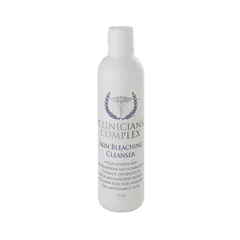
Works for:
based on ingredients and %- Cleansing
Can it cause trouble?
- Irritation risk: high
- Comedogenic risk ingredients: 2
Key actives
Works for
Cleansing
What does the product description say?
Skin Bleaching Cleanser
Source: From product name
This product works by removing dirt and oil from the surface of the skin.
Keep in mind that cleansing can disrupt the skin barrier, and most people do not need to cleanse their skin more than once per day.
Helps oil and water mix together. Has some emollient properties
A non-drying alcohol. Works as an emollient. Helps water and oil mix together and creates a nice product texture
An emollient that softens the skin and forms a protective layer on its surface. Helps water and oil mix together
Helps oil and water mix together and works as an emollient
Used to create a thicker product consistency
How honest is this product?
| Promise | Can it deliver? |
|---|---|
| Cleansing |
Total Promises Fulfilled score: 75/100.
Potential irritants
Comedogenic ingredients
User reviews (0)
Averages from community submissions.
No reviews yet for this product.
Be the first to share your experience!
Tried this product?
Help capture what the ingredient list can't—texture, finish, pilling, scent, and more. Answer what you can, skip the rest.
Takes ~30 seconds.
Reviews are shown in aggregate. No personal details.
| Product | Similarity | Price | Irritancy |
|---|---|---|---|
 Clinicians Complex Skin Bleaching Cleanser | Current | - | |
 Gallinée Prebiotic Soothing Cleansing Cream | 50% | ≈ $30.82 |
Key Actives
An exfoliating and moisturizing alpha-hydroxy acid (AHA). Typically causes less irritation than other AHAs, for example, glycolic acid. At high concentrations (about 15%), lactic acid can help reduce lines and wrinkles. Recent studies show that lactic acid can support the "good" bacteria living on skin's surface (healthy skin microbiome)
Helps oil and water mix together and works as an emollient
An emollient that softens the skin and forms a protective layer on its surface. Helps water and oil mix together
Helps to reduce hyperpigmentation and neutralize free radicals. Can be irritating
A non-drying alcohol. Works as an emollient. Helps water and oil mix together and creates a nice product texture
Helps attract water to the upper layer of the skin and improves the product texture
One of the best moisturizing ingredients. Naturally present in skin. It attracts water to the upper layer of the skin working as a humectant
Used to create a thicker product consistency
Helps oil and water mix together. Has some emollient properties
Potential irritants
Can be drying and contribute to skin irritation. Used in formulars to dissolve other ingredients, create a thinner product consistency or for its antibacterial properties
Helps to reduce hyperpigmentation and neutralize free radicals. Can be irritating
An aromatic blend of unspecified and possibly irritating ingredients
An exfoliating and moisturizing alpha-hydroxy acid (AHA). Typically causes less irritation than other AHAs, for example, glycolic acid. At high concentrations (about 15%), lactic acid can help reduce lines and wrinkles. Recent studies show that lactic acid can support the "good" bacteria living on skin's surface (healthy skin microbiome)
Can work as an exfoliant but is typically used to adjust the product pH
Helps oil and water mix together. Has some emollient properties
Comedogenic ingredients
A non-drying alcohol. Works as an emollient. Helps water and oil mix together and creates a nice product texture
Helps oil and water mix together. Has some emollient properties
All ingredients
An oil from a mixture of different vegetables. Helps soften the upper layer of the skin
An emollient that softens the skin and forms a protective layer on its surface. Helps water and oil mix together
Can be drying and contribute to skin irritation. Used in formulars to dissolve other ingredients, create a thinner product consistency or for its antibacterial properties
Helps attract water to the upper layer of the skin and improves the product texture
An exfoliating and moisturizing alpha-hydroxy acid (AHA). Typically causes less irritation than other AHAs, for example, glycolic acid. At high concentrations (about 15%), lactic acid can help reduce lines and wrinkles. Recent studies show that lactic acid can support the "good" bacteria living on skin's surface (healthy skin microbiome)
Can work as an exfoliant but is typically used to adjust the product pH
Helps to reduce hyperpigmentation and neutralize free radicals. Can be irritating
One of the best moisturizing ingredients. Naturally present in skin. It attracts water to the upper layer of the skin working as a humectant
A type of silicone that helps to create nice product texture and is used as an anti-foaming agent
A non-drying alcohol. Works as an emollient. Helps water and oil mix together and creates a nice product texture
Helps oil and water mix together. Has some emollient properties
An aromatic blend of unspecified and possibly irritating ingredients
Ingredient list view
Water, Vegetable oil, Stearic acid, Glyceryl stearate, Alcohol, Betaine, Lactic acid, Unknown, Mel, Citric acid, Kojic acid, Unknown, Citrus aurantifolia oil, Unspecified form of vitamin c, Glycerin, Edta, Sodium metabisulfite, Xanthan gum, Microcrystalline cellulose, Methylparaben, Propylparaben, Simethicone, Cetearyl alcohol, Ceteareth-20, Unknown, Parfum
- Epidermal and dermal effects of topical lactic acid
- Dual Effects of Alpha-Hydroxy Acids on the Skin
- TOPICAL TREATMENT OF MELASMA
- Postinflammatory hyperpigmentation: a review of the epidemiology, clinical features, and treatment options in skin of color.
- Glycerol and the skin: holistic approach to its origin and functions
- Final report on the safety assessment of sodium sulfite, potassium sulfite, ammonium sulfite, sodium bisulfite, ammonium bisulfite, sodium metabisulfite and potassium metabisulfite