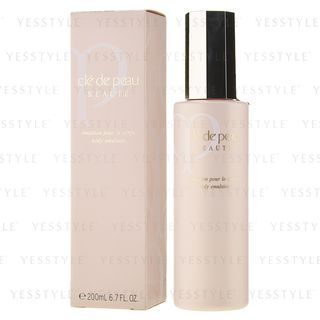
Clé de Peau Beauté Body Emulsion
Works for
2 of 3 advertised claims delivered
Anti-aging1 ingredient credited for this claimModerate evidence
“Helps protect against dryness and provides exceptional surface retexturizing to inspire new vitality and a smoother younger look in even the most severly fatigued skin.”
This product contains tocopherol. This ingredient help neutralize free radicals in skin. By doing so, they might be able to prevent early signs of aging (like fine lines and wrinkles), at least to some extent. These ingredients will not be able to "reverse" signs of aging.
Moisturizing18 ingredients credited for this claimGood evidence
“Replenishes critical moisture and improves suppleness.”
This product can help improve hydration of the skin with the two types of ingredients.
The first type is called “humectants”:
these ingredients help attract water.
When humectants are on the surface of the skin, they “pull in” the moisture from the outside environment, or from
within deeper layers of the skin. The following ingredients in this product do the job:
dipotassium glycyrrhizate, glycerin.
This product also contains ingredients called “occlusives”. They help reduce the speed with which our skin loses moisture to the outside environment. These ingredients also help soften the upper layer of the skin, so it feels less tight and nicer to the touch. The following ingredients in this product do the job: methicone, diisostearyl malate.
Evens skin tone1 ingredient credited for this claimLimited evidence
“Minimizes uneven skin tone and dullness for enhanced luminosity.”
This product contains ingredients (dipotassium glycyrrhizate) that could help reduce hyperpigmentation (for example, post-acne marks or age spots) in theory, but there is not enough evidence that they actually work.
Anti-oxidationNot advertised by the brand · 1 ingredient credited for this claimStrong evidence
This product contains antioxidants (tocopherol) that can help neutralize free radicals in skin. By doing so, they can lessen the damage the skin gets from the UV light (sun).
Can it cause trouble?
Irritancy13 flagged ingredients — patch-test recommendedHigh risk
Comedogenic1 ingredient rated 2 or more on the 0–5 pore-clogging scale1 flagged
User reviews
Be the first — your take helps the next person decide.
Ingredients
Filter by role to see what each ingredient is doing.
Tocopherol~26–39%
- Irritation risk
- Low
Pure form of vitamin E. Can help moisturise and protect the skin from free radicals. Often used to help stabilise other ingredients or the formula itself
More about TocopherolDipotassium glycyrrhizate~4.6–6.9%
- Irritation risk
- Low
A salt derived from licorice. Works as an emollient to soften the upper layer of the skin and can help calm down inflammation. Might be helpful for skin lightening
More about Dipotassium glycyrrhizateHydrolyzed conchiolin protein~4.6–6.9%
Hydrolyzed silk~3–4.5%
- Irritation risk
- Medium
Can help attract water to the upper layer of the skin
More about Hydrolyzed silkRoyal jelly extract~2.2–3.3%
- Irritation risk
- Medium
A compound secreted by bees. Might be able to attract water to the top layer of the skin. Avoid if sensitive to honey and bee products
More about Royal jelly extractRosa damascena extract~1.8–2.7%
- Irritation risk
- High
Oil of a very fragrant pink rose used as fragrance in cosmetics. Extensive research has shown it has mixed benefits. In the pro column, inhaling this flower’s scent seems to have relaxing properties and the plant’s petals contain skin-soothing and antioxidant compounds that can benefit skin. On the flipside, the numerous chemicals that create this rose’s distinctive fragrance pose a risk of causing skin aggravation.
More about Rosa damascena extractGlycerin~1.6–2.4%
- Irritation risk
- Low
One of the best moisturizing ingredients. Naturally present in skin. It attracts water to the upper layer of the skin working as a humectant
More about GlycerinTrehalose~1.3–2%
- Irritation risk
- Low
A sugar that attracts water to the upper layer of the skin
More about TrehalosePolyethylene~1.3–2%
Polypropylene~0.9–1.3%
Dimethyl ether~0.55–1.25%
- Irritation risk
- Low
Sodium acetylated hyaluronate~0.45–1%
- Irritation risk
- Low
A type of hyaluronic acid that works as an excellent moisturizer by attracting water into the upper layer of the skin. Is typically feels less sticky on the skin compared to the usual hyaluronic acid
More about Sodium acetylated hyaluronateMethacryloyloxyethyl phosphorylcholine~0.4–0.95%
- Irritation risk
- Low
Butyl methacrylate~0.4–0.9%
- Irritation risk
- Low
Rosa damascena extract~0.35–0.75%
- Irritation risk
- High
Oil of a very fragrant pink rose used as fragrance in cosmetics. Extensive research has shown it has mixed benefits. In the pro column, inhaling this flower’s scent seems to have relaxing properties and the plant’s petals contain skin-soothing and antioxidant compounds that can benefit skin. On the flipside, the numerous chemicals that create this rose’s distinctive fragrance pose a risk of causing skin aggravation.
More about Rosa damascena extractMacadamia ternifolia seed oil~0.4–0.9%
- Irritation risk
- Medium
Plant oil from nuts that helps soften the upper layer of the skin. Contains a high concentration of oleic acid that can weaken skin's barrier function and increase water-loss while enhancing penetration of other ingredients
More about Macadamia ternifolia seed oilCamellia japonica seed oil~0.4–0.9%
- Irritation risk
- Low
A plant oil that helps to soften the upper layer of the skin and can help restore skin's barrier function. Might have an anti-oxidant effect
More about Camellia japonica seed oilWater~0.3–0.7%
Butylene glycol~0.2–0.75%
- Irritation risk
- Low
Used to create a nice product texture and help delivery of other ingredients. Might be somewhat helpful in attracting water to the upper layer of the skin
More about Butylene glycolDenatonium benzoate~0.2–0.7%
- Irritation risk
- Low
Alcohol~0.15–0.65%
- Irritation risk
- High
Can be drying and contribute to skin irritation. Used in formulars to dissolve other ingredients, create a thinner product consistency or for its antibacterial properties
More about AlcoholMethicone~0.2–0.75%
- Irritation risk
- Low
A type of silicone that helps soften the upper layer of the skin and reduces the water loss from the skin surface
More about MethiconeDiisostearyl malate~0.2–0.75%
- Irritation risk
- Medium
Helps to soften the upper layer of the skin
More about Diisostearyl malatePentaerythrityl tetraethylhexanoate~0.2–0.8%
- Irritation risk
- Low
Used to create a nice product consistency while softening the upper layer of the skin
More about Pentaerythrityl tetraethylhexanoatePolyethylene~0.35–0.75%
Glyceryl stearate~0.2–0.8%
- Irritation risk
- Low
An emollient that softens the skin and forms a protective layer on its surface. Helps water and oil mix together
More about Glyceryl stearatePolyethylene~0.3–0.75%
Glyceryl stearate~0.2–0.8%
- Irritation risk
- Low
An emollient that softens the skin and forms a protective layer on its surface. Helps water and oil mix together
More about Glyceryl stearateMaltitol~0.15–0.6%
- Irritation risk
- Low
Helps attract water to the upper layer of the skin
More about MaltitolBehenyl alcohol~0.2–0.8%
- Irritation risk
- Low
Non-drying alcohol that helps water and oil mix together. Also serves as an emollient
More about Behenyl alcoholPetrolatum~0.2–0.75%
- Irritation risk
- Low
One of the most effective and the most studied occlusive ingredients that creates a protective layer on top of the skin preventing moisture loss
More about PetrolatumMyristyl myristate~0.2–0.75%
- Irritation risk
- Medium
- Comedogenicity
- 3/5
An emollient. Is not recommended for acne-prone skin as it can be comedogenic
More about Myristyl myristateLac~0.15–0.6%
- Irritation risk
- Low
Helps form a film on the surface of the skin and disperse other ingredients (like colorants) in cosmetics. Lac is a resinous substance secreted by parasite insects living on trees
More about LacAlcohol~0.15–0.6%
- Irritation risk
- High
Can be drying and contribute to skin irritation. Used in formulars to dissolve other ingredients, create a thinner product consistency or for its antibacterial properties
More about AlcoholPotassium hydroxide~0.15–0.6%
Alcohol~0.15–0.55%
- Irritation risk
- High
Can be drying and contribute to skin irritation. Used in formulars to dissolve other ingredients, create a thinner product consistency or for its antibacterial properties
More about AlcoholSodium metaphosphate~0.1–0.5%
Xanthan gum~0.15–0.55%
- Irritation risk
- Low
Used to create a thicker product consistency
More about Xanthan gumSodium metabisulfite~0.1–0.2%
Phenoxyethanol~0.1–0.35%
- Irritation risk
- Low
A preservative. It helps prevent bacterial growth in cosmetic products
More about PhenoxyethanolParfum~0.1–0.4%
- Irritation risk
- High
An aromatic blend of unspecified and possibly irritating ingredients
More about ParfumCi 15985~0.1–0.4%
Iron oxides~0.05–0.25%
- Irritation risk
- Low
An umbrella term for the following three colorants: CI 77491, CI 77492, CI 77499. They might be able to offer some protection against visible light, but the degree of the protection is not clear
More about Iron oxidesIngredient list view
Tocopherol, Unknown, Dipotassium glycyrrhizate, Hydrolyzed conchiolin protein, Unknown, Hydrolyzed silk, Unknown, Royal jelly extract, Rosa damascena extract, Glycerin, Trehalose, Polyethylene, Polypropylene, Dimethyl ether, Sodium acetylated hyaluronate, Methacryloyloxyethyl phosphorylcholine, Butyl methacrylate, Rosa damascena extract, Macadamia ternifolia seed oil, Unknown, Camellia japonica seed oil, Water, Butylene glycol, Denatonium benzoate, Alcohol, Methicone, Diisostearyl malate, Pentaerythrityl tetraethylhexanoate, Polyethylene, Glyceryl stearate, Polyethylene, Glyceryl stearate, Maltitol, Unknown, Behenyl alcohol, Petrolatum, Myristyl myristate, Unknown, Lac, Alcohol, Potassium hydroxide, Alcohol, Sodium metaphosphate, Xanthan gum, Unknown, Sodium metabisulfite, Phenoxyethanol, Parfum, Ci 15985, Iron oxides
Compare prices
Retailers ranked by price — lowest first.

Affiliate links · prices updated regularly
Sources cited in this review
Every concentration estimate and effectiveness label is anchored to one of these 11 studies and safety reviews.
- 1Vitamin E in dermatologyncbi.nlm.nih.gov
- 2Vitamin E and Skin Healthlpi.oregonstate.edu
- 3
- 4
- 5
- 6

Affiliate links · As an Amazon Associate, WIMJ earns from qualifying purchases.