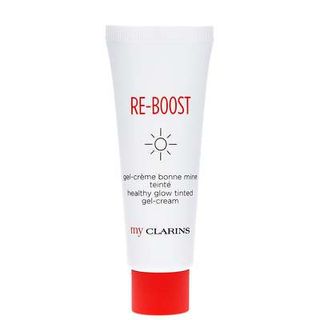
Clarins My Clarins RE-BOOST Healthy glow tinted gel-cream
Works for
1 of 1 advertised claim delivered
MoisturizingAnhydroxylitol, Glycerin + 10 moreGood evidence
“- Fig Extract: Hydrates skin.”
This product can help improve hydration of the skin with the two types of ingredients.
The first type is called “humectants”:
these ingredients help attract water.
When humectants are on the surface of the skin, they “pull in” the moisture from the outside environment, or from
within deeper layers of the skin. The following ingredients in this product do the job:
anhydroxylitol, glycerin.
This product also contains ingredients called “occlusives”. They help reduce the speed with which our skin loses moisture to the outside environment. These ingredients also help soften the upper layer of the skin, so it feels less tight and nicer to the touch. The following ingredients in this product do the job: prunus armeniaca kernel oil, cetearyl ethylhexanoate.
Anti-oxidationNot advertised by the brand · Ficus carica fruit extract, Tartaric acid + 4 moreModerate evidence
This product contains antioxidants (ficus carica fruit extract, tartaric acid) that might be able to help neutralize free radicals in skin to lessen the damage it gets from the UV light (sun). There is not enough evidence to confirm their effectiveness in skin though.
Can it cause trouble?
Irritancy2 strong irritants: Parfum, Lapsana communis flower/leaf/stem extractMedium risk
Comedogenic1 ingredient rated 2 or more on the 0–5 pore-clogging scale1 flagged

User reviews
Ingredients
Filter by role to see what each ingredient is doing.
Water~40–60%
Glycerin~4–5.9%
- Irritation risk
- Low
One of the best moisturizing ingredients. Naturally present in skin. It attracts water to the upper layer of the skin working as a humectant
More about GlycerinCetearyl ethylhexanoate~3.7–5.6%
- Irritation risk
- Low
An emollient that helps soften the skin
More about Cetearyl ethylhexanoateTitanium dioxide~3.2–4.8%
- Irritation risk
- Low
Works as a UV filter when used in high concentrations. It is photostable and is effective mostly against the UVB light, with some protection in the UVA range. In small concentrations, used for its ability to improve the color of cosmetic products. Is usually well tolerated by the skin
More about Titanium dioxideButylene glycol~2.1–3.2%
- Irritation risk
- Low
Used to create a nice product texture and help delivery of other ingredients. Might be somewhat helpful in attracting water to the upper layer of the skin
More about Butylene glycol1,2-hexanediol~0.85–1.25%
Hydroxyethyl acrylate/sodium acryloyldimethyl taurate copolymer~1.4–2.1%
- Irritation risk
- Medium
A gelling agent that thickens the product consistency and leaves the skin with a velvety finish
More about Hydroxyethyl acrylate/sodium acryloyldimethyl taurate copolymerPrunus armeniaca kernel oil~1.2–1.9%
- Irritation risk
- Medium
An emollient that helps soften the skin
More about Prunus armeniaca kernel oilSilica~1.2–1.8%
Cocos nucifera fruit juice~0.55–1.3%
- Irritation risk
- Low
Synthetic fluorphlogopite~0.5–1.1%
- Irritation risk
- Low
A mineral that is used as an optical filter (makes the skin looks nicer through light reflection) and to improve the texture of cosmetic products
More about Synthetic fluorphlogopitePropylene glycol~0.35–0.8%
- Irritation risk
- High
Helps oil and water mix together and can enhance the penetration of other ingredients into the skin. It can be irritating
More about Propylene glycolIron oxides~0.35–0.8%
- Irritation risk
- Low
An umbrella term for the following three colorants: CI 77491, CI 77492, CI 77499. They might be able to offer some protection against visible light, but the degree of the protection is not clear
More about Iron oxidesXylitylglucoside~0.2–0.7%
- Irritation risk
- Low
Helps attract water to the upper layer of the skin and repair the skin barrier function
More about XylitylglucosideAcrylates/c10-30 alkyl acrylate crosspolymer~0.15–0.7%
- Irritation risk
- Medium
Maintains the texture of skincare products. Allows the product to spread evenly. Helps oil and water mix together
More about Acrylates/c10-30 alkyl acrylate crosspolymerAnhydroxylitol~0.15–0.65%
- Irritation risk
- Low
Helps attract water to the upper layer of the skin and repair the skin barrir function
More about AnhydroxylitolCellulose acetate~0.15–0.65%
- Irritation risk
- Low
Ethylhexylglycerin~0.15–0.55%
Iron oxides~0.15–0.6%
- Irritation risk
- Low
An umbrella term for the following three colorants: CI 77491, CI 77492, CI 77499. They might be able to offer some protection against visible light, but the degree of the protection is not clear
More about Iron oxidesMagnesium stearate~0.15–0.5%
Propylene glycol stearate~0.1–0.4%
Parfum~0.1–0.35%
- Irritation risk
- High
An aromatic blend of unspecified and possibly irritating ingredients
More about ParfumIron oxides~0.05–0.3%
- Irritation risk
- Low
An umbrella term for the following three colorants: CI 77491, CI 77492, CI 77499. They might be able to offer some protection against visible light, but the degree of the protection is not clear
More about Iron oxidesTartaric acid~0.1–0.35%
- Irritation risk
- Medium
An AHA (alpha-hydroxy acid). It oxidizes quickly which makes it less effective in skincare formulations. It can support skin's barrier and moisture levels
More about Tartaric acidXylitol~0.1–0.3%
- Irritation risk
- Low
Helps attract water to the upper layer of the skin and repair the skin barrier function
More about XylitolSodium hydroxide~0.1–0.35%
Disodium edta~0.1–0.3%
Tamarindus indica extract~0.1–0.35%
- Irritation risk
- High
A plant extract that might have antioxidant and anti-inflammatory effect in skin but solid evidence is lacking
More about Tamarindus indica extractEthylcellulose~0.1–0.35%
- Irritation risk
- Low
Glucose~0.1–0.35%
- Irritation risk
- Low
Helps attract water to the upper layer of the skin. Could be helpful in restoring the skin barrier function
More about GlucoseMarrubium vulgare extract~0.1–0.35%
- Irritation risk
- Low
Lycium barbarum fruit extract~0.1–0.3%
- Irritation risk
- Medium
A plant extract that can help neutralize free radicals in skin and attract water to its upper layer
More about Lycium barbarum fruit extractCitric acid~0.1–0.35%
- Irritation risk
- Medium
Can work as an exfoliant but is typically used to adjust the product pH
More about Citric acidFicus carica fruit extract~0.1–0.4%
- Irritation risk
- Medium
A plant extract that can help neutralize free radicals. The concentrations typically used in cosmetics are too small to have an effect
More about Ficus carica fruit extractMalpighia emarginata seed extract~0.1–0.4%
- Irritation risk
- High
Can help neutralize free radicals in skin but is typically not used in a high enough concentration
More about Malpighia emarginata seed extractPhenethyl alcohol~0.1–0.4%
Furcellaria lumbricalis extract~0.1–0.4%
- Irritation risk
- Medium
Might be able to support collagen production, but no solid research is available
More about Furcellaria lumbricalis extractSodium benzoate~0.1–0.3%
Rhododendron ferrugineum extract~0.1–0.35%
- Irritation risk
- High
Potassium sorbate~0.05–0.25%
Sorbic acid~0.1–0.3%
Ci 14700~0.05–0.3%
Lapsana communis flower/leaf/stem extract~0.05–0.15%
- Irritation risk
- High
Used for its fragrance. Can be irritating
More about Lapsana communis flower/leaf/stem extractMaris sal~0.05–0.15%
- Irritation risk
- Medium
Used to thicken the product formulation and might help to add minerals to the surface of the skin. It is used in scrubs as a physical exfoliant. Can increase sensitivity to other ingredients if left on the skin or used in high concentration
More about Maris salIngredient list view
Water, Glycerin, Cetearyl ethylhexanoate, Titanium dioxide, Butylene glycol, 1,2-hexanediol, Hydroxyethyl acrylate/sodium acryloyldimethyl taurate copolymer, Prunus armeniaca kernel oil, Silica, Cocos nucifera fruit juice, Synthetic fluorphlogopite, Propylene glycol, Iron oxides, Xylitylglucoside, Acrylates/c10-30 alkyl acrylate crosspolymer, Anhydroxylitol, Cellulose acetate, Ethylhexylglycerin, Iron oxides, Magnesium stearate, Propylene glycol stearate, Parfum, Iron oxides, Tartaric acid, Xylitol, Sodium hydroxide, Disodium edta, Tamarindus indica extract, Ethylcellulose, Glucose, Marrubium vulgare extract, Lycium barbarum fruit extract, Citric acid, Ficus carica fruit extract, Malpighia emarginata seed extract, Phenethyl alcohol, Furcellaria lumbricalis extract, Sodium benzoate, Rhododendron ferrugineum extract, Potassium sorbate, Sorbic acid, Ci 14700, Lapsana communis flower/leaf/stem extract, Maris sal
Compare prices
Retailers ranked by price — lowest first.
Affiliate links · prices updated regularly
Worth comparing, line by line.
Match % combines shared ingredients, the first five ingredients, shared actives and hero ingredients, irritancy (lower counts in the alternative's favour), texture and body area. Only products in the same routine step are compared.
| ClarinsMy Clarins RE-BOOST Healthy glow tinted gel-creamYOUR PRODUCT | RevolutionSalicylic Acid and Zinc PCA gel cream | BootsNo7 HydraLuminous+ Night Gel | REVOLUTION SKINCARESalicylic Acid & Zinc PCA Gel Cream | |
|---|---|---|---|---|
| Match | — | 59% | 59% | 59% |
| Price | $25.72 | — | — | $10.65−$15.07 |
| Shared key ingredients | — | 4 of 8 | 3 of 8 | 4 of 8 |
| Key difference | — | Salicylic Acid | Niacinamide | Salicylic Acid |
| Irritancy | Medium | Low | Low | Low |
| Drying alcohol | — | — | — | — |
| View product | Shop | Shop | Shop |

Sources cited in this review
Every concentration estimate and effectiveness label is anchored to one of these 17 studies and safety reviews.
- 1
- 2
- 3Surfactants and experimental irritant contact dermatitisncbi.nlm.nih.gov
- 4Propylene Glycolpubmed.ncbi.nlm.nih.gov
- 5Skin-sensitizing and irritant properties of propylene glycolonlinelibrary.wiley.com
- 6

Affiliate links · As an Amazon Associate, WIMJ earns from qualifying purchases.