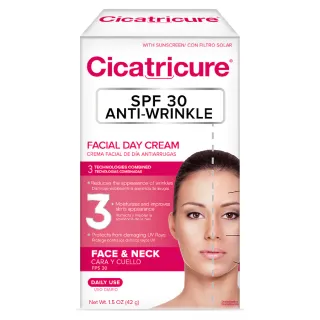
Cicatricure Anti-Wrinkle Face and Neck Facial Day Cream with Sunscreen SPF 30
Works for
4 of 4 advertised claims delivered
Sun protectionSPF 30 · 5 UV filtersBroad spectrum
This product offers a good level of protection against both UVB and UVA rays.
This sunscreen uses organic (so-called "chemical") sunscreen filters. Organic, or "chemical" filters usually provide reliable sun protection and rarely leave a white cast. Sunscreens with organic filters can sting eyes.
MoisturizingPalmitoyl tripeptide-1, Myristoyl nonapeptide-3 + 17 moreStrong evidence
“Anti-Wrinkle Face and Neck Facial Day Cream with Sunscreen SPF 30”
This product can help improve hydration of the skin with the two types of ingredients.
The first type is called “humectants”:
these ingredients help attract water.
When humectants are on the surface of the skin, they “pull in” the moisture from the outside environment, or from
within deeper layers of the skin. The following ingredients in this product do the job:
glycerin, sodium hyaluronate.
This product also contains ingredients called “occlusives”. They help reduce the speed with which our skin loses moisture to the outside environment. These ingredients also help soften the upper layer of the skin, so it feels less tight and nicer to the touch. The following ingredients in this product do the job: dimethicone, cetearyl alcohol.
The following ingredients in this product are especially good for supporting the skin barrier and helping with the hydration level: myristoyl nonapeptide-3, palmitoyl tetrapeptide-7, palmitoyl tripeptide-1
Anti-agingHydroxypinacolone retinoate, Retinol + 6 moreStrong evidence
“Anti-Wrinkle Face and Neck Facial Day Cream with Sunscreen SPF 30”
This product can help reduce and prevent fine lines and wrinkles, improve skin elasticity and firmness because it contains hydroxypinacolone retinoate, retinol, bakuchiol.
These ingredients in the product can also be helpful, even though there is less evidence for their effectiveness: myristoyl nonapeptide-3, palmitoyl tetrapeptide-7, palmitoyl tripeptide-1, retinyl palmitate.
Keep in mind that it typically takes at least 6 weeks to notice any results because the changes that are needed to improve fine lines and elasticity happen in the deeper layers of the skin. No topical anti-aging product can “erase” wrinkles or fully reverse signs of aging.
This product can also help prevent early signs of skin aging because it offers a good level of broad spectrum sun protection. Sun damage is the main cause of premature skin aging, and protecting your skin from the sun is the best anti-aging strategy.
Evens skin toneHydroxypinacolone retinoate, Retinol + 2 moreStrong evidence
“We offer a full line of products to brighten & cleanse your skin, even skin tone & reduce the appearance of wrinkles, as well as protect skin from harmful UV rays.”
This product offers broad spectrum sun protection. It means that it can prevent hyperpigmentation and help keep the skin tone even (sun damage is the main factor causing age spots, darkening of post-acne marks and other discolorations).
Anti-oxidationNot advertised by the brand · Retinol, Bakuchiol + 3 moreStrong evidence
This product contains antioxidants (bakuchiol, retinol) that can help neutralize free radicals in skin. By doing so, they can lessen the damage the skin gets from the UV light (sun).
Anti-blemishNot advertised by the brand · Retinol, Hydroxypinacolone retinoate + 2 moreStrong evidence
This product can help reduce breakouts and clogged pores because it contains the following ingredient: hydroxypinacolone retinoate, retinol. These ingredients is used for treating acne and can have a noticeable effect.
In addition, this product contains bakuchiol. It can help in reducing blemishes, even though it is less effective.
The following ingredient (ingredients) in this product might be helpful, but there is no evidence to confirm that it actually works: retinyl palmitate
ExfoliationNot advertised by the brand · Retinol, Hydroxypinacolone retinoate + 1 moreStrong evidence
This product can help exfoliate the skin. In other words, it helps break down the bonds between dead cells on the surface of the skin and speed up the skin turnover. Skin often appears softer and brighter after exfoliation, but overdoing it can result in disrupted skin barrier. The following ingredient is doing the exfoliating job in this product: retinol.
Can it cause trouble?
Irritancy5 strong irritants: Benzophenone-3, Retinyl palmitate + 3 more — patch-test recommendedHigh risk
Comedogenic3 ingredients rated 2 or more on the 0–5 pore-clogging scale3 flagged
User reviews
Be the first — your take helps the next person decide.
Ingredients
Filter by role to see what each ingredient is doing.
Butyl methoxydibenzoylmethane3%
- Irritation risk
- Medium
Avobenzone. An organic, or so-called "chemical" UV filter. Protects against both UVA and UVB rays. Needs to be combined with other filters in a formulation to be stable.
More about Butyl methoxydibenzoylmethaneEthylhexyl methoxycinnamate7.5%
- Irritation risk
- High
Octinoxate. When used in higher concentrations, works as a sunscreen protecting the skin from UVB rays. When used in lower concentration, helps to preserve the product formulation. Is shown to be harmful to coral reefs - consider avoiding bathing in coral reef areas when wearing a product with this ingredient. It can be irritating
More about Ethylhexyl methoxycinnamateEthylhexyl salicylate5%
- Irritation risk
- Low
Octisalate. A UV filter. It offers some protection against the sun rays that cause sunburn (UVB), but does not protect against the most aging sun rays (UVA). It loses its effectiveness quickly when exposed to sunlight. It is an organic, or so called "chemical" sunscreen
More about Ethylhexyl salicylateOctocrylene2.7%
- Irritation risk
- Medium
A weak sunscreen that protects against the sun rays that cause sunburn (UVB) and is somewhat effective against the UVA rays. It is quite stable and can help stabilize other, more vulnerable, sunscreen ingredients like Avobenzone. It is an organic, or so called "chemical" sunscreen
More about OctocryleneBenzophenone-34%
- Irritation risk
- High
Same as oxybenzone. Protects in the UVB and short UVA range. In small concentrations, used to stabilize product formulation. Can be irritating. Is shown to be harmful to coral reefs - consider avoiding bathing in coral reef areas when wearing a product with this ingredient. It can penetrate the skin and get absorbed into bloodstream faster than other popular filters available in the US. The study that produced this finding did not address any potential health effects of the absorption
More about Benzophenone-3Water~45–55%
Glycerin~3.8–4.6%
- Irritation risk
- Low
One of the best moisturizing ingredients. Naturally present in skin. It attracts water to the upper layer of the skin working as a humectant
More about GlycerinDimethicone~5.2–6.3%
- Irritation risk
- Low
A silicone that helps to reduce water loss from the surface of the skin. Can temporarily "fill in" lines and wrinkles, absorb oil, and create a nice product finish
More about DimethiconeEthylhexyl methoxycrylene~4.2–5.1%
- Irritation risk
- Medium
Helps improve stability of sunscreen filters and boost their effectiveness
More about Ethylhexyl methoxycryleneNeopentyl glycol diheptanoate~3.2–3.9%
- Irritation risk
- Low
Helps soften the upper layer of the skin and create a nice product consistency
More about Neopentyl glycol diheptanoateGlyceryl stearate~2.3–2.8%
- Irritation risk
- Low
An emollient that softens the skin and forms a protective layer on its surface. Helps water and oil mix together
More about Glyceryl stearateButylene glycol~1.7–2%
- Irritation risk
- Low
Used to create a nice product texture and help delivery of other ingredients. Might be somewhat helpful in attracting water to the upper layer of the skin
More about Butylene glycolIsostearyl neopentanoate~1.5–1.8%
- Irritation risk
- Medium
- Comedogenicity
- 2/5
Used to create a nice product texture and helps soften the upper layer of the skin. Could be comedogenic
More about Isostearyl neopentanoatePolymethyl methacrylate~1.2–1.5%
- Irritation risk
- Low
Is used to enhance product texture and can help to optically mask skin imperfections
More about Polymethyl methacrylatePpg-2 isoceteth-20 acetate~0.9–1.1%
- Irritation risk
- Medium
Helps water and oil mix together
More about Ppg-2 isoceteth-20 acetateRetinyl palmitate~0.6–0.9%
- Irritation risk
- High
Three steps removed from the active form of vitamin A - retinoic acid. To have an effect in the skin, it first needs to be converted twice to become the retinoic acid. This means it is less potent than retinol, but could also be less irritating. Once converted to the retinoic acid in the skin, it helps against all signs of aging, improves skin cell turnover and helps fight blemishes and clogged pores. However, in many cosmetic formulations, it is used in a concentration that is too low to have the full effect
More about Retinyl palmitateBisabolol~0.5–0.75%
- Irritation risk
- Low
An active component of chamomile plant that historically has been used to calm down irritated skin. A recent study shows that bisabolol indeed can have some anti-inflammatory effect on skin, even though conclusive data is lacking. Bisabolol has a sweet floral scent and can be added to products for its aromatic properties
More about BisabololTocopheryl acetate~0.5–0.75%
- Irritation risk
- Medium
A more stable but less bio-available form of vitamin E compared to Tocopherol. Might help moisturize and protect the skin from free radicals, but mostly used in low concentrations to stabilize other ingredients.
More about Tocopheryl acetateSorbitan oleate~0.45–0.65%
- Irritation risk
- Medium
- Comedogenicity
- 2/5
Helps oil and water mix together
More about Sorbitan oleateCetearyl alcohol~0.5–0.75%
- Irritation risk
- Low
- Comedogenicity
- 2/5
A non-drying alcohol. Works as an emollient. Helps water and oil mix together and creates a nice product texture
More about Cetearyl alcoholBakuchiol~0.45–0.7%
- Irritation risk
- Medium
A plant extract that is, though different in chemical structure, acts similar to retinoids. First studies show that it can help reduce fine lines and wrinkles, improve skin tone, reduce clogged pores and blemishes, and reduce inflammation. There is no conclusive evidence that bakuchiol is as effective as retinol however. The study that directly compared retinol with bakuchiol used bakuchiol applied twice daily compared to once per day for the retinol. According to this study, bakuchiol is less irritating than retinol. Bakuchiol is extracted from seeds of Babchi plant. Other parts of the plant contain coumarins that could cause allergic and irritant reactions. These compounds should be removed in the extraction process when bakuchiol is produced, but it is a good idea to be cautious and stay away from products that include the Babchi plant extracts other than purified bakuchiol to avoid irritation
More about BakuchiolPalmitoyl tripeptide-1~0.45–0.7%
- Irritation risk
- Low
A type of peptide. Peptides are excellent moisturizers and might be able support collagen production reducing fine lines and wrinkles
More about Palmitoyl tripeptide-1Palmitoyl tetrapeptide-7~0.45–0.65%
- Irritation risk
- Low
A type of peptide. Peptides are excellent moisturizers and might be able support collagen production reducing fine lines and wrinkles
More about Palmitoyl tetrapeptide-7Myristoyl nonapeptide-3~0.3–0.55%
- Irritation risk
- Low
A type of peptide. Peptides are excellent moisturizers and might be able support collagen production reducing fine lines and wrinkles
More about Myristoyl nonapeptide-3Tocopherol~0.25–0.5%
- Irritation risk
- Low
Pure form of vitamin E. Can help moisturise and protect the skin from free radicals. Often used to help stabilise other ingredients or the formula itself
More about TocopherolRetinol~0.2–0.4%
- Irritation risk
- High
Two steps removed from the active form of vitamin A - retinoic acid. Once converted to the retinoic acid in the skin, retinol is proven to be effective against all signs of aging. It improves skin cell turnover, helps fight blemishes and clogged pores, can regulate excess oil production and even skin tone. It can, however, be quite irritating
More about RetinolSodium lactate~0.2–0.4%
- Irritation risk
- Medium
Helps attract water to the upper layer of the skin. Is often used to adjust the pH level of the product
More about Sodium lactateSodium hyaluronate~0.2–0.35%
- Irritation risk
- Low
One of the best moisturizing ingredients. Attracts water into the upper layer of the skin
More about Sodium hyaluronateDimethicone crosspolymer~0.2–0.4%
- Irritation risk
- Low
Used to create a thicker product texture. Helps soften the upper layer of the skin and might be able to prevent moisture loss from its surface
More about Dimethicone crosspolymerAcrylamide/sodium acryloyldimethyltaurate copolymer~0.2–0.4%
- Irritation risk
- Low
Helps water and oil mix together and create gel-like textures
More about Acrylamide/sodium acryloyldimethyltaurate copolymerIsohexadecane~0.3–0.55%
- Irritation risk
- Low
Improves the texture of the product and helps soften the skin. Helps oil and water mix together and can be used as a cleansing agent
More about IsohexadecanePolysorbate 80~0.25–0.4%
Behenyl alcohol~0.3–0.55%
- Irritation risk
- Low
Non-drying alcohol that helps water and oil mix together. Also serves as an emollient
More about Behenyl alcoholCaprylic/capric triglyceride~0.3–0.55%
- Irritation risk
- Medium
A good mix of fatty acids that forms a protective layer on the skin. Improves the shelf life of products. Derived from coconut and glycerin
More about Caprylic/capric triglycerideSodium ascorbate~0.2–0.4%
- Irritation risk
- Low
Carbomer~0.2–0.35%
- Irritation risk
- Low
Helps create a thicker or gel-like product texture. It is not a surfactant but can be used in gentle cleansing formulations
More about CarbomerPolysorbate 20~0.25–0.45%
Phenoxyethanol~0.2–0.4%
- Irritation risk
- Low
A preservative. It helps prevent bacterial growth in cosmetic products
More about PhenoxyethanolCaprylyl glycol~0.2–0.4%
- Irritation risk
- Medium
Helps preserve products and creates a nice product texture
More about Caprylyl glycolChlorphenesin~0.15–0.3%
Ethylhexylglycerin~0.2–0.35%
Parfum~0.15–0.3%
- Irritation risk
- High
An aromatic blend of unspecified and possibly irritating ingredients
More about ParfumPentylene glycol~0.3–0.5%
- Irritation risk
- Medium
Used to preserve products, dissolve other ingredients and create a nice product texture
More about Pentylene glycolXanthan gum~0.2–0.35%
- Irritation risk
- Low
Used to create a thicker product consistency
More about Xanthan gumAcrylates/c10-30 alkyl acrylate crosspolymer~0.25–0.5%
- Irritation risk
- Medium
Maintains the texture of skincare products. Allows the product to spread evenly. Helps oil and water mix together
More about Acrylates/c10-30 alkyl acrylate crosspolymerDisodium edta~0.15–0.3%
Dimethyl isosorbide~0.15–0.3%
- Irritation risk
- Low
Used to dissolve other ingredients in a product and can enhance their ability to penetrate the skin
More about Dimethyl isosorbideHydroxypinacolone retinoate~0.01–0.05%
- Irritation risk
- High
A derivative of the most potent form of vitamin A, retinoic acid. The ingredient can be sold under name Granactive Retinoid. Note that if a skincare brand discloses the concentration of Granactive Retinoid in a product, the concentration refers to a diluted form of Hydroxypinacolone Retinoate: 1% of Granactive Retinoid corresponds to 0.1% of Hydroxypinacolone Retinoate. Hydroxypinacolone Retinoate (HPR) is a unique derivative of retinoic acid because it can directly work in the skin and does not require additional conversion steps. According to studies done by the manufacturer on models of human skin (not real people), this derivative is more effective than other cosmetic versions of retinoids (such as retinol, retinaldehyde, and retinyl palmitate), and, at the same time, causes less irritation. It has been also demonstrated to be more stable than retinol which makes formulating with easier and increases the chances that a product with it will maintain its effectiveness after opening. The packaging should still ideally be air-tight. HPR is available over the counter in the EU, UK, Asia, Australia and New Zealand, but is only with a prescription in Canada.
More about Hydroxypinacolone retinoateCitric acid~0.15–0.25%
- Irritation risk
- Medium
Can work as an exfoliant but is typically used to adjust the product pH
More about Citric acidPotassium sorbate~0.15–0.3%
Sodium hydroxide~0.15–0.25%
Ingredient list view
Butyl methoxydibenzoylmethane, Ethylhexyl methoxycinnamate, Ethylhexyl salicylate, Octocrylene, Benzophenone-3, Water, Glycerin, Dimethicone, Ethylhexyl methoxycrylene, Neopentyl glycol diheptanoate, Glyceryl stearate, Butylene glycol, Isostearyl neopentanoate, Polymethyl methacrylate, Ppg-2 isoceteth-20 acetate, Retinyl palmitate, Bisabolol, Tocopheryl acetate, Sorbitan oleate, Cetearyl alcohol, Bakuchiol, Palmitoyl tripeptide-1, Palmitoyl tetrapeptide-7, Myristoyl nonapeptide-3, Tocopherol, Retinol, Sodium lactate, Sodium hyaluronate, Dimethicone crosspolymer, Acrylamide/sodium acryloyldimethyltaurate copolymer, Isohexadecane, Polysorbate 80, Behenyl alcohol, Caprylic/capric triglyceride, Sodium ascorbate, Carbomer, Polysorbate 20, Phenoxyethanol, Caprylyl glycol, Chlorphenesin, Ethylhexylglycerin, Parfum, Pentylene glycol, Xanthan gum, Acrylates/c10-30 alkyl acrylate crosspolymer, Disodium edta, Dimethyl isosorbide, Hydroxypinacolone retinoate, Citric acid, Potassium sorbate, Sodium hydroxide
Compare prices
Retailers ranked by price — lowest first.

Affiliate links · prices updated regularly
Worth comparing, line by line.
Match % combines shared ingredients, the first five ingredients, shared actives and hero ingredients, irritancy (lower counts in the alternative's favour), texture and body area. Only products in the same routine step are compared.
| CicatricureAnti-Wrinkle Face and Neck Facial Day Cream with Sunscreen SPF 30YOUR PRODUCT | StriVectinAdvanced Retinol Day Moisturizer Broad Spectrum SPF 30 | NEOSTRATASkin Active Matrix Support SPF 30 | ExuvianceAge Reverse Day Repair SPF 30 | |
|---|---|---|---|---|
| Match | — | 67% | 61% | 61% |
| Price | $19.79 | — | $69.52+$49.73 | $40.99+$21.20 |
| Shared key ingredients | — | 13 of 18 | 7 of 18 | 7 of 18 |
| Key difference | — | Palmitoyl Oligopeptide | Acetyl Glucosamine | Acetyl Glucosamine |
| Irritancy | High | High | Medium | Medium |
| SPF | SPF 30 | SPF 30 | SPF 30 | SPF 30 |
| Drying alcohol | — | — | — | — |
| View product | Shop | Shop | Shop |


Product summary
We believe that "Cicatricure - Anti-Wrinkle Face and Neck Facial Day Cream with Sunscreen SPF 30" can provide reliable sun protection based on the ingredients listed. We love that it can protect from both UVA and UVB rays (not all sunscreens with SPF ratings give UVA protection. UVA rays do not cause sunburn, but still damage our skin and lead to early aging).
Its formula is also hydrating, so you might not need an additional moistruizer during the day. Like all broad-spectrum sunscreens, this product helps prevent early signs of aging.
Sunscreen filters
This sunscreen uses so-called "chemical", or organic UV filters (organic simply means that their molecules contain atoms of carbon). These filters typically give good sun protection and rarely leave a white cast, but they can be irritating for sensitive skin. The UV filters in this sunscreen are: oxybenzone 4.00% (declared), avobenzone 3.00% (declared), octinoxate 7.50% (declared), octisalate 5.00% (declared) and octocrylene 2.70% (declared).
Irritation risk
This formulation includes some common irritants, including ingredients that do not provide a benefit for the skin. We assess the overall irritancy of this moisturizer to be high. For a detailed overview of all potential irritants: click here
You can see the detailed formula review with the breakdown of all actives in the product and the full ingredient list with estimated concentrations in the tables below.
Price
The product retails for 19.79$ in the United States.
For a detailed price comparison: click here.
Sources cited in this review
Every concentration estimate and effectiveness label is anchored to one of these 22 studies and safety reviews.
- 1
- 2
- 3On Photostability of Oxybenzonecore.ac.uk
- 4
- 5
- 6Final Report on the Safety Assessment of Dimethicone Copolyoljournals.sagepub.com

Affiliate links · As an Amazon Associate, WIMJ earns from qualifying purchases.