Works for
1 of 1 advertised claim delivered
Moisturizing7 ingredients credited for this claimGood support
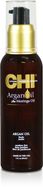
“CHI, Argan Oil A nourishing blend of oils that supports and hydrates the hair, the Plus Moringa Oil is light and absorbs quickly, repairing damage to the hair whilst helping to smooth it.”
This product can help soften the skin and reduce its moisture loss with emollients and occlusives: argania spinosa kernel oil, c12-15 alkyl benzoate.
Keep in mind that this product does not contain effective ingredients to attract water to the upper layer of the skin. This is why an additional product with humectants like glycerin or hyaluronic acid can be helpful (apply it before this product for the best results).
Evens skin toneNot advertised by the brand · 1 ingredient credited for this claimModerate support
The following ingredient (ingredients) in this product might be helpful, but there is no evidence to confirm that it actually works: retinyl palmitate.
Anti-agingNot advertised by the brand · 1 ingredient credited for this claimModerate support
This product contains retinyl palmitate. This ingredient might be able to help reduce and prevent fine lines and wrinkles, improve skin elasticity and firmness, but there is not enough evidence that it actually works.
Can it cause trouble?
Irritancy14 strong irritants: Retinyl palmitate, Parfum + 12 more — patch-test recommendedHigh risk
ComedogenicClean of flagged comedogenic ingredientsNone flagged
User reviews
Be the first — your take helps the next person decide.
Ingredients
Filter by role to see what each ingredient is doing.
Cyclopentasiloxane~23–35%
- Irritation risk
- Low
A silicone that helps improve the product texture and spreadability. Can absorb oil creating a short-term mattifying effect on the skin
More about CyclopentasiloxaneCyclotetrasiloxane~5.3–7.9%
- Irritation risk
- Low
Cyclohexasiloxane~4.3–6.4%
- Irritation risk
- Low
A silicone that serves as an emollient. Helps create a nice non-greasy feels
More about CyclohexasiloxaneCaprylyl methicone~3.6–5.4%
- Irritation risk
- Low
A type of silicone that helps to soften the upper layer of the skin and create a nice product finish on the skin
More about Caprylyl methiconeArgania spinosa kernel oil~2.9–4.3%
- Irritation risk
- Medium
An emollient that helps soften the upper layer of the skin. Might have some weak anti-oxidant properties
More about Argania spinosa kernel oilMoringa oleifera seed oil~2.2–3.3%
- Irritation risk
- Medium
A plant oil that helps soften the upper layer of the skin. Is unlikely to be helpful in restoring skin barrier function due to the low content of linoleic acid
More about Moringa oleifera seed oilHydrolyzed silk~1.6–2.4%
- Irritation risk
- Medium
Can help attract water to the upper layer of the skin
More about Hydrolyzed silkTocopheryl acetate~1.2–1.9%
- Irritation risk
- Medium
A more stable but less bio-available form of vitamin E compared to Tocopherol. Might help moisturize and protect the skin from free radicals, but mostly used in low concentrations to stabilize other ingredients.
More about Tocopheryl acetateRetinyl palmitate~1.1–1.6%
- Irritation risk
- High
Three steps removed from the active form of vitamin A - retinoic acid. To have an effect in the skin, it first needs to be converted twice to become the retinoic acid. This means it is less potent than retinol, but could also be less irritating. Once converted to the retinoic acid in the skin, it helps against all signs of aging, improves skin cell turnover and helps fight blemishes and clogged pores. However, in many cosmetic formulations, it is used in a concentration that is too low to have the full effect
More about Retinyl palmitateC12-15 alkyl benzoate~0.95–1.45%
- Irritation risk
- Low
Enhances the product texture and makes it more spreadable. Helps reduce water loss from the outer layer of skin. Extands the shelf life by preventing bacteria growth
More about C12-15 alkyl benzoatePhenoxyethanol~0.5–1%
- Irritation risk
- Low
A preservative. It helps prevent bacterial growth in cosmetic products
More about PhenoxyethanolParfum~0.4–0.95%
- Irritation risk
- High
An aromatic blend of unspecified and possibly irritating ingredients
More about ParfumBenzyl alcohol~0.35–0.8%
- Irritation risk
- High
A preservative. Can be used to mask unpleasant smell. Can be irritating
More about Benzyl alcoholBenzyl benzoate~0.3–0.75%
- Irritation risk
- High
Fragrance with sweet balsamic smell. Help to preserve products and dissolve other ingredients. Could trigger allergic reactions and be irritating
More about Benzyl benzoateBenzyl salicylate~0.2–0.8%
Citral~0.2–0.75%
Citronellol~0.2–0.7%
Coumarin~0.15–0.6%
Eugenol~0.15–0.55%
Geraniol~0.15–0.5%
Hydroxycitronellal~0.1–0.45%
- Irritation risk
- High
A fragrance. A likely allergen and can be irritating
More about HydroxycitronellalLimonene~0.1–0.45%
- Irritation risk
- High
A common frangrance that can easily irritate skin, especially if exposed to air, light or heat
More about LimoneneLinalool~0.1–0.4%
Butylphenyl methylpropional~0.1–0.4%
- Irritation risk
- High
A fragrance. Can trigger allergic reactions and be irritating
More about Butylphenyl methylpropionalIsoeugenol~0.1–0.35%
- Irritation risk
- High
Ci 15850~0.1–0.4%
Yellow 11~0.1–0.3%
- Irritation risk
- Low
Ci 61565~0.05–0.25%
- Irritation risk
- Low
Ingredient list view
Cyclopentasiloxane, Cyclotetrasiloxane, Cyclohexasiloxane, Caprylyl methicone, Argania spinosa kernel oil, Moringa oleifera seed oil, Hydrolyzed silk, Tocopheryl acetate, Retinyl palmitate, C12-15 alkyl benzoate, Phenoxyethanol, Parfum, Benzyl alcohol, Benzyl benzoate, Benzyl salicylate, Citral, Citronellol, Coumarin, Eugenol, Geraniol, Hydroxycitronellal, Limonene, Linalool, Butylphenyl methylpropional, Isoeugenol, Ci 15850, Yellow 11, Unknown, Ci 61565
Compare prices
Retailers ranked by price — lowest first.

Sources cited in this review
Every concentration estimate and effectiveness label is anchored to one of these 5 studies and safety reviews.
- 1
- 2
- 3
- 4
- 5

Affiliate links · As an Amazon Associate, WIMJ earns from qualifying purchases.