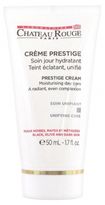
Château Rouge Prestige Cream Moisturizing Day Care
Works for
1 of 3 advertised claims delivered
Moisturizing14 ingredients credited for this claimGood support
“Prestige Cream Moisturizing Day Care”
This product can help improve hydration of the skin with the two types of ingredients.
The first type is called “humectants”:
these ingredients help attract water.
When humectants are on the surface of the skin, they “pull in” the moisture from the outside environment, or from
within deeper layers of the skin. The following ingredients in this product do the job:
glycerin, glucose.
This product also contains ingredients called “occlusives”. They help reduce the speed with which our skin loses moisture to the outside environment. These ingredients also help soften the upper layer of the skin, so it feels less tight and nicer to the touch. The following ingredients in this product do the job: squalane, isopropyl myristate.
Anti-aging3 ingredients credited for this claimWeak support
“Its lightening active ingredients of plant and marine origin participate in the reduction of pigmentation spots and unify the skin the white lily, renowned for its anti-spot action and healing properties,the cherry blossom that limits skin aging and promotes the elimination of toxins,brown algae which inhibits melanogenesis and the transport of melanin to the upper layers of the epidermis, thus limiting the appearance of spots.Result spots are faded, the complexion is unified, moisturized and luminous.”
Effective ingredients missing or their concentration is too low.
Evens skin tone2 ingredients credited for this claimWeak support
“Its lightening active ingredients of plant and marine origin participate in the reduction of pigmentation spots and unify the skin the white lily, renowned for its anti-spot action and healing properties,the cherry blossom that limits skin aging and promotes the elimination of toxins,brown algae which inhibits melanogenesis and the transport of melanin to the upper layers of the epidermis, thus limiting the appearance of spots.Result spots are faded, the complexion is unified, moisturized and luminous.”
Effective ingredients missing or their concentration is too low
Can it cause trouble?
Irritancy8 strong irritants: Alcohol, Lilium candidum flower extract + 6 more — patch-test recommendedHigh risk
Comedogenic2 ingredients rated 2 or more on the 0–5 pore-clogging scale2 flagged
User reviews
Be the first — your take helps the next person decide.
Ingredients
Filter by role to see what each ingredient is doing.
Water~45–55%
Isononyl isononanoate~4.8–5.8%
- Irritation risk
- Low
Forms a protective film on the surface of the skin to prevent moisture loss. Gives a velvety feel to products while reducing tackiness
More about Isononyl isononanoateGlycerin~4–4.8%
- Irritation risk
- Low
One of the best moisturizing ingredients. Naturally present in skin. It attracts water to the upper layer of the skin working as a humectant
More about GlycerinCyclopentasiloxane~3.2–3.9%
- Irritation risk
- Low
A silicone that helps improve the product texture and spreadability. Can absorb oil creating a short-term mattifying effect on the skin
More about CyclopentasiloxaneCetyl palmitate~2.4–2.9%
- Irritation risk
- Low
An emollient that helps soften the skin and is used to improve product texture and stability
More about Cetyl palmitateIsopropyl myristate~2–2.4%
- Irritation risk
- Low
- Comedogenicity
- 3/5
An emollient that helps soften the skin. Could be comedogenic
More about Isopropyl myristateAlcohol~1.7–2%
- Irritation risk
- High
Can be drying and contribute to skin irritation. Used in formulars to dissolve other ingredients, create a thinner product consistency or for its antibacterial properties
More about AlcoholPentylene glycol~1.5–1.8%
- Irritation risk
- Medium
Used to preserve products, dissolve other ingredients and create a nice product texture
More about Pentylene glycolNylon-12~1.3–1.6%
Glyceryl stearate~1–1.2%
- Irritation risk
- Low
An emollient that softens the skin and forms a protective layer on its surface. Helps water and oil mix together
More about Glyceryl stearatePeg-100 stearate~0.75–1.15%
- Irritation risk
- Low
Helps oil and water mix togehter and creates a nice product texture
More about Peg-100 stearateMaris aqua~0.6–0.85%
Sea water extract~0.5–0.75%
- Irritation risk
- Low
Lilium candidum flower extract~0.45–0.7%
Prunus cerasus flower extract~0.45–0.65%
- Irritation risk
- Low
Chondrus crispus powder~0.6–0.9%
- Irritation risk
- Low
- Comedogenicity
- 3/5
A powder from red algae extract that helps attract water to the upper layer of the skin and create a nicer product consistency
More about Chondrus crispus powderTocopheryl acetate~0.45–0.65%
- Irritation risk
- Medium
A more stable but less bio-available form of vitamin E compared to Tocopherol. Might help moisturize and protect the skin from free radicals, but mostly used in low concentrations to stabilize other ingredients.
More about Tocopheryl acetateSqualane~0.45–0.65%
- Irritation risk
- Low
An oil naturally present in skin. Works as an emollient to soften the skin and form a protective layer on its surface without a greasy feeling.
More about SqualaneEthylhexylglycerin~0.3–0.6%
Ascorbyl tetraisopalmitate~0.3–0.6%
- Irritation risk
- Medium
A vitamin C derivative. Studies show that is might be effective in reducing hyperpigmentation, but there are no studies confirming that it is effectively converted into the bioavailable form of Vitamin C in skin. It is not clear how this derivative compares in effectiveness to the topical application of bioavailable form of vitamin C (L-ascorbic acid)
More about Ascorbyl tetraisopalmitateGlucose~0.3–0.5%
- Irritation risk
- Low
Helps attract water to the upper layer of the skin. Could be helpful in restoring the skin barrier function
More about GlucoseTocopherol~0.3–0.5%
- Irritation risk
- Low
Pure form of vitamin E. Can help moisturise and protect the skin from free radicals. Often used to help stabilise other ingredients or the formula itself
More about TocopherolCetearyl glucoside~0.25–0.5%
- Irritation risk
- Medium
Helps water and oil in the product mix well together and improves product texture
More about Cetearyl glucosideParfum~0.2–0.4%
- Irritation risk
- High
An aromatic blend of unspecified and possibly irritating ingredients
More about ParfumHydroxyethyl acrylate/sodium acryloyldimethyl taurate copolymer~0.25–0.45%
- Irritation risk
- Medium
A gelling agent that thickens the product consistency and leaves the skin with a velvety finish
More about Hydroxyethyl acrylate/sodium acryloyldimethyl taurate copolymerPolysorbate 60~0.25–0.5%
Xanthan gum~0.25–0.45%
- Irritation risk
- Low
Used to create a thicker product consistency
More about Xanthan gumSorbitan isostearate~0.25–0.45%
- Irritation risk
- Low
Helps oil and water mix together
More about Sorbitan isostearateCaprylyl glycol~0.25–0.45%
- Irritation risk
- Medium
Helps preserve products and creates a nice product texture
More about Caprylyl glycolLactic acid~0.2–0.4%
- Irritation risk
- Medium
An exfoliating and moisturizing alpha-hydroxy acid (AHA). Typically causes less irritation than other AHAs, for example, glycolic acid. At high concentrations (about 15%), lactic acid can help reduce lines and wrinkles. Recent studies show that lactic acid can support the "good" bacteria living on skin's surface (healthy skin microbiome)
More about Lactic acidCitric acid~0.2–0.4%
- Irritation risk
- Medium
Can work as an exfoliant but is typically used to adjust the product pH
More about Citric acidDisodium edta~0.2–0.4%
Tetrasodium glutamate diacetate~0.2–0.35%
- Irritation risk
- Low
Helps stabilize the product formulation
More about Tetrasodium glutamate diacetateO-cymen-5-ol~0.05–0.1%
Sodium benzoate~0.15–0.3%
Potassium sorbate~0.15–0.3%
Limonene~0.15–0.25%
- Irritation risk
- High
A common frangrance that can easily irritate skin, especially if exposed to air, light or heat
More about LimoneneLinalool~0.1–0.25%
Citral~0.1–0.2%
Eugenol~0.05–0.1%
Geraniol~0.1–0.15%
Ingredient list view
Water, Isononyl isononanoate, Glycerin, Cyclopentasiloxane, Cetyl palmitate, Isopropyl myristate, Unknown, Alcohol, Pentylene glycol, Nylon-12, Glyceryl stearate, Peg-100 stearate, Maris aqua, Sea water extract, Lilium candidum flower extract, Prunus cerasus flower extract, Chondrus crispus powder, Tocopheryl acetate, Squalane, Ethylhexylglycerin, Ascorbyl tetraisopalmitate, Glucose, Tocopherol, Cetearyl glucoside, Parfum, Hydroxyethyl acrylate/sodium acryloyldimethyl taurate copolymer, Polysorbate 60, Xanthan gum, Sorbitan isostearate, Caprylyl glycol, Lactic acid, Citric acid, Disodium edta, Tetrasodium glutamate diacetate, O-cymen-5-ol, Sodium benzoate, Potassium sorbate, Limonene, Linalool, Citral, Eugenol, Geraniol
Compare prices
Retailers ranked by price — lowest first.
Sources cited in this review
Every concentration estimate and effectiveness label is anchored to one of these 13 studies and safety reviews.
- 1
- 2
- 3
- 4
- 5
- 6

Affiliate links · As an Amazon Associate, WIMJ earns from qualifying purchases.