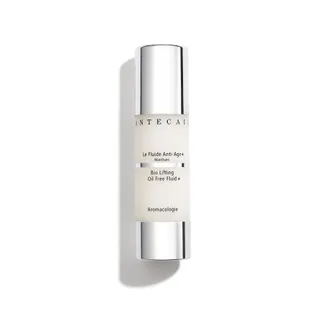
Chantecaille Bio Lifting Oil Free Fluid +
Works for
MoisturizingPalmitoyl tetrapeptide-7, Palmitoyl tripeptide-1 + 31 moreWorks well
“This lightweight, oil-free moisturizer with mattifying effects is suitable for all skin types.”
This product can help improve hydration of the skin with the two types of ingredients.
The first type is called “humectants”:
these ingredients help attract water.
When humectants are on the surface of the skin, they “pull in” the moisture from the outside environment, or from
within deeper layers of the skin. The following ingredients in this product do the job:
biosaccharide gum-1, glutamic acid.
This product also contains ingredients called “occlusives”. They help reduce the speed with which our skin loses moisture to the outside environment. These ingredients also help soften the upper layer of the skin, so it feels less tight and nicer to the touch. The following ingredients in this product do the job: helianthus annuus seed oil, cetyl alcohol.
The following ingredients in this product are especially good for supporting the skin barrier and helping with the hydration level: acetyl hexapeptide-8, palmitoyl tetrapeptide-7, palmitoyl tripeptide-1
Anti-agingPalmitoyl tripeptide-1, Threonine + 7 moreMay help
“It is ideal as a powerful base to layer under makeup for smoother looking skin, as an anti-aging moisturizer, or as an overnight power-packed treatment.”
This product contains acetyl hexapeptide-8, palmitoyl tetrapeptide-7, palmitoyl tripeptide-1, threonine. There is some human evidence that these ingredients help reduce and prevent fine lines and wrinkles and improve skin elasticity and firmness, though it is smaller or less consistent than the evidence for the best anti-aging ingredients.
Anti-oxidationSide benefit · Imperata cylindrica root extract, Camellia sinensis leaf extract + 9 moreMay help
This product contains antioxidants (camellia sinensis leaf extract, imperata cylindrica root extract) that can help neutralize free radicals in skin to lessen the damage it gets from the UV light (sun). There is some human evidence for this effect in skin, though it is smaller or less consistent than the evidence for the best antioxidants.
Can it cause trouble?
Irritancy10 strong irritants: Rosa damascena flower water, Alcohol + 8 more — patch-test recommendedHigh risk
Comedogenic4 ingredients rated 2 or more on the 0–5 pore-clogging scale4 flagged


User reviews
Be the first — your take helps the next person decide.
Ingredients
Filter by role to see what each ingredient is doing.
Rosa damascena flower water~28–34%
- Irritation risk
- High
Used to add a nice rose smell to the product. Might help attract water to the upper layer of the skin and have some anti-oxidant effect. Can be irritating
More about Rosa damascena flower waterWater~12–15%
Glycerin~5–6.1%
- Irritation risk
- Low
One of the best moisturizing ingredients. Naturally present in skin. It attracts water to the upper layer of the skin working as a humectant
More about GlycerinPropanediol~3.4–4.2%
- Irritation risk
- Low
Acts as a solvent for other ingredients. Speeds up the absorption of other ingredients into the skin
More about PropanediolDicaprylyl carbonate~2.8–3.4%
- Irritation risk
- Low
Helps products spread more easily and works as an emollient to soften skin
More about Dicaprylyl carbonateC13-15 alkane~2–2.4%
Cetyl alcohol~1.7–2.1%
- Irritation risk
- Low
A non-drying alcohol that works to soften the skin and stabilize product formulations helping oil and water mix together
More about Cetyl alcoholCoco-caprylate/caprate~1.5–1.8%
- Irritation risk
- Low
Helps to soften the upper layer of the skin without creating a greasy texture
More about Coco-caprylate/caprateSilica~1.6–1.9%
Imperata cylindrica root extract~1–1.2%
- Irritation risk
- Medium
A plat extract that might help neutralize free radicals in skin and attract water to its upper layer
More about Imperata cylindrica root extractGlyceryl stearate~0.8–1.2%
- Irritation risk
- Low
An emollient that softens the skin and forms a protective layer on its surface. Helps water and oil mix together
More about Glyceryl stearateSorbitan oleate~0.65–0.95%
- Irritation risk
- Medium
- Comedogenicity
- 2/5
Helps oil and water mix together
More about Sorbitan oleateButylene glycol~0.55–0.85%
- Irritation risk
- Low
Used to create a nice product texture and help delivery of other ingredients. Might be somewhat helpful in attracting water to the upper layer of the skin
More about Butylene glycolStearic acid~0.65–1%
- Irritation risk
- Low
Helps oil and water mix together and works as an emollient
More about Stearic acidPeg-100 stearate~0.6–0.9%
- Irritation risk
- Low
Helps oil and water mix togehter and creates a nice product texture
More about Peg-100 stearateHydrolyzed soy protein~0.5–0.75%
- Irritation risk
- Low
Helps attract water to the upper layer of the skin. Might have some anti-aging, anti-oxidant, and skin lightening properties, but solid evidence is missing
More about Hydrolyzed soy proteinPlantago lanceolata leaf extract~0.5–0.75%
- Irritation risk
- Medium
A plant extract that might have anti-oxidant properties
More about Plantago lanceolata leaf extractEthylhexylglycerin~0.45–0.7%
Butyrospermum parkii butter~0.5–0.75%
- Irritation risk
- Low
- Comedogenicity
- 3/5
A great moisturising ingredient that softens the skin and reduces water loss from its upper layer. It also can be helpful in protecting skin from free radicals
More about Butyrospermum parkii butterCarbomer~0.4–0.65%
- Irritation risk
- Low
Helps create a thicker or gel-like product texture. It is not a surfactant but can be used in gentle cleansing formulations
More about CarbomerSaccharide isomerate~0.35–0.65%
- Irritation risk
- Low
Helps attract water to the upper layer of the skin
More about Saccharide isomerateBisabolol~0.3–0.55%
- Irritation risk
- Low
An active component of chamomile plant that historically has been used to calm down irritated skin. A recent study shows that bisabolol indeed can have some anti-inflammatory effect on skin, even though conclusive data is lacking. Bisabolol has a sweet floral scent and can be added to products for its aromatic properties
More about BisabololArgania spinosa kernel oil~0.4–0.6%
- Irritation risk
- Medium
An emollient that helps soften the upper layer of the skin. Might have some weak anti-oxidant properties
More about Argania spinosa kernel oilTocopheryl acetate~0.35–0.6%
- Irritation risk
- Medium
A more stable but less bio-available form of vitamin E compared to Tocopherol. Might help moisturize and protect the skin from free radicals, but mostly used in low concentrations to stabilize other ingredients.
More about Tocopheryl acetateTocopherol~0.35–0.6%
- Irritation risk
- Low
Pure form of vitamin E. Can help moisturise and protect the skin from free radicals. Often used to help stabilise other ingredients or the formula itself
More about TocopherolSodium hydroxide~0.3–0.6%
Paeonia albiflora root extract~0.3–0.6%
- Irritation risk
- Low
Capryloyl glycine~0.45–0.7%
- Irritation risk
- Low
Helps oil and water mix together, preserve cosmetic products, and attract water to the upper layer of the skin
More about Capryloyl glycineCamellia sinensis leaf extract~0.45–0.65%
- Irritation risk
- Low
Can contain potent anti-oxidant compounds (abbreviated ECG, GCG, EGC, and EGCG) that might help protect the skin from free radicals. Can help calm down inflammation and has some anti-bacterial properties. Unfortunately, these antioxidants are unstable and lose their effectiveness very quickly in products. The concentration of the antioxidant compounds in the extract also tends to be low to be effective in topical formulation
More about Camellia sinensis leaf extractHexylene glycol~0.3–0.6%
- Irritation risk
- Medium
Helps create a more spreadable product texture
More about Hexylene glycolPhytic acid~0.35–0.6%
- Irritation risk
- Medium
An alpha-hydroxy acid (AHA), but is mostly used to stabilize product formulations in cosmetics
More about Phytic acidCaprylyl glycol~0.35–0.65%
- Irritation risk
- Medium
Helps preserve products and creates a nice product texture
More about Caprylyl glycolAlcohol~0.35–0.6%
- Irritation risk
- High
Can be drying and contribute to skin irritation. Used in formulars to dissolve other ingredients, create a thinner product consistency or for its antibacterial properties
More about AlcoholRosa damascena flower oil~0.3–0.6%
- Irritation risk
- High
Used as a fragrance. Can be irritating
More about Rosa damascena flower oilSodium lactate~0.3–0.6%
- Irritation risk
- Medium
Helps attract water to the upper layer of the skin. Is often used to adjust the pH level of the product
More about Sodium lactateGlycoproteins~0.3–0.6%
Citric acid~0.3–0.6%
- Irritation risk
- Medium
Can work as an exfoliant but is typically used to adjust the product pH
More about Citric acidAcacia dealbata flower wax~0.4–0.6%
- Irritation risk
- Low
Citrus aurantium amara flower wax~0.35–0.6%
- Irritation risk
- High
Jasminum grandiflorum flower wax~0.35–0.6%
- Irritation risk
- Low
Sodium hyaluronate~0.3–0.6%
- Irritation risk
- Low
One of the best moisturizing ingredients. Attracts water into the upper layer of the skin
More about Sodium hyaluronateSodium citrate~0.3–0.6%
- Irritation risk
- Medium
Helps to control the skin's pH level. Maintains the skin's natural film of amino-lactic acids and oils. Helps to preserve products
More about Sodium citrateSarcosine~0.3–0.55%
- Irritation risk
- Low
Helps to enhance the penetration of other ingredients and attract water to the upper layer of the skin
More about SarcosineCoco-glucoside~0.45–0.65%
- Irritation risk
- High
Used as a cleansing agent (surfactant) in cleansers. Helps water and oil mix together in lotions. Can be irritating
More about Coco-glucosideGlutamic acid~0.3–0.6%
- Irritation risk
- Low
An amino-acid that helps attract water to the upper layer of the skin
More about Glutamic acidLaminaria saccharina extract~0.3–0.6%
- Irritation risk
- Low
- Comedogenicity
- 3/5
A seaweed extract that contains sugars and can be helpful in attracting water to the upper layers of the skin if used in high enough concentrations
More about Laminaria saccharina extract1,2-hexanediol~0.3–0.6%
Helianthus annuus seed oil~0.4–0.6%
- Irritation risk
- Low
A great emollient due to its high linoleic acid content. One of the most effective plant oils in helping skin hydration and repairing skin barrier function
More about Helianthus annuus seed oilMichelia alba leaf oil~0.3–0.55%
- Irritation risk
- High
An essential oil used in cosmetics for its smell. Can be irritating
More about Michelia alba leaf oilPsilanthus bengalensis leaf cell culture extract~0.3–0.6%
- Irritation risk
- Low
Cinnamomum zeylanicum bark extract~0.3–0.55%
- Irritation risk
- High
Xanthan gum~0.35–0.6%
- Irritation risk
- Low
Used to create a thicker product consistency
More about Xanthan gumBiosaccharide gum-1~0.3–0.6%
- Irritation risk
- Low
Helps attract water to the upper layer of the skin and is claimed to provide a longer-lasting hydration because of its ability to create a water-binding film on the surface of the skin
More about Biosaccharide gum-1Threonine~0.3–0.6%
- Irritation risk
- Low
An amino-acid that helps to attract water to the upper layer of the skin. In combination with other amino-acids, might help to reduce fine lines and wrinkles
More about ThreonineValine~0.3–0.6%
- Irritation risk
- Low
Zinc sulfate~0.3–0.55%
Benzoic acid~0.25–0.5%
Rubus idaeus leaf cell culture~0.3–0.55%
- Irritation risk
- Low
Daphne odora callus extract~0.25–0.5%
- Irritation risk
- High
Pollen extract~0.35–0.65%
- Irritation risk
- Low
Acrylates/c10-30 alkyl acrylate crosspolymer~0.45–0.7%
- Irritation risk
- Medium
Maintains the texture of skincare products. Allows the product to spread evenly. Helps oil and water mix together
More about Acrylates/c10-30 alkyl acrylate crosspolymerNicotiana sylvestris leaf cell culture~0.3–0.6%
- Irritation risk
- Medium
Has been claimed to have an ability to protect collagen and stimulate its production in skin but further research is lacking so far
More about Nicotiana sylvestris leaf cell culturePlankton extract~0.3–0.55%
- Irritation risk
- Medium
- Comedogenicity
- 3/5
Can help attract water to the upper layer of the skin
More about Plankton extractAcetyl hexapeptide-8~0.25–0.5%
- Irritation risk
- Low
A type of peptide. Peptides are excellent moisturizers and might be able support collagen production reducing fine lines and wrinkles
More about Acetyl hexapeptide-8Palmitoyl tripeptide-1~0.3–0.6%
- Irritation risk
- Low
A type of peptide. Peptides are excellent moisturizers and might be able support collagen production reducing fine lines and wrinkles
More about Palmitoyl tripeptide-1Palmitoyl tetrapeptide-7~0.3–0.6%
- Irritation risk
- Low
A type of peptide. Peptides are excellent moisturizers and might be able support collagen production reducing fine lines and wrinkles
More about Palmitoyl tetrapeptide-7Sorbic acid~0.2–0.4%
Sodium metabisulfite~0.1–0.2%
Pyridoxine hcl~0.2–0.35%
- Irritation risk
- Medium
Might help neutralize free radicals in skin
More about Pyridoxine hclPhenoxyethanol~0.15–0.25%
- Irritation risk
- Low
A preservative. It helps prevent bacterial growth in cosmetic products
More about PhenoxyethanolBiotin~0.15–0.3%
- Irritation risk
- Low
Might have some moisturising properties. Is not effective when applied topically beyond some moisturizing effect
More about BiotinCitronellol~0.15–0.25%
Geraniol~0.05–0.15%
Linalool~0.05–0.15%
Ingredient list view
Rosa damascena flower water, Water, Glycerin, Propanediol, Dicaprylyl carbonate, C13-15 alkane, Cetyl alcohol, Coco-caprylate/caprate, Silica, Imperata cylindrica root extract, Glyceryl stearate, Sorbitan oleate, Butylene glycol, Stearic acid, Peg-100 stearate, Hydrolyzed soy protein, Plantago lanceolata leaf extract, Ethylhexylglycerin, Butyrospermum parkii butter, Carbomer, Saccharide isomerate, Bisabolol, Argania spinosa kernel oil, Tocopheryl acetate, Tocopherol, Sodium hydroxide, Paeonia albiflora root extract, Capryloyl glycine, Camellia sinensis leaf extract, Hexylene glycol, Phytic acid, Caprylyl glycol, Alcohol, Rosa damascena flower oil, Sodium lactate, Glycoproteins, Citric acid, Acacia dealbata flower wax, Citrus aurantium amara flower wax, Jasminum grandiflorum flower wax, Sodium hyaluronate, Sodium citrate, Sarcosine, Coco-glucoside, Glutamic acid, Laminaria saccharina extract, 1,2-hexanediol, Helianthus annuus seed oil, Michelia alba leaf oil, Psilanthus bengalensis leaf cell culture extract, Cinnamomum zeylanicum bark extract, Xanthan gum, Biosaccharide gum-1, Threonine, Valine, Zinc sulfate, Benzoic acid, Rubus idaeus leaf cell culture, Daphne odora callus extract, Pollen extract, Acrylates/c10-30 alkyl acrylate crosspolymer, Nicotiana sylvestris leaf cell culture, Plankton extract, Acetyl hexapeptide-8, Palmitoyl tripeptide-1, Palmitoyl tetrapeptide-7, Sorbic acid, Sodium metabisulfite, Pyridoxine hcl, Phenoxyethanol, Biotin, Citronellol, Geraniol, Linalool
Compare prices
Retailers ranked by price — lowest first.


Worth comparing, line by line.
Match % combines shared ingredients, the first five ingredients, shared actives and hero ingredients, irritancy (lower counts in the alternative's favour), texture and body area. Only products in the same routine step are compared.
| ChantecailleBio Lifting Oil Free Fluid +YOUR PRODUCT | OngredientsSkin Barrier Calming Lotion | FilorgaNight Care Time-Filler Night Multi-Correction Wrinkle Cream | CliniqueDDMID Moisturizing Lotion + Lines and Wrinkles Concentrate | |
|---|---|---|---|---|
| Match | — | 56% | 55% | 55% |
| Price | $223.50 | $14.42−$209.08 | $89.72−$133.78 | — |
| Shared key ingredients | — | 6 of 20 | 11 of 20 | 5 of 20 |
| Key difference | — | Copper Tripeptide-1 | Niacinamide | Mineral Oil |
| Irritancy | High | Medium | High | Medium |
| Drying alcohol | Contains drying alcohol | — | — | — |
| View product | Shop | Shop | Shop |
More alternatives: NEOGEN X SUR.MEDIC Dermalogy High R Exosome CreamM-61 Major Moisture!
Product summary
Judging from the ingredient list, "Chantecaille - Bio Lifting Oil Free Fluid +" works well for improving skin hydration The formulation is based on a combination of good humectants and emollients. Both are needed to increase the skin hydration level. Acetyl hexapeptide-8, biosaccharide gum-1, glutamic acid, glycerin and imperata cylindrica root extract in this product (humectants) attract water molecules to the upper layer of the skin (the water comes from the outside air or from the deeper layers of the skin if the air is dry). Palmitoyl tetrapeptide-7, palmitoyl tripeptide-1, helianthus annuus seed oil, cetyl alcohol and coco-caprylate/caprate in this product help decrease the water evoporation from the skin, so that it stays hydrated for longer. These ingredients also soften the skin and take away the feeling of tightness and dryness.
Ingredient callouts
- We like that this moisturizer contains peptides (palmitoyl tetrapeptide-7 0.30% - 0.60%, acetyl hexapeptide-8 0.25% - 0.50% and palmitoyl tripeptide-1 0.30% - 0.60%). There are many different kind of Peptides and they are naturally present in our skin. They all are a combination of aminoacids. Some of them work as natural antibiotics, promote wound-healing and production of collagen. The science is still not settled on how effective Peptides are in skincare, but it is very likely that they have a benefit. Peptides might help restore the skin barrier and fight the signs of aging. At the very least, Peptides work as humectants: they attract water to the upper layer of the skin and improve its hydration.
Irritation risk
There are quite a few common irritants in this product, including ingredients without particular skin benefits. We would not recommend it for sensitive skin. We assess the overall irritancy of this moisturizer to be high. For a detailed overview of all potential irritants: click here
You can see the detailed formula review with the breakdown of all actives in the product and the full ingredient list with estimated concentrations in the tables below.
About the brand
According to Cruelty-Free Kitty "Chantecaille" is cruelty free, but its parent company is not.
Price
The product retails from 275.00$ up to 395.00$ in the United States and from 232.00£ up to 310.00£ in the United Kingdom.
For a detailed price comparison: click here.
Sources cited in this review
Every concentration estimate and effectiveness label is anchored to one of these 28 studies and safety reviews.
- 1
- 2
- 3Safety Assessment of Alkyl Esters as Used in Cosmeticscir-safety.org
- 4Allergic contact dermatitis from grassespubmed.ncbi.nlm.nih.gov
- 5Surfactants and experimental irritant contact dermatitisncbi.nlm.nih.gov
- 6Extracts from Glycine max (soybean) induce elastin synthesis and inhibit elastase activityonlinelibrary.wiley.com

Affiliate links · As an Amazon Associate, WIMJ earns from qualifying purchases.