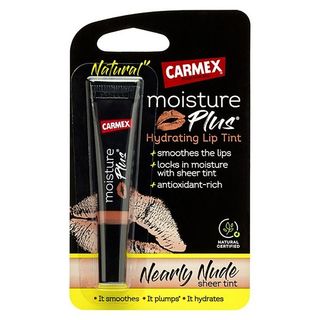
Carmex Moisture Plus Nearly Nude Hydrating Lip Balm
Works for
1 of 1 advertised claim delivered
Moisturizing13 ingredients credited for this claimGood support
“Moisture Plus Nearly Nude Hydrating Lip Balm”
This product can help soften the skin and reduce its moisture loss with emollients and occlusives: butyrospermum parkii butter, cera alba.
Keep in mind that this product does not contain effective ingredients to attract water to the upper layer of the skin. This is why an additional product with humectants like glycerin or hyaluronic acid can be helpful (apply it before this product for the best results).
Can it cause trouble?
Irritancy3 strong irritants: Aroma, Rosmarinus officinalis leaf extract + 1 more — patch-test recommendedHigh risk
Comedogenic2 ingredients rated 2 or more on the 0–5 pore-clogging scale2 flagged
User reviews
Be the first — your take helps the next person decide.
Ingredients
Filter by role to see what each ingredient is doing.
Ricinus communis seed oil~25–37%
- Irritation risk
- Medium
A plant oil that can help soften the skin. It might be helpful in calming down inflammation, but solid research is lacking. Is often used in lip products to create the needed product consistency
More about Ricinus communis seed oilButyrospermum parkii butter~5.6–8.4%
- Irritation risk
- Low
- Comedogenicity
- 3/5
A great moisturising ingredient that softens the skin and reduces water loss from its upper layer. It also can be helpful in protecting skin from free radicals
More about Butyrospermum parkii butterRaphanus sativus seed extract~4.7–7.1%
- Irritation risk
- Low
Helianthus annuus seed wax~3.7–5.5%
- Irritation risk
- Low
Helps soften the upper layer of the skin and support skin's barrier function while creating a thicker product consistency
More about Helianthus annuus seed waxPolyhydroxystearic acid~2.5–3.7%
- Irritation risk
- Medium
Used to create a thicker product consistency and stabilize the formulation
More about Polyhydroxystearic acidStearyl behenate~2.1–3.1%
- Irritation risk
- Low
Helps soften the upper layer of the skin
More about Stearyl behenateAstrocaryum murumuru seed butter~1.6–2.4%
- Irritation risk
- Medium
Helps soften the upper layer of the skin. Could be comedogenic due to the myrisic acid content
More about Astrocaryum murumuru seed butterAroma~1.3–1.9%
Butyrospermum parkii butter~1.3–1.9%
- Irritation risk
- Low
- Comedogenicity
- 3/5
A great moisturising ingredient that softens the skin and reduces water loss from its upper layer. It also can be helpful in protecting skin from free radicals
More about Butyrospermum parkii butterTheobroma grandiflorum seed butter~0.85–1.3%
- Irritation risk
- Medium
Helps soften the upper layer of the skin and might as well help to attract moisture to its upper layer
More about Theobroma grandiflorum seed butterRhus succedanea fruit cera~0.55–1.35%
- Irritation risk
- Low
Rhus verniciflua peel cera~0.5–1.15%
- Irritation risk
- Low
Cera alba~0.8–1.2%
- Irritation risk
- Medium
Forms a protective barrier that holds water and keeps dry skin hydrated. Keeps an emulsion from separating into its oil and liquid components, and increases the thickness of a product. Can be an allergen
More about Cera albaCopernicia cerifera cera~0.55–1.3%
- Irritation risk
- Low
Brazilian palm wax. Helps soften the upper layer of the skin
More about Copernicia cerifera ceraLauryl laurate~0.35–0.8%
- Irritation risk
- Medium
Helps soften the upper layer of the skin
More about Lauryl laurateMenthyl nicotinate~0.2–0.8%
- Irritation risk
- Low
Hippophae rhamnoides fruit oil~0.15–0.7%
- Irritation risk
- High
A plant oil that might somewhat help to neutralize free radicals. It could be irritating
More about Hippophae rhamnoides fruit oilRosmarinus officinalis leaf extract~0.15–0.55%
- Irritation risk
- High
Can be helpful in reducing inflammation in skin, including inflamed acne. It can be irritating
More about Rosmarinus officinalis leaf extractHelianthus annuus seed oil~0.2–0.75%
- Irritation risk
- Low
A great emollient due to its high linoleic acid content. One of the most effective plant oils in helping skin hydration and repairing skin barrier function
More about Helianthus annuus seed oilAscorbyl palmitate~0.1–0.45%
- Irritation risk
- Medium
Being a lipid soluble form of vitamin C, it is more stable and can penetrate the skin better than L-Ascorbic acid. It is effective in protecting the skin from free radicals, as well as evening the skin tone, but is less effective in stimulating collagen production compared to L-Ascorbic acid.
More about Ascorbyl palmitateTocopherol~0.1–0.45%
- Irritation risk
- Low
Pure form of vitamin E. Can help moisturise and protect the skin from free radicals. Often used to help stabilise other ingredients or the formula itself
More about TocopherolStevia rebaudiana extract~0.1–0.35%
- Irritation risk
- Medium
A plant extract that adds a sweat taste to products (for example, for lip products). Might help to attract water to the upper layer of the skin and have some anti-oxidant effect
More about Stevia rebaudiana extractLimonene~0.05–0.25%
- Irritation risk
- High
A common frangrance that can easily irritate skin, especially if exposed to air, light or heat
More about LimoneneCitric acid~0.05–0.15%
- Irritation risk
- Medium
Can work as an exfoliant but is typically used to adjust the product pH
More about Citric acidIngredient list view
Ricinus communis seed oil, Butyrospermum parkii butter, Raphanus sativus seed extract, Helianthus annuus seed wax, Polyhydroxystearic acid, Stearyl behenate, Astrocaryum murumuru seed butter, Aroma, Butyrospermum parkii butter, Unknown, Theobroma grandiflorum seed butter, Rhus succedanea fruit cera, Rhus verniciflua peel cera, Cera alba, Copernicia cerifera cera, Lauryl laurate, Menthyl nicotinate, Hippophae rhamnoides fruit oil, Rosmarinus officinalis leaf extract, Helianthus annuus seed oil, Ascorbyl palmitate, Tocopherol, Unknown, Stevia rebaudiana extract, Limonene, Citric acid
Compare prices
Retailers ranked by price — lowest first.

Affiliate links · prices updated regularly
Sources cited in this review
Every concentration estimate and effectiveness label is anchored to one of these 16 studies and safety reviews.
- 1
- 2
- 3
- 4
- 5
- 6Advanced Skin Care – A Novel Ingredientncbi.nlm.nih.gov

Affiliate links · As an Amazon Associate, WIMJ earns from qualifying purchases.