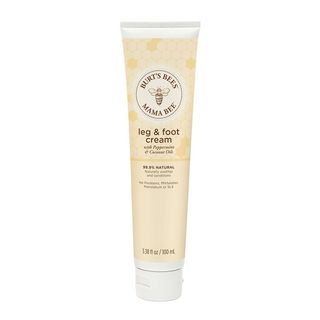
Burt's Bees Mama Bee Leg and Foot Creme
Works for
1 of 1 advertised claim delivered
Moisturizing11 ingredients credited for this claimGood support
“This rich cream is specially formulated with peppermint oil and rosemary extract to soothe and condition.”
This product can help improve hydration of the skin with the two types of ingredients.
The first type is called “humectants”:
these ingredients help attract water.
When humectants are on the surface of the skin, they “pull in” the moisture from the outside environment, or from
within deeper layers of the skin. The following ingredients in this product do the job:
glycerin, glucose.
This product also contains ingredients called “occlusives”. They help reduce the speed with which our skin loses moisture to the outside environment. These ingredients also help soften the upper layer of the skin, so it feels less tight and nicer to the touch. The following ingredients in this product do the job: beeswax, cocos nucifera oil.
Can it cause trouble?
Irritancy9 strong irritants: Mentha piperita oil, Hamamelis virginiana water + 7 more — patch-test recommendedHigh risk
Comedogenic2 ingredients rated 2 or more on the 0–5 pore-clogging scale2 flagged
User reviews
Be the first — your take helps the next person decide.
Ingredients
Filter by role to see what each ingredient is doing.
Water~40–60%
Helianthus annuus seed oil~5.2–7.8%
- Irritation risk
- Low
A great emollient due to its high linoleic acid content. One of the most effective plant oils in helping skin hydration and repairing skin barrier function
More about Helianthus annuus seed oilGlycerin~3.4–5.1%
- Irritation risk
- Low
One of the best moisturizing ingredients. Naturally present in skin. It attracts water to the upper layer of the skin working as a humectant
More about GlycerinCocos nucifera oil~2.8–4.2%
- Irritation risk
- Low
- Comedogenicity
- 3/5
An emollient. Found to be as effective as a moisturizer for dry skin as mineral oil. Could be comedogenic
More about Cocos nucifera oilBeeswax~2.2–3.3%
- Irritation risk
- Low
Forms a protective barrier that holds water and keeps dry skin hydrated. Keeps an emulsion from separating into its oil and liquid components, and increases the thickness of a product. Can be an allergen
More about BeeswaxMentha piperita oil~1.6–2.4%
Stearic acid~1.5–2.3%
- Irritation risk
- Low
Helps oil and water mix together and works as an emollient
More about Stearic acidHamamelis virginiana water~1.1–1.7%
- Irritation risk
- High
A plant extract that can help calm down inflammation in skin. Can, however, itself be irritating
More about Hamamelis virginiana waterMenthol~1–1.5%
- Irritation risk
- High
Sodium bicarbonate~1–1.5%
Melaleuca alternifolia leaf oil~0.5–1.15%
- Irritation risk
- High
An essential oil that can be irritating. Has some anti-bacterial properties
More about Melaleuca alternifolia leaf oilPetroselinum crispum leaf oil~0.4–0.95%
- Irritation risk
- Low
Triticum vulgare germ oil~0.4–0.9%
- Irritation risk
- Low
- Comedogenicity
- 3/5
A good emoillient. Contains vitamin E which can help neutralise free radicals, however the oil is unstable. Avoid if you have gluten or wheat sensitivity (including food allergies).
More about Triticum vulgare germ oilCitrus aurantium dulcis peel wax~0.3–0.75%
- Irritation risk
- High
Rosmarinus officinalis leaf extract~0.2–0.75%
- Irritation risk
- High
Can be helpful in reducing inflammation in skin, including inflamed acne. It can be irritating
More about Rosmarinus officinalis leaf extractTocopherol~0.2–0.8%
- Irritation risk
- Low
Pure form of vitamin E. Can help moisturise and protect the skin from free radicals. Often used to help stabilise other ingredients or the formula itself
More about TocopherolSucrose stearate~0.3–0.75%
Glucose~0.15–0.65%
- Irritation risk
- Low
Helps attract water to the upper layer of the skin. Could be helpful in restoring the skin barrier function
More about GlucoseXanthan gum~0.15–0.6%
- Irritation risk
- Low
Used to create a thicker product consistency
More about Xanthan gumCanola oil~0.15–0.6%
- Irritation risk
- Medium
A plant oil that can help soften the upper layer of the skin
More about Canola oilSodium borate~0.1–0.45%
Sodium chloride~0.15–0.5%
- Irritation risk
- Low
Used to stabilize mixtures of oil and water, and create thicker, gel-like product textures
More about Sodium chlorideAlcohol~0.1–0.4%
- Irritation risk
- High
Can be drying and contribute to skin irritation. Used in formulars to dissolve other ingredients, create a thinner product consistency or for its antibacterial properties
More about AlcoholGlucose oxidase~0.1–0.35%
- Irritation risk
- Low
Helps attract water to the upper layer of the skin
More about Glucose oxidaseLactoperoxidase~0.1–0.35%
- Irritation risk
- Low
Helps attract water to the upper layer of the skin. In theory, could support healthy skin's microbiome, but evidence of effectiveness in skin is lacking
More about LactoperoxidasePotassium iodide~0.1–0.35%
- Irritation risk
- Low
Potassium thiocyanate~0.05–0.3%
- Irritation risk
- Low
Limonene~0.05–0.15%
- Irritation risk
- High
A common frangrance that can easily irritate skin, especially if exposed to air, light or heat
More about LimoneneLinalool~0.05–0.15%
Ingredient list view
Water, Helianthus annuus seed oil, Glycerin, Cocos nucifera oil, Beeswax, Mentha piperita oil, Stearic acid, Hamamelis virginiana water, Menthol, Sodium bicarbonate, Melaleuca alternifolia leaf oil, Petroselinum crispum leaf oil, Triticum vulgare germ oil, Citrus aurantium dulcis peel wax, Rosmarinus officinalis leaf extract, Tocopherol, Sucrose stearate, Glucose, Xanthan gum, Canola oil, Sodium borate, Sodium chloride, Alcohol, Glucose oxidase, Lactoperoxidase, Potassium iodide, Potassium thiocyanate, Limonene, Linalool
Compare prices
Retailers ranked by price — lowest first.
.png)
Sources cited in this review
Every concentration estimate and effectiveness label is anchored to one of these 12 studies and safety reviews.
- 1
- 2
- 3Effect of topically applied lipids on surfactant-irritated skinonlinelibrary.wiley.com
- 4
- 5
- 6Allergic contact dermatitis induced by rosemary leaf extract in a cleansing gelpubmed.ncbi.nlm.nih.gov

Affiliate links · As an Amazon Associate, WIMJ earns from qualifying purchases.